Design and Features
The Huben 2 made a great first impression before I’d even seen it: its hard-shell case was sturdier and more premium than I was expecting, with its insides perfectly modeled to the contours of the controller, spare D-pad hat, and USB dongle. It also has a netted area to store the USB cable, complete with an integrated hook-and-loop fastener to keep it coiled in place.
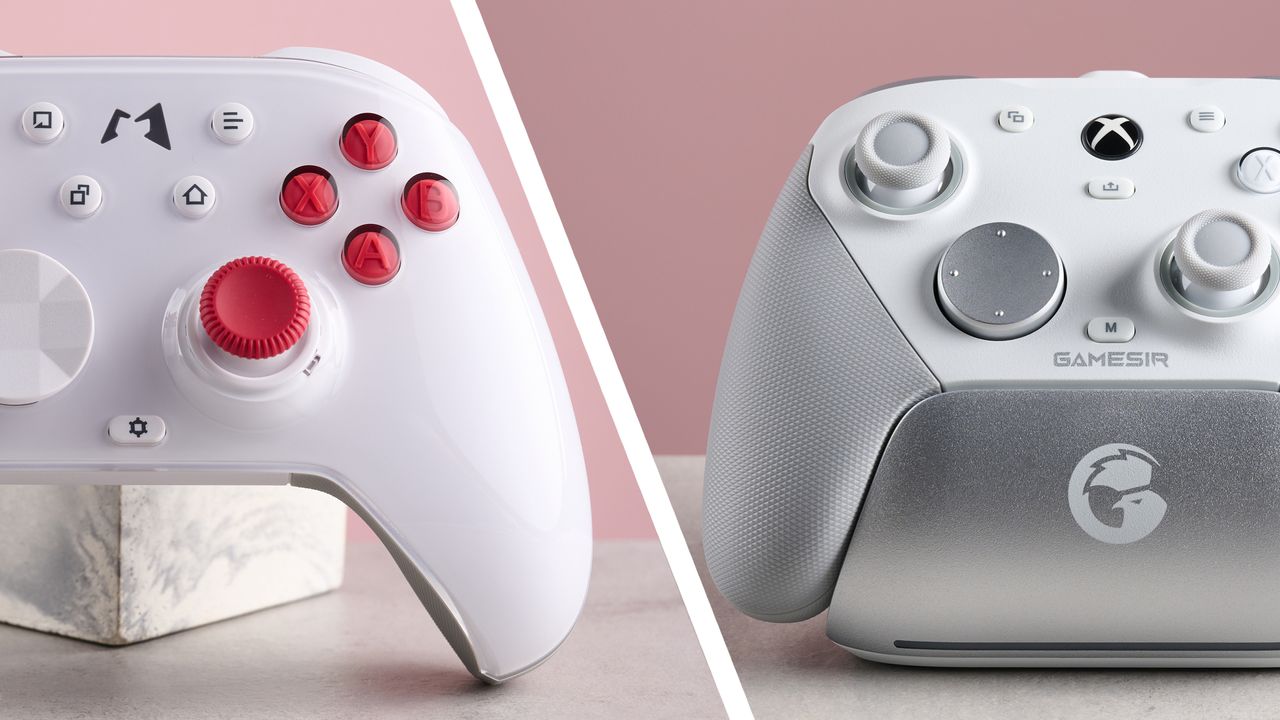
The controller itself lives up to its high quality packaging. It looks very sleek and smart with its transparent faceplate revealing the brilliant white colorway of my review unit, which is nicely accented by the red sticks and face buttons. All of its materials look and feel premium, and the overall build quality is excellent, with the moving parts being smooth to operate yet solidly fitted. The material behind the handles is textured to offer grip, although it’s a slight shame it’s still made from a hard plastic material.
The G7 Pro has a slightly smaller form than the Huben 2, so those with smaller hands might find it preferable to hold. Build quality is similar to that of Huben 2, although it’s perhaps not quite as sharp looking or as premium. Nevertheless, it still feels very nice in the hand, and it has better grips, thanks to the soft-touch material on their undersides that provide more grip than the Huben 2’s. The texture and even the color are very similar on both pads, though.
There’s no included case for the G7 Pro, but it does come with a charging dock, which is made to a similarly high standard and fits the pad seamlessly, offering plenty of security while being easy to set and release. It’s also pleasingly slight, so it takes up minimal space.
Both controllers adopt the familiar Xbox controller style, although there are some differences in their features. The G7 Pro has a headset jack, the Huben 2 doesn’t. But the Huben 2 has four back buttons, while the G7 Pro only has two. However, the G7 Pro has a further two extra buttons nestled between the triggers and bumpers. This is a choice location for them, as they’re very easy to use – easier than using back buttons. There’s also less chance of accidentally triggering them when gripping the pad, as I often did with the Huben 2’s back buttons.
What’s more, the two back buttons of the G7 Pro have an adjacent slider to disable them, which is far more convenient than having to use its accompanying software, as is the case with the Huben 2. Speaking of which, the software for both gamepads offers plenty of customization options, beyond those accessible on-board. Both have mobile and Windows apps, although in the case of GameSir, its app for the latter system (GameSir Nexus) is far more capable than its app for the former.
The Mobapad mobile app, on the other hand, does feature plenty of tweaking potential to please serious tinkerers. As with Nexus, it allows buttons to be remapped and stick deadzones and curve profiles to be altered. Other adjustments for motion controls and Turbo functions are also possible in both Nexus and the Moboapad app, although the latter offers slightly more depth. In reality, though, you won’t find many other software that offer as many customizations as these two. Both are also easy to use, although it’s a shame the Huben 2 itself can’t be used to navigate the Mobapad app – even though it can be used to navigate your phone’s UI.
While both controllers have Bluetooth and USB dongles for multiple wireless connections, there are some differences in the platforms they support. Both work with PC and Android devices, but the Huben 2 has added iOS compatibility. And as for consoles, the G7 Pro is compatible with the Xbox Series X and Series S and the Xbox One, while the Huben 2 works with Switch.
Performance
In action, the Huben 2 really shines. The face buttons are clicky, lacking the heavily damped feel of many other controllers, but still just as tactile; they’re more akin to the clicks of the best gaming mice. They’re also very snappy and responsive as a result. Even better is the D-pad: it feels very similar to the face buttons, and is just as quick and easy to use. Rapid, multiple inputs were a cinch in Tekken 8, while maintaining high levels of accuracy. There’s a small amount of dampening in each direction, which helps to make presses more controlled.
The default hat also helped in this regard. It adopts a very similar design to that of the latest Xbox controller, with its prominent middle dip and clearly squared-off segments, which provide plenty of feedback and stability. The D-pad on the G7 Pro is, if anything, even easier and more clicky in its actuation than the Huben 2’s. However, it lacks any discernable dampening, which can result in less control over presses. I also found the hat too small and flat to provide sufficient grip, resulting in my thumb frequently falling off its left edge.
Both controllers have similar shoulder buttons, adopting the familiar shape and placement of those adorning the best Xbox controllers. I did find the bumpers of the Huben 2 a tad too high for my liking, but this is a minor gripe. Both sets of triggers offer sufficient travel and feel, although those on the G7 Pro offer more resistance and have greater dampening. You might think this would make them easier to control than the Huben 2’s, but the latter’s more rounded shape compensates for their light actuation.
This is because a larger portion of your fingers is in contact with the physical buttons, which in turn allows you to control their depression more easily, at least in my experience. They’re also more comfortable as a result of this shape, allowing me to play with the Huben 2 for longer periods without fatigue. I certainly welcomed this aspect when playing games requiring constant use of the triggers, such Assetto Corsa and titles requiring vehicle control. However, all of this isn’t to say that the triggers of the G7 Pro are poor, as they’re still perfectly enjoyable to use.
Each trigger also has its own travel lock switch next to it, allowing you to switch it from analog to digital modes, which is useful in the case of shooters where quick taps are required. Both controllers also feature motion controls. The Huben 2’s work excellently on Switch: when I aimed bows in The Legend of Zelda: Breath of the Wild, their tracking and precision rivalled that of the best Nintendo Switch controllers. I experienced no drop outs or lag, either.
Since the G7 Pro isn’t compatible with the console, its motion controls can only be used on PC as a substitute for the sticks or even mouse inputs (something the Huben 2 is capable of, too). While they’re accurate enough, few PC games were designed with these controls in mind, so they don’t work as seamlessly. This isn’t exactly the G7 Pro’s fault, but it does beg the question as to why it has gyro capabilities if it’s not compatible with the platform that makes best use of them.
When it comes to sticks, I prefer the smoother, softer material on the Huben 2’s, as well as their deeper indentations which offer more purchase, and overall feel more satisfying to use than the G7 Pro’s. It’s not that their hall effect technology seems more accurate than the TMR sensors in the G7 Pro’s sticks, but they feel more responsive as well as being easier to wrangle, moving in precisely the way you want them to.
As for connectivity, both controllers worked with their respective devices without issue during my testing. Switching between devices is also easy, since both feature sliders on the rear for changing platforms, although it can take a few moments and press of the power button to connect to the new device.
Verdict
Both the Huben 2 and the G7 Pro are great controllers. They’re expensive – and there are plenty of great budget alternatives out there (including other models from the two brands) – but if you’re looking for something a little more upmarket, neither is likely to disappoint. However, I think the Huben 2 has the slight edge, feeling just that little more premium and satisfying to use, with the D-pad deserving special mention. A large part of your decision may come down to the specific platform support, but if you’re playing on PC, Android, or Switch – or all three – the Huben 2 is the superior choice as far as I’m concerned.