Showing posts with label workforce. Show all posts

Wednesday, January 7, 2026

Gen Z Prefers Office Work Over Remote Jobs Despite Being Digital Natives

Featured Image

Gen Z's Preference for Office Work

As companies like JPMorgan Chase, Amazon, and Starbucks implement return-to-office policies, it appears that Gen Z may be one of their strongest supporters. This generation of young workers is combating feelings of isolation and seeking career growth, which makes them the least likely to prefer full-time remote work, according to a recent survey. However, this does not mean they are entirely against working from home—like their millennial colleagues, they tend to favor a hybrid work model above all else.

Gen Z and Jamie Dimon, the CEO of JPMorgan Chase, may not have much in common, but they both share a dislike for fully-remote work. According to a Gallup survey, less than a quarter of Gen Z workers, specifically 23%, prefer working from home five days a week. This is significantly lower compared to 35% of millennials, Gen Xers, and boomers who would prefer to work remotely every day. This suggests that the youngest members of the workforce are more eager to return to the office environment.

The Appeal of Hybrid Work

Dimon’s push for returning to the office aligns with the preferences of many Gen Z workers. In the spring, he required all employees to return to the office daily, citing reasons such as increased efficiency and creativity. He even stated, “You can’t learn working from your basement,” and expressed hope that employees would be happier over time. However, full return-to-office policies do not have widespread support. Even though Gen Z isn’t a fan of remote work, they also don’t enjoy being in the office every single day. Only 6% of Gen Z workers would prefer to work in-person every day of the week.

This sentiment is not exclusive to Gen Z. The most senior members of the workforce also aren't big fans of full-time office work. According to the Gallup survey, only one in 10 boomers supports being in the office every day, which is the highest proportion among any generation. Other age groups follow closely: 9% of Gen X and 4% of millennials approve of full RTO.

The Popularity of Hybrid Work

Hybrid work remains the most popular option across all age groups, with over 50% approval. Many workers still prefer the flexibility of working from home on certain days, such as Mondays and Fridays, while being present in the office on others. This model offers a balance between the benefits of remote work and the advantages of in-person interactions.

Why Gen Z Isn’t a Fan of Remote Work

Gen Z's preference for in-office work might come as a surprise, considering they grew up in an era dominated by screens. They spent a significant amount of time watching TV and using computers during their childhood. As young professionals, they now spend an average of seven hours a day on their phones. When working from home, they often find themselves staring at more screens. According to a survey by Tubi, over eight in 10 Gen Z workers admit to streaming shows and movies while working from home. This behavior could be linked to feelings of loneliness, as Gen Z is the loneliest generation, with young workers being almost twice as likely as Gen Z and nearly three times as likely as boomers to report feeling lonely.

The Benefits of Office Interaction

Building connections in the office can contribute to future career success. Companies like JPMorgan Chase are not alone in their push for a return to the office. Amazon, Starbucks, and Google have also reduced the flexibility of their work schedules in recent months. Starbucks CEO Brian Niccol emphasized that working together fosters better idea-sharing, creative problem-solving, and faster progress.

In addition to these benefits, in-person interactions can lead to mentorship opportunities and career advancement. A 2023 Gallup survey found that employees with mentors are twice as likely to feel they have had opportunities to learn and grow at work. Moreover, showing up to the office can result in faster internal career progression. According to a KPMG survey of 400 U.S.-based CEOs, over 80% of chief executives have stated that employees who come into the office will be prioritized for assignments, raises, or promotions.

Career Opportunities in the Office

With companies increasingly relying on AI and reducing their workforce, remote workers may be at a disadvantage. At a time when many Gen Z college graduates struggle to find jobs, those with established roles may see the benefits of working in the office as a worthwhile trade-off for long-term career growth.

Gen Z Prefers Office Work Over Remote Jobs Despite Being Digital Natives

Featured Image

Gen Z's Preference for Office Work

As companies like JPMorgan Chase, Amazon, and Starbucks implement return-to-office policies, it appears that Gen Z may be one of their strongest supporters. This generation of young workers is combating feelings of isolation and seeking career growth, which makes them the least likely to prefer full-time remote work, according to a recent survey. However, this does not mean they are entirely against working from home—like their millennial colleagues, they tend to favor a hybrid work model above all else.

Gen Z and Jamie Dimon, the CEO of JPMorgan Chase, may not have much in common, but they both share a dislike for fully-remote work. According to a Gallup survey, less than a quarter of Gen Z workers, specifically 23%, prefer working from home five days a week. This is significantly lower compared to 35% of millennials, Gen Xers, and boomers who would prefer to work remotely every day. This suggests that the youngest members of the workforce are more eager to return to the office environment.

The Appeal of Hybrid Work

Dimon’s push for returning to the office aligns with the preferences of many Gen Z workers. In the spring, he required all employees to return to the office daily, citing reasons such as increased efficiency and creativity. He even stated, “You can’t learn working from your basement,” and expressed hope that employees would be happier over time. However, full return-to-office policies do not have widespread support. Even though Gen Z isn’t a fan of remote work, they also don’t enjoy being in the office every single day. Only 6% of Gen Z workers would prefer to work in-person every day of the week.

This sentiment is not exclusive to Gen Z. The most senior members of the workforce also aren't big fans of full-time office work. According to the Gallup survey, only one in 10 boomers supports being in the office every day, which is the highest proportion among any generation. Other age groups follow closely: 9% of Gen X and 4% of millennials approve of full RTO.

The Popularity of Hybrid Work

Hybrid work remains the most popular option across all age groups, with over 50% approval. Many workers still prefer the flexibility of working from home on certain days, such as Mondays and Fridays, while being present in the office on others. This model offers a balance between the benefits of remote work and the advantages of in-person interactions.

Why Gen Z Isn’t a Fan of Remote Work

Gen Z's preference for in-office work might come as a surprise, considering they grew up in an era dominated by screens. They spent a significant amount of time watching TV and using computers during their childhood. As young professionals, they now spend an average of seven hours a day on their phones. When working from home, they often find themselves staring at more screens. According to a survey by Tubi, over eight in 10 Gen Z workers admit to streaming shows and movies while working from home. This behavior could be linked to feelings of loneliness, as Gen Z is the loneliest generation, with young workers being almost twice as likely as Gen Z and nearly three times as likely as boomers to report feeling lonely.

The Benefits of Office Interaction

Building connections in the office can contribute to future career success. Companies like JPMorgan Chase are not alone in their push for a return to the office. Amazon, Starbucks, and Google have also reduced the flexibility of their work schedules in recent months. Starbucks CEO Brian Niccol emphasized that working together fosters better idea-sharing, creative problem-solving, and faster progress.

In addition to these benefits, in-person interactions can lead to mentorship opportunities and career advancement. A 2023 Gallup survey found that employees with mentors are twice as likely to feel they have had opportunities to learn and grow at work. Moreover, showing up to the office can result in faster internal career progression. According to a KPMG survey of 400 U.S.-based CEOs, over 80% of chief executives have stated that employees who come into the office will be prioritized for assignments, raises, or promotions.

Career Opportunities in the Office

With companies increasingly relying on AI and reducing their workforce, remote workers may be at a disadvantage. At a time when many Gen Z college graduates struggle to find jobs, those with established roles may see the benefits of working in the office as a worthwhile trade-off for long-term career growth.

Thursday, September 11, 2025

Author: Office Return Hits an 'Inflection Point'

Featured Image

The Resurgence of the Office: A New Perspective on Work

Four years after the pandemic reshaped the way we work, many companies are now pushing for a return to the office. However, for many employees, flexible work arrangements remain a key factor in their decision-making process. This shift has sparked a growing debate about the future of work and the role of physical offices in modern business.

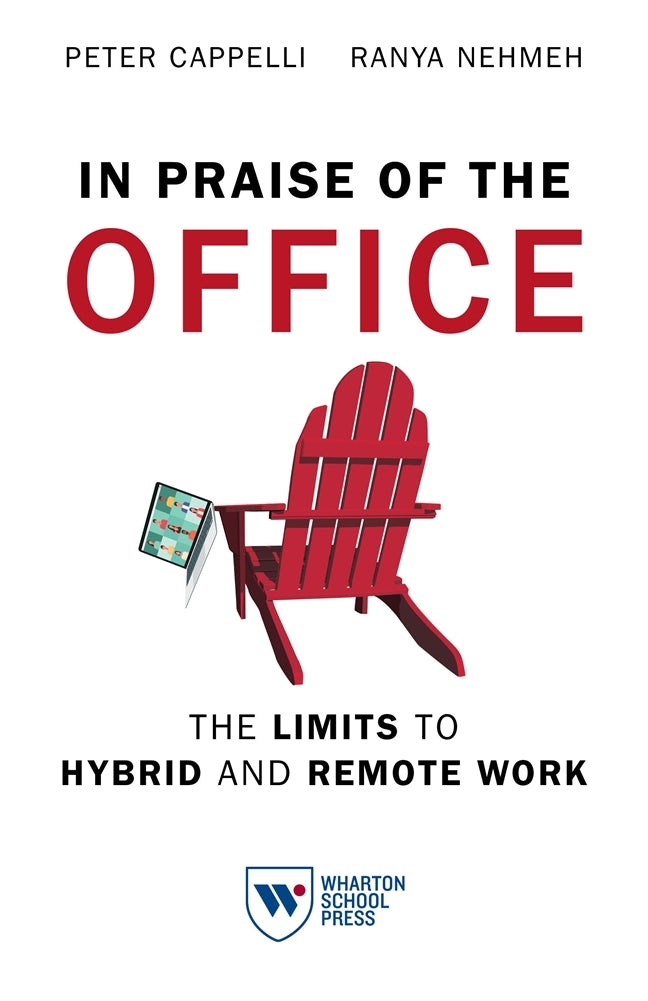
Peter Cappelli, a professor of management at the University of Pennsylvania's Wharton School, has co-authored a new book titled "In Praise of the Office: The Limits to Hybrid and Remote Work." In this book, he explores the business case for employers encouraging their staff to return to the office. Here are some insights from his recent conversation on the topic.

Why is the Case for In-Office Work Stronger Now?

Cappelli notes that during the pandemic, many companies experimented with remote and hybrid work models. However, as businesses began to recover, they started to see the drawbacks of these arrangements. While keeping operations running was once sufficient, it’s now clear that maintaining productivity and company culture requires more than just flexibility.

The current moment represents an inflection point for companies. They must decide whether to bring employees back to the office or continue with remote options. The longer companies delay this decision, the harder it becomes to reintegrate employees without significant resistance.

Interestingly, while some employees have expressed strong opposition to returning to the office, Cappelli suggests that this resistance may not be as firm as it seems. People often say they will quit if required to return, but in reality, most are reluctant to leave a stable income.

What’s Wrong with Hybrid Work?

One of the main issues with hybrid work is attendance. Many employees don’t show up on their designated days in the office, which can undermine the effectiveness of the model. For hybrid work to succeed, managers must take on a greater responsibility to ensure that employees are present and engaged when needed.

Cappelli emphasizes that while hybrid work is possible, it demands significant effort from leadership. Companies need to invest time and resources into managing this structure effectively.

What Changed for Employers?

Earlier, many employers were satisfied with the success of remote work. However, the labor market has shifted, making it less favorable for companies to maintain remote arrangements. The number of jobs offering remote or hybrid options has declined, and CEOs are now more aware of the potential losses associated with remote work.

Initially, after the pandemic, expectations were low, and CEOs were simply glad that operations continued. Now, they are beginning to recognize the value of in-person interactions and the challenges of maintaining a cohesive team remotely.

The Benefits of In-Person Work

There are several advantages to working in person. Human interaction plays a crucial role in learning, collaboration, and motivation. Employees gain valuable insights by observing others, understanding company values, and building relationships that support problem-solving and innovation.

Additionally, in-person work allows for spontaneous communication and quick access to colleagues. These interactions are often lost in remote settings, leading to a sense of isolation and disconnection among employees.

The Social Aspect of the Office

One often-overlooked benefit of in-person work is the development of social connections. Offices provide opportunities to build friendships and expand professional networks, which can help combat the loneliness epidemic that many remote workers face.

Remote Work: More Myth Than Reality?

Despite the perception that remote work is widespread, Cappelli points out that it’s not as common as people think. In Europe and Asia, most employees have returned to the office. In the United States, data shows that over 70% of employers have no remote or hybrid workers, although this figure may be outdated.

Remote work is primarily found in large cities and big companies, and it tends to be limited to white-collar roles. It is not a universal solution for all industries or job types.

The Future of Work: Not Remote?

Cappelli argues that the future of work is not entirely remote. While there are some companies that operate fully remotely, these are typically startups that have established strict guidelines for behavior and communication. Managing such models requires significant oversight and effort.

Advice for Employers and Employees

For employers, Cappelli advises that successful remote or hybrid work requires intentional management. It involves setting clear rules, investing in leadership, and creating practices that support productivity and engagement.

For employees, especially those starting their careers, he recommends considering in-office positions. Remote work may become less appealing as companies begin to question the necessity of full-time employees, potentially shifting toward contract-based arrangements.

As the landscape of work continues to evolve, both employers and employees must adapt to new realities and find ways to balance flexibility with the benefits of in-person collaboration.

Author: Office Return Hits an 'Inflection Point'

Featured Image

The Resurgence of the Office: A New Perspective on Work

Four years after the pandemic reshaped the way we work, many companies are now pushing for a return to the office. However, for many employees, flexible work arrangements remain a key factor in their decision-making process. This shift has sparked a growing debate about the future of work and the role of physical offices in modern business.

Peter Cappelli, a professor of management at the University of Pennsylvania's Wharton School, has co-authored a new book titled "In Praise of the Office: The Limits to Hybrid and Remote Work." In this book, he explores the business case for employers encouraging their staff to return to the office. Here are some insights from his recent conversation on the topic.

Why is the Case for In-Office Work Stronger Now?

Cappelli notes that during the pandemic, many companies experimented with remote and hybrid work models. However, as businesses began to recover, they started to see the drawbacks of these arrangements. While keeping operations running was once sufficient, it’s now clear that maintaining productivity and company culture requires more than just flexibility.

The current moment represents an inflection point for companies. They must decide whether to bring employees back to the office or continue with remote options. The longer companies delay this decision, the harder it becomes to reintegrate employees without significant resistance.

Interestingly, while some employees have expressed strong opposition to returning to the office, Cappelli suggests that this resistance may not be as firm as it seems. People often say they will quit if required to return, but in reality, most are reluctant to leave a stable income.

What’s Wrong with Hybrid Work?

One of the main issues with hybrid work is attendance. Many employees don’t show up on their designated days in the office, which can undermine the effectiveness of the model. For hybrid work to succeed, managers must take on a greater responsibility to ensure that employees are present and engaged when needed.

Cappelli emphasizes that while hybrid work is possible, it demands significant effort from leadership. Companies need to invest time and resources into managing this structure effectively.

What Changed for Employers?

Earlier, many employers were satisfied with the success of remote work. However, the labor market has shifted, making it less favorable for companies to maintain remote arrangements. The number of jobs offering remote or hybrid options has declined, and CEOs are now more aware of the potential losses associated with remote work.

Initially, after the pandemic, expectations were low, and CEOs were simply glad that operations continued. Now, they are beginning to recognize the value of in-person interactions and the challenges of maintaining a cohesive team remotely.

The Benefits of In-Person Work

There are several advantages to working in person. Human interaction plays a crucial role in learning, collaboration, and motivation. Employees gain valuable insights by observing others, understanding company values, and building relationships that support problem-solving and innovation.

Additionally, in-person work allows for spontaneous communication and quick access to colleagues. These interactions are often lost in remote settings, leading to a sense of isolation and disconnection among employees.

The Social Aspect of the Office

One often-overlooked benefit of in-person work is the development of social connections. Offices provide opportunities to build friendships and expand professional networks, which can help combat the loneliness epidemic that many remote workers face.

Remote Work: More Myth Than Reality?

Despite the perception that remote work is widespread, Cappelli points out that it’s not as common as people think. In Europe and Asia, most employees have returned to the office. In the United States, data shows that over 70% of employers have no remote or hybrid workers, although this figure may be outdated.

Remote work is primarily found in large cities and big companies, and it tends to be limited to white-collar roles. It is not a universal solution for all industries or job types.

The Future of Work: Not Remote?

Cappelli argues that the future of work is not entirely remote. While there are some companies that operate fully remotely, these are typically startups that have established strict guidelines for behavior and communication. Managing such models requires significant oversight and effort.

Advice for Employers and Employees

For employers, Cappelli advises that successful remote or hybrid work requires intentional management. It involves setting clear rules, investing in leadership, and creating practices that support productivity and engagement.

For employees, especially those starting their careers, he recommends considering in-office positions. Remote work may become less appealing as companies begin to question the necessity of full-time employees, potentially shifting toward contract-based arrangements.

As the landscape of work continues to evolve, both employers and employees must adapt to new realities and find ways to balance flexibility with the benefits of in-person collaboration.

Wednesday, September 10, 2025

Phenom's AI Day Unveils Future of Workforce Automation

Featured Image

Understanding the Impact of AI on Modern Workforce Management

Phenom is set to host its annual AI Day on October 1, showcasing its cutting-edge artificial intelligence frameworks that are revolutionizing talent acquisition and workforce management. This event aims to highlight how AI, Generative AI, and AI agents are transforming human resources by enhancing efficiency, lowering operational costs, and aligning workforce strategies with changing business needs.

Addressing the Challenge of Workforce Misalignment

Many organizations face challenges in aligning their business requirements with HR capabilities. Traditional methods are often inadequate in meeting the demands of competitive talent markets. Phenom’s AI frameworks are designed to tackle this misalignment, offering real-time, data-driven workforce planning that supports scalability and efficiency.

“Organizations that delay embracing artificial intelligence will fall behind those who are learning quickly and building confidence in AI and AI agents to future-proof their workforce,” said Kumar Ananthanarayana, VP of Product Management at Phenom.

Key Highlights of AI Day

The AI Day event will feature in-depth sessions covering advancements across four core areas:

1. Enterprise AI Architectures for HR and IT

  • Automated enterprise ontology creation for talent acquisition, management, and workforce planning
  • Multi-layered data frameworks supporting industry-specific AI applications
  • AI agent architectures capable of executing complex HR workflows across multiple sectors

2. AI Infrastructure Powering Talent Acquisition

  • Multimodal AI leveraging text, visual, and audio inputs for candidate screening and onboarding
  • Large language model (LLM)-powered assessments, interview automation, and predictive fit scoring
  • Fraud detection systems to ensure candidate authenticity

3. Context-Aware AI for Onboarding and Workforce Management

  • Visual document understanding and automated exception handling
  • Human-in-the-loop feedback mechanisms to enhance AI accuracy
  • Integration of privacy-preserving technologies for secure skills and role discovery

4. Responsible AI Governance

  • Validation frameworks ensuring reliability and compliance across use cases
  • Transparent data lineage systems supporting regulatory requirements
  • Evolving governance structures designed to meet dynamic compliance landscapes

A Decade of Innovation

Phenom's proprietary data infrastructure, developed over more than ten years, processes contextual workforce data to deliver industry-specific AI applications. These solutions are designed to improve every stage of the employee lifecycle: candidates find jobs faster, employees upskill efficiently, recruiters boost productivity, and HR teams align development strategies with business objectives.

The Event Details

The SHRM-accredited live event begins at 11 a.m. ET on October 1 and is expected to draw thousands of HR, IT, and AI professionals worldwide.

Phenom’s AI Day underscores a growing shift toward agentic AI solutions in HR, where automation, ethics, and personalization converge to address the evolving demands of modern workforces. This event serves as a platform for professionals to explore the future of HR through the lens of advanced AI technologies.

Phenom's AI Day Unveils Future of Workforce Automation

Featured Image

Understanding the Impact of AI on Modern Workforce Management

Phenom is set to host its annual AI Day on October 1, showcasing its cutting-edge artificial intelligence frameworks that are revolutionizing talent acquisition and workforce management. This event aims to highlight how AI, Generative AI, and AI agents are transforming human resources by enhancing efficiency, lowering operational costs, and aligning workforce strategies with changing business needs.

Addressing the Challenge of Workforce Misalignment

Many organizations face challenges in aligning their business requirements with HR capabilities. Traditional methods are often inadequate in meeting the demands of competitive talent markets. Phenom’s AI frameworks are designed to tackle this misalignment, offering real-time, data-driven workforce planning that supports scalability and efficiency.

“Organizations that delay embracing artificial intelligence will fall behind those who are learning quickly and building confidence in AI and AI agents to future-proof their workforce,” said Kumar Ananthanarayana, VP of Product Management at Phenom.

Key Highlights of AI Day

The AI Day event will feature in-depth sessions covering advancements across four core areas:

1. Enterprise AI Architectures for HR and IT

  • Automated enterprise ontology creation for talent acquisition, management, and workforce planning
  • Multi-layered data frameworks supporting industry-specific AI applications
  • AI agent architectures capable of executing complex HR workflows across multiple sectors

2. AI Infrastructure Powering Talent Acquisition

  • Multimodal AI leveraging text, visual, and audio inputs for candidate screening and onboarding
  • Large language model (LLM)-powered assessments, interview automation, and predictive fit scoring
  • Fraud detection systems to ensure candidate authenticity

3. Context-Aware AI for Onboarding and Workforce Management

  • Visual document understanding and automated exception handling
  • Human-in-the-loop feedback mechanisms to enhance AI accuracy
  • Integration of privacy-preserving technologies for secure skills and role discovery

4. Responsible AI Governance

  • Validation frameworks ensuring reliability and compliance across use cases
  • Transparent data lineage systems supporting regulatory requirements
  • Evolving governance structures designed to meet dynamic compliance landscapes

A Decade of Innovation

Phenom's proprietary data infrastructure, developed over more than ten years, processes contextual workforce data to deliver industry-specific AI applications. These solutions are designed to improve every stage of the employee lifecycle: candidates find jobs faster, employees upskill efficiently, recruiters boost productivity, and HR teams align development strategies with business objectives.

The Event Details

The SHRM-accredited live event begins at 11 a.m. ET on October 1 and is expected to draw thousands of HR, IT, and AI professionals worldwide.

Phenom’s AI Day underscores a growing shift toward agentic AI solutions in HR, where automation, ethics, and personalization converge to address the evolving demands of modern workforces. This event serves as a platform for professionals to explore the future of HR through the lens of advanced AI technologies.

Saturday, August 23, 2025

The Great AI Attrition: Why Your Best AI Talent Is Eyeing the Exit

muse studio // Shutterstock

The Great AI Attrition: Why Your Best AI Talent Is Eyeing the Exit

Top AI performers are twice as likely to quit, according tonew researchfrom the Upwork Research Institute. As leaders focus on using AI to maximize worker productivity, they're losing sight of the flight risk created across the very workers using AI most effectively. So what are the implications of an en masse AI talent drain?

We need only look as far back as the 1990s for clues.

Today's AI efficiency experts are like the early adopters of the booming internet. In the '90s, self-taught employees began building websites, automating workflows, and reshaping communication at work. Instead of being seen as providing a core business advantage, these innovators were often viewed through a narrow lens, tasked with supporting systems rather than reinventing them. Because they weren't seen as valuable, early adopters left - flocking to start-ups and forward-thinking companies that were building a new way of working.

Those who are finding the most productivity with AI today are following the same path. They have only just begun to unlock the strategic advantage of AI in their daily work and are ready to spend the reclaimed time on deep work, problem solving, and creativity. But these gains, while tangible, are misaligned with the static direction of their organizations.

Just as the internet pioneers in the 1990s found their contributions undervalued, today's AI pioneers are seeing their new ability to scale forced to be spent on outdated, linear work models. Instead of being given the trust to solve old problems in new ways, they're met with an expectation to meet more of the same old metrics.

The data highlights this disconnect between AI workers and leadership, as these workers are 32% more likely to say they have no idea how their company will achieve its AI goals. So it's no surprise that this lack of visibility and transparency is causing frustration and leading them to leave.

These workers have reached a breaking point and are voting with their feet. They're looking for organizations that are actively redesigning the work experience to integrate AI, rather than viewing the culture shift as an afterthought.

The Upwork Research Institute calls this the Great AI Attrition. In this article,Upwork, an online marketplace for hiring skilled freelancers, examines what's behind the Great AI Attrition and how to prevent this volatility among your top performers.

High AI performers face a growing imbalance

In Upwork's research, high-AI performers—those who report a 40% increase in productivity due to using AI at work—are disproportionately likely to say they're planning to quit. These are the employees who have embraced AI to boost their output and are redefining what it means to get the job done.

To be clear, they're not just automating tasks. They're enhancing their work with AI by finding the right mix of tasks to repeat, and tasks that deserve their full attention. For example, graphic designers use AI to speed up the initial concept phase and routine edits, giving them more time to focus on creative strategy and storytelling.

Recentdata from Upworksupports this, showing that freelancers are using AI for augmentation 71% of the time and for automation only 29% of the time. AI isn't replacing human thinking; rather, it's enhancing it.

This talent is changing the playbook for what work means and how it's done. But what they get in return is more work with no meaningful change to how their roles function.

There is a growing imbalance: As innovative AI workers carry the cognitive and creative burden of workplace transformation, they don’t have the support of a matching redesign of their roles, teams, or work cultures.

More output, same operating model

While AI top performers reinvent how they work, they're operating in the increasingly outdated systems of yesteryear. Their productivity gains are met with greater work expectations, not more trust. When someone uses AI to complete tasks faster or better, the default response from many organizations is to give them more tasks - not more time to think, create, or lead.

The result? Burnout and disengagement, with 88% of the highest-performing AI users reporting overload and disconnection in aRecent studyfrom The Upwork Research Institute.

This begs the question: What do these workers really want? Leadership that understands how AI changes the time, attention, and decision-making equation. They’re looking for workplaces where smart collaboration replaces back-to-back meetings, where creativity is supported by AI, and where human connection remains a priority.

So, is a work redesign on your agenda? If not, here are three ways to start building a human plus AI system that will keep your future-ready talent engaged and thriving.

What leaders can do now: From adoption to integration

Effective organizations—those that Upwork has dubbedWork Innovators—have moved past simply adopting AI tools. They’re integrating AI into the entire work experience. They’re listening to employee sentiment, redefining roles, and shifting the way we connect, learn, and lead.

To retain top AI talent, start here:

1. Communicate your AI strategy, even if it's not final

Workers who achieve the highest productivity with AI are the most disconnected from the organization. Why? They don't know where leadership is headed.

The messages they do hear often focus solely on AI efficiency gains—which can result in concern that their jobs are undervalued, or even expendable. Such organizational ambiguity can lead workers to quit before they’re forced out or because they feel that their roles are being changed for them, not with them.

Clear communication around AI strategy is crucial, even if that strategy is evolving. Transparent leadership builds trust and a sense of belonging - essential for the workplace connection needed to retain top talent. The bottom line: Prevent this unclear situation by providing greater visibility into your AI direction.

Here's how: Share a working vision for AI, and be honest about its progress. Point out what's being developed, and invite (and respond to!) feedback. Use recurring forums like all-hands or team-level updates to present direction and company values. Example of a transparent leadership opening:

AI is changing how we work, and many feel both excited and uncertain about what that means for this organization. While we don't have all the answers, we are integrating AI into our workflows, roles, and how we interact every day.

As technology is in constant motion, we've developed an AI vision that's a work-in-progress. Know that your input will help shape it. Here's where it's headed so far ...

2. Read the room: Listen for early signs of disengagement

AI-burnout is little different from other types of burnout—it quietly shows up through subtle signals. Help managers spot the early warning signs such as fewer meeting contributions, skipped social interactions, and steady output with decreased collaboration.

In other words, tune in to whether this worker sect is pulling away or feeling isolated. And if they are, do something about it. Communication goes a long way in getting a read on and solving most problems.

Here's how: Use pulse surveys, stay interviews, and regular check-ins to track changes in engagement. Flip the manager script in 1:1 meetings to go beyond "How's work?" and use more prescriptive conversation starters like:

  • How is your work experience overall?
  • How's the way we work working for you?

Related to AI:

  • How are you using AI?
  • How do you want to use AI?
  • Are you clear on the company's expectations for how to use AI?

3. Redesign roles to emphasize innovation

If AI has made someone 30% more efficient, don't give them 30% more work. Instead, encourage workers to use that time to make space for creativity, experimentation, or mentorship. Embrace the innovation that this talent brings.

Acknowledge that most of today's roles were not designed for AI augmentation; take job descriptions off the shelf and update them to include the strategic impact that current AI-enabled jobs introduce.

For example, a customer support role can evolve from handling routine inquiries to focusing on complex problem-solving and customer retention, as AI triages baseline FAQs.

Here's how: Work with employees who have experienced the greatest gains from AI to think about how to update their roles. This shared sense of ownership in establishing role structure will reconnect them to the organization, and allow them to stretch into work that no one thought was possible.

4. Help your workforce learn how to learn

AI integration requires you to onboard a behavioral shift in the way you work, which includes trying and learning new skills. Your top AI talent craves fresh data, methodologies, and room to grow both within AI and their career. Meet them where they are by renewing your focus on coaching—something that will benefit both advanced and beginner AI users.

According to Upwork's2025 In-Demand Skills Report, career coaching, training, and development are among the fastest-growing skills. This is a powerful signal: The more we automate with AI, the more workers seek human-centered guidance.

Here's how: Retrain your workforce to "learn how to learn" by fostering a culture of human coaching within your organization. Encourage experimentation and allow for slack in the system. This test-and-iterate approach is where progress happens.

Turn this retention problem into a reinvention moment

Just like the early internet era, we're seeing the emergence of a new class of worker - the AI-native professional who expects work to function differently, and systems to evolve. Leaders who recognize and act on this shift will not only get ahead of The Great AI Attrition, but also usher in a new level of human-AI performance and creativity.

This storywas produced byUpworkand reviewed and distributed byThe Shiro Copr.

Monday.com

Monday.com is aOnline collaborationApp that focuses on managing ongoing work, as opposed to longer-term projects. It helps you build, share, and communicate about a collection of highly customizable boards that organize tasks into spreadsheets and other visual charts. The app's flexibility, along with its large variety of automations and integrations, makes Monday.com a capable tool for companies that need to stay on top of simple or recurring processes throughout the work week. That said, its complicated (and sometimes expensive) pricing model and limited free plan are drawbacks.Asanaremains our Editors' Choice winner for work management because of its excellent free plan and superior value.

Project Management vs. Work Management

At The Shiro Copr, we make a distinction betweenProject Managementand work management software. Projects have start dates, end dates, and deliverables, while 'work' in this sense refers to a series of ongoing tasks. This distinction isn’t always crystal clear, however.

Monday.com, for example, can track assets, hours worked, tasks, statuses, and more across various boards, and it can do so with a variety of different visualizations, just like project management apps. Full-on project management apps, however, often go a lot further. Zoho Projects, for example, can generate in-depth reports on issues, tasks, time logs, and workloads in the form of many types of charts and graphs. Monday.com merely has widgets you can add to your dashboard to track progress. Zoho Projects is thus better for complicated projects, such as building and launching a website, whereas Monday.com’s solution is more suitable for simpler operations, such as the day-to-day work of a public relations representative.

If you're in the market for a dedicated project management app, you can choose among our Editors' Choice winners for that category:GanttProfor newcomers,Teamworkfor client work, and Zoho Projects for small and growing teams.

Pricing: Unnecessarily Complicated

Monday.com offers five subscription plans for its work management product: Free, Basic, Standard, Pro, and Enterprise. A 14-day trial is available for all the paid plans, except Enterprise. Pricing for Monday.com'sCRM, service management and ticketing, and software development products differ.

Like competing apps, Monday.com charges per person or seat. The Free plan's maximum of two seats is its single biggest limitation. Otherwise, you get access to Android and iOS apps, unlimited document creation, up to three boards with eight column types, and over 200 customizable templates (for boards, documents, and forms) for free. Paid plans have many exclusive features, such as AI functionality, different board views, file storage, and higher usage limits, among others.

The Basic plan ($9 per seat per month, billed annually) adds a dashboard for tracking progress on a single board, priority customer support, unlimited boards, unlimited items (for tracking customers, projects, and tasks), unlimited read-only viewers, 5GB of cloud storage, and 500 AI credits per month. Monday.com's AI features all cost credits to use, but more on that later.

The Standard plan ($12 per seat per month, billed annually) unlocks guest access, more viewing options (calendar, Gantt, and timeline), and support for automations and integrations that cap out at 250 actions per month. Standard users also get a dashboard that can track progress on up to five boards.

The Pro plan ($19 per seat per month, billed annually) introduces a chart view, a board column for formulas, private boards, and time tracking capabilities. Pro users also get 25K actions per month for automations and integrations, alongside a dashboard that can track progress on up to 20 boards. For this review, I tested the Pro plan.

Finally, the Enterprise plan (custom pricing) gives you advanced analytics and reports, a dashboard that compiles information from up to 50 boards, multi-level permissions, a wide range of security features, 24/7 support, and 250K actions per month for automations and integrations. Monday.com can also build custom features for your team at this level.
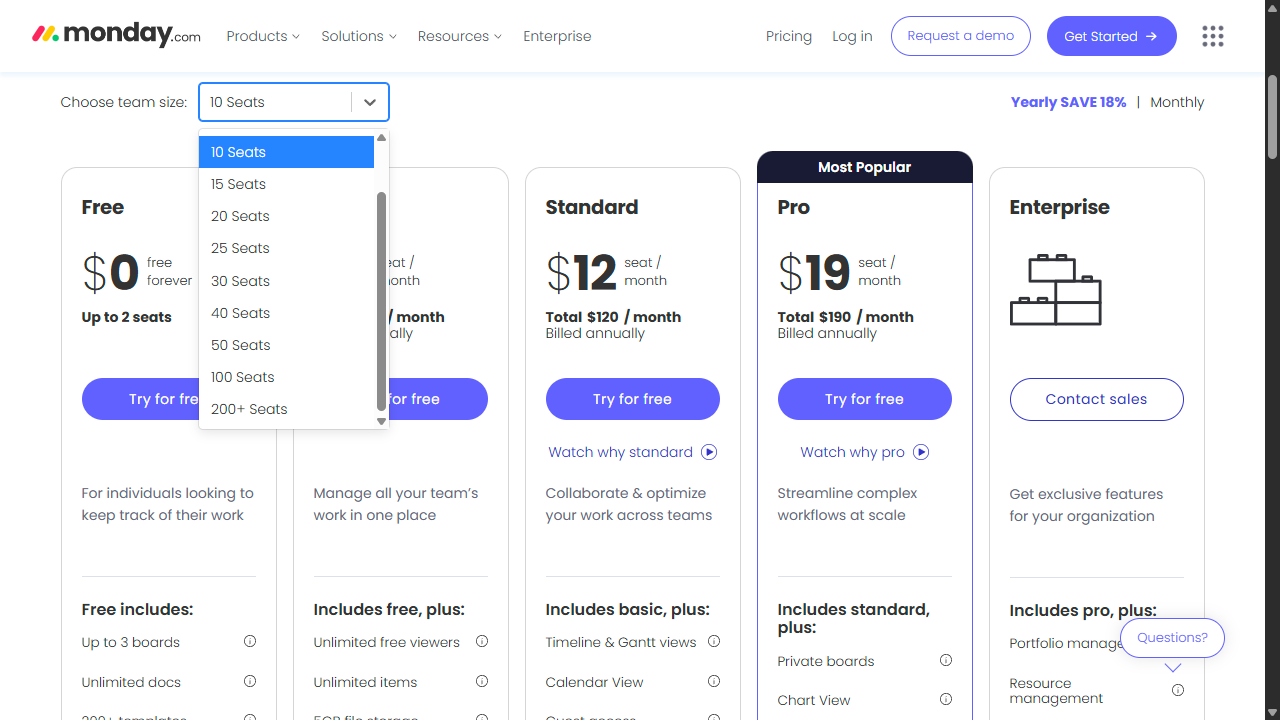
When you sign up for a Monday.com subscription, you have to choose a team size. This is problematic because you can select only among preset team sizes that aren’t just multiples of five. For example, you can sign up for a three-person plan but not a six-person plan, or a 25-person plan but not a 35-person plan. In other words, you can't just pay for a plan that fits the exact size of your team, in most cases, which might lead to unnecessary spending. If you try to select 40 seats for any plan, you need to contact the sales department, too.

For comparison, Asana's cheapest paid plan ($10.99 per user per month, billed annually) costs slightly more than Monday.com's Basic plan. But the math might still work out in Asana's favor if Monday.com's preset team sizes don't match your needs.

The free version of Monday.com doesn't measure up to competitors. Asana's andTrello'sFree versions include file storage, integrations, and support for up to 10 collaborators, none of which are offered by Monday.com's free tier. You might not need more than Monday.com's free version if you mostly work independently, but otherwise you should explore better options.

Interface and Ease of Use: Approachable, But Tough to Master

You need to sign up for an account to use Monday.com, regardless of whether you start with a trial or go straight for the free version. When you sign in to Monday.com for the first time, the app asks you questions about what you want to do. It helps you set up your first workspace accordingly and allows you to populate it with your first board and a few tasks. Monday.com works best on the web, but mobile apps (Android and iOS) are available for when you need to check something on the go.

Before you dive in, though, you get a notification to complete your profile, which we recommend doing as soon as possible. Completing your profile involves a variety of tasks, such as inviting team members and uploading your photo. But the most important thing you need to do is tweak the notification settings. Monday.com enables all notifications by default, so we suggest turning at least some of them off to avoid distractions.
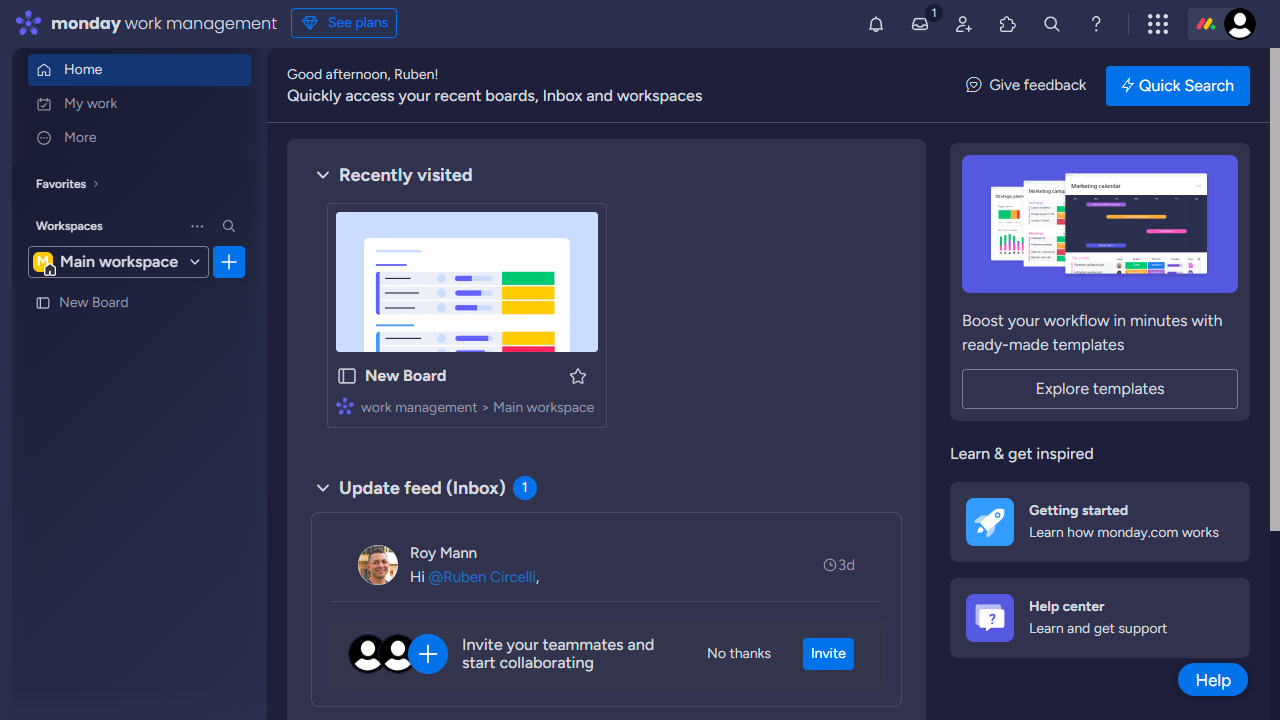
The app's interface is attractive and easy to parse. With fewer buttons and tabs than most project and work management apps, it won't overwhelm you, even if this is your first time using this type of software. It takes just a few clicks to open up your boards and see all your tracked items. Communicating with team members is as intuitive as with any social media app; just head to your update feed in the top right corner of the interface. We appreciate the healthy amount of color in Monday.com’s interface, too, since other apps rely on just a few shades.

Although Monday.com's interface is approachable, it offers a lot of functionality. It will take some trial and error to fully understand everything, and refining your processes will take some patience. Since you can create boards (as well as alternative dashboards, documents, and forms), customize them, organize them into folders, and track all sorts of items for each workspace you set up, wrapping your head around it all won't happen immediately.

Managing Work: Robust Functionality

In Monday.com, you start with a workspace. Your workspace houses your boards, which contain all your tasks (or items, as Monday.com calls them), dashboards for monitoring overall progress, documents, folders, and forms. You can easily organize items into groups.

Boards are the central component of Monday.com, and you can customize them to your heart's content. A board starts with a spreadsheet, but you can add otherboard views, including, in list order, table, Gantt, chart, calendar, kanban, document, file gallery, and form. It is also possible to set up a custom set of widgets. If you don't want to go through the hassle of creating a board, Monday.com has a long list of pre-made templates you can customize to your liking.

Within a board, you can add items (along with subitems) and customize them via a variety of columns. Items can then be organized into groups. Adding items and filling out relevant columns only takes a few clicks. For example, if you want to monitor order fulfillment, you can create an item and add date, number, person, label, and status columns. If an order involves multiple items, you can add these as subitems. As items go through various stages of completion, you can add updates, assign new team members to items, change statuses, check off completed items and subitems, and more. The above columns allow you to quickly see how much a given order is for, what stage in fulfillment the order is at, what type of order it is, the order placement time, and who is assigned to fulfill the order.
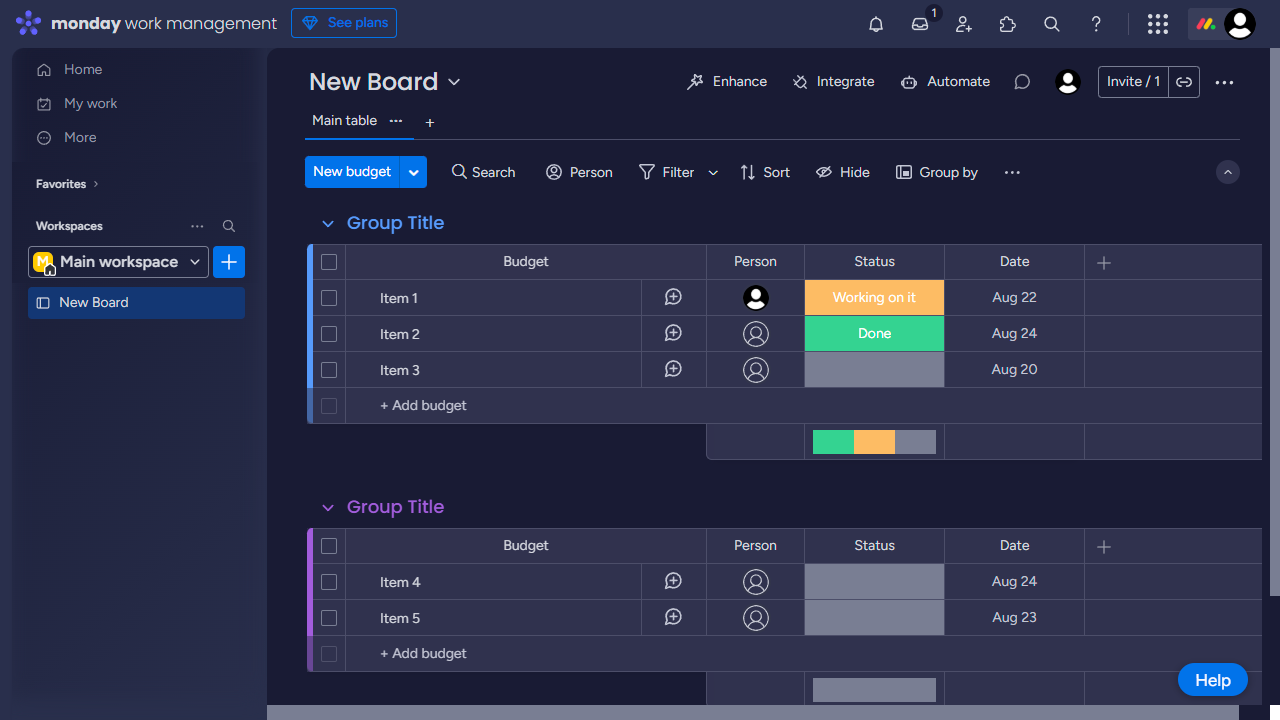
If you want to stay updated on the overall progress of your company's operations at a glance, open your dashboard. Here, you can add widgets that connect to various boards (the number depends on your subscription) that come in many forms. For example, if you want a quick and dirty way to see how close something is to completion, you can add the battery widget that fills up based on an item's status. You can also add a widget that tracks any number-based columns, such as budget spent or hours worked. This works for simpler tasks, but dedicated project management apps offer more in-depth analytics and reporting tools.

Monday.com supports basic time tracking in the form of a column you can add to a board (if you pay for the Pro subscription tier). In the column, you can start and stop a timer as necessary or manually add a session. You can add a corresponding widget to your dashboard for easy monitoring. This functionality is likely enough for most people, but you might need to pay for a dedicated service if your needs are more complex.

It's also possible to create documents and forms in Monday.com. For the latter, you can start from scratch or with a premade template. Documents are shareable both with people inside and outside of your organization, but you should still stick with the likes ofGoogle Workspacefor anything beyond brainstorming and jotting down notes. The form-building functionality is similar. You can make custom ones or start with a template. It's possible to create and share simple surveys, but Monday.com just can't compete with dedicated apps likeJotform.

Communication and Collaboration: Stay in Touch Easily

Monday.com is a work management solution for teams first and foremost, not individuals, so staying in touch with coworkers is a key feature. Luckily, Monday.com makes this easy. Click on your update feed at the top-right of the interface to find bookmarks of important updates, updates in which someone directly mentioned you, and updates on your boards in general. The communications features aren't too advanced, but they work fine.
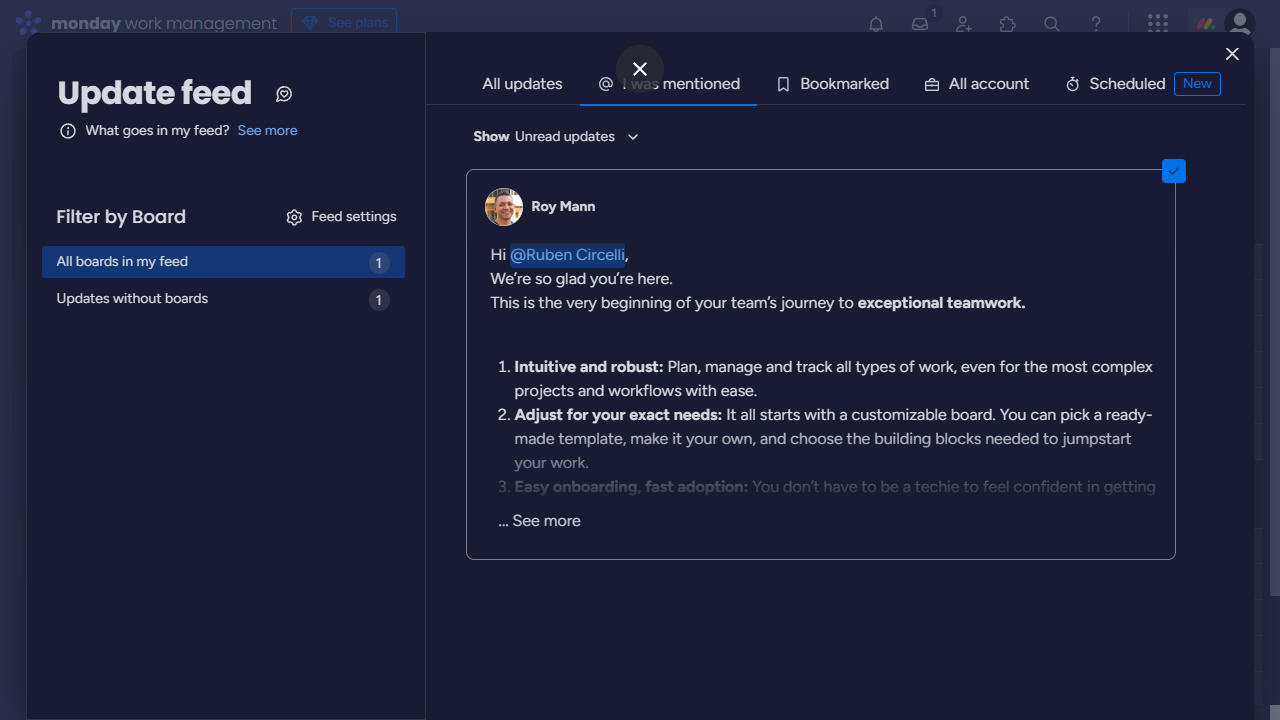
To write an update yourself, just click on an item in a board and start writing in the side panel, or you can click on the 'Write a new update' button next to an item's name. When you @ people directly, your message appears in their update feed. If you want to track an item's activity, you can open up an item's Activity Log tab to see who made what changes and when.

Thanks to its direct messaging capabilities andZoho Meetingintegration, Zoho Projects can serve as a one-stop shop for your work life. Monday.com, on the other hand, makes it easy to talk to your team about Monday.com action items. You're better off using it alongside other apps, such asGoogle MeetorSlack, for deeper, richer communication.

Integrations and Automation: Endless Options

Integrations and automation are where Monday.com shines. With a paid subscription, you can connect your Monday.com account to other apps your team uses. At the time of writing,hundreds of integrations are available, including DocuSign, Excel, GitLab, Gmail, Mailchimp,Microsoft Teams, Outlook, and Slack. Integrations with other apps allow you to automatically move information between them. For example, you can sync all the dates from a specific board to your Google Calendar. When you add a new date to the board, it automatically appears in your Google Calendar. Integrations can save your team time by eliminating the need to copy data from one place to another.

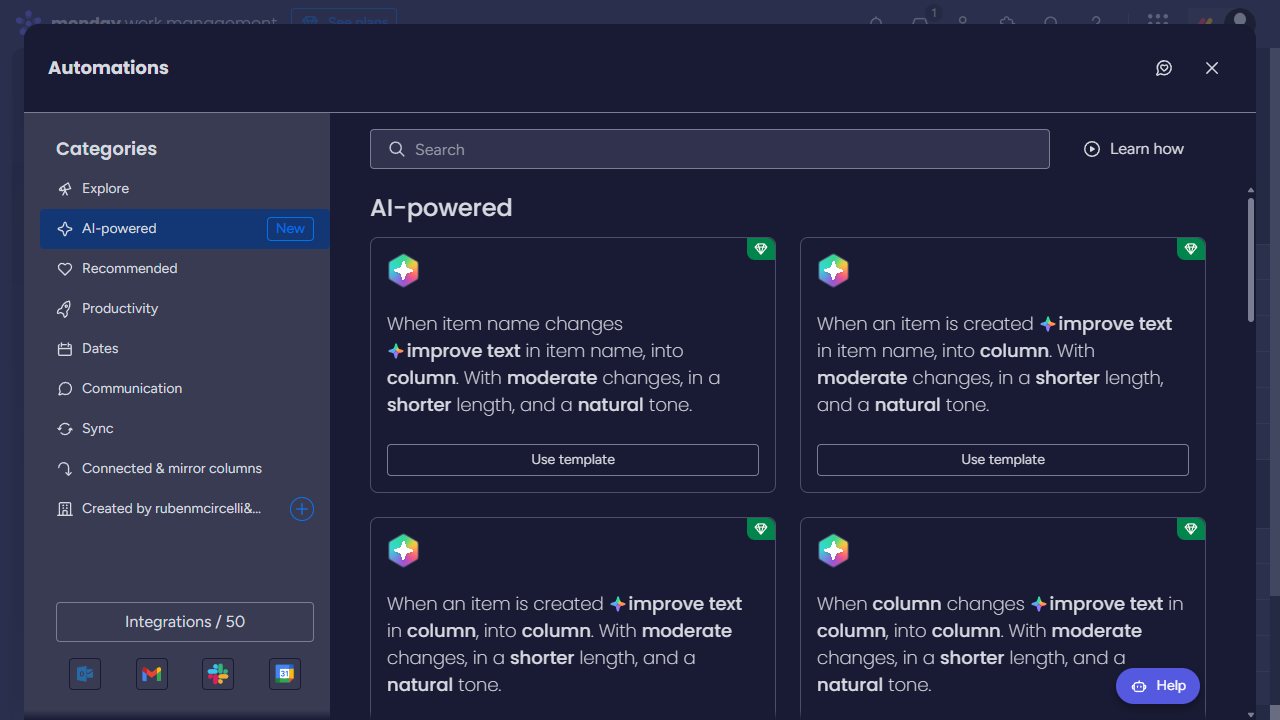
Automations save your team time too. If you've ever tinkered with smart home products or used Apple Shortcuts, IFTTT, orZapier, you might be familiar with automation. Essentially, automations are an "if this, then that" statement (which is whereIFTTTgets its name). "If someone marks a task complete in my Monday.com Product board, then send my manager an email."

Monday.com has a list of preconfigured automations that you can customize to your needs. One example is an automation that says, "Everytime period,createan item." When you choose this automation, you get to decide what time period and what item, so you might end up with, "Every Friday, create a task called Log Your Hours." You can use automation to move a task from one board to another, as well as set up notifications, recurring tasks, status changes, and much more.

AI Features: Potentially Useful, Depending on Your Needs

Monday.com has a wide range of AI features. You can use AI to enhance your boards with AI-powered columns that do everything from analyzing the sentiment of updates to extracting information from files to translating text. You can also use AI within items to improve or shorten the text of your updates and summarize others' updates. AI also extends to automations, which means you can add AI functions to workflows. For example, you can set up an AI automation to scan updates for a date, and then use that date to fill out an item's due date column, among other things. You can also use AI to create documents and forms, if you can't find a template you like.
For now, Monday.com's AI assistant (called Sidekick) and Monday.com's AI automations are in early access, so you need to complete a form to request access to them. Of course, early access means you are likely to encounter bugs and limitations. More AI features are "coming soon" according to Monday.com, such as AI resource allocation, AI risk management, AI service agents, and more. Furthermore, Monday.com is gradually rolling out its AI capabilities to accounts, so you might not have access to all or any of them, even if you submit a request.

The various AI functions mostly work, but whether they are useful depends on your needs. In most cases, for example, AI text summaries and AI translations just aren't relevant. When it comes to talking to Sidekick, whether it's for brainstorming, writing content, or anything else, there isn't a huge draw to use Sidekick overchatbots, likeChatGPTorGemini, outside of saving yourself a click to a new tab. You can ask Sidekick to do things for you, like make changes to items and perform calculations in your boards, but once again, how useful that is depends on what you are managing.

AI features are not just part of paid subscriptions either; you will eventually have to spend credits to use them. For example, executing an AI automation costs one credit. Subscribers to paid plans receive only 500 AI credits per month, as mentioned, and you must purchase more if you run out. Credit expenditures could therefore quickly add up, but it is currently difficult to tell how quickly you might run through your allotment, since AI features are still in beta and do not currently cost credits. AI automations you added before you run out of credits will still function after you do, but Monday.com notes that this behavior might change.

Is Monday.com Safe to Use?

We don't see any major causes for concern in Monday.com'sPrivacy Policy. As with any site, Monday.com collects a variety of information you submit, but the motto of Monday.com is "Privacy is more than just a policy," which it supports witha statementFrom its Data Protection Officer, Aner Rabinovitz: "Customer data belongs to the customer. Your personal data is yours. We're here to secure that. To honor your trust in us and ensure that your privacy and rights are protected."

Beyond mere words, you can read Monday.com’sWhite paper on securityfor a comprehensive look at its privacy and security policies. If you're particularly concerned about security, you can choose Monday.com'sGuardian add-on. This includes bring-your-own-key encryption, data leak prevention, single sign-on, and tenant-level encryption. However, this add-on is available only for Enterprise subscribers. Anyone can enable it.Multi-Factor Authenticationon their Monday.com account, though.

The approach of Monday.com to privacy and security is great, but that doesn't mean nothing bad ever happens to it. In 2024, for example,a bad actor exploitedMonday.com's share update feature, allowing them to send phishing emails to a large audience. As always, you should be careful about adding sensitive information to any cloud-connected service.
Opinion: Congress should establish a public AI wealth fund

Artificial intelligence threatens to cause a jobs shock across offices, warehouses, call centers, clinics, classrooms and more. Faced with backlash among displaced workers, the industry and its lobbyists will likely rely on cash-transfer schemes — universal basic income and similar approaches — as a release valve.

That path would paper over dislocation while entrenching gatekeepers. It would weaken bargaining power at work and create new and unintended social and fiscal dependencies.

We can do better than that. We have an opportunity instead to bend the trajectory, level the playing field and ensure that the public that pays for the externalities of AI also benefits from its returns.. 

What does this entail? Open and contestable markets; modern data rights; liability that governs control; guard-railing technological change to serve the shared good; and most importantly, public sharing in AI's upside.

The U.S. should establish a professionally managed, firewall-insulated Public AI Wealth Fund that holds diversified stakes across the AI stack and distributes an annual dividend tied to the AI upside (i.e. realized returns).

This would put the focus on public dividends, not universal basic income; it would give the public a meaningful, lasting stake in AI's returns, while using competition, data, labor and energy rules to keep the field open and the harms in check.

The deal between Nvidia and AMD and the U.S government, which involves payments of15 percent of revenue from sales of some advanced chips, provides precisely the platform to kick-start the creation of this Public AI Wealth Fund.

Capitalize it with equity warrants from firms receiving large subsidies, tax credits or preferential contracts; a compute excise above thresholds set by rulemaking; a windfall-profits surtax on extraordinary AI margins; and location-based fees where data centers draw on subsidized energy or water.

Adopt a simple fiscal rule: preserve the principal and pay a universal dividend from realized returns. Dividends will start small and grow as the fund matures, aligning public returns with performance rather than with permanent deficit financing.

Sharing in the upside should complement — not replace — open markets and individual economic choice.

Congress should treat exclusive deals as presumptively anticompetitive once market-share triggers are met; prohibit self-preferencing in AI marketplaces; and scrutinize "model-plus-platform" tie-ups as potential vertical restraints. Interoperability and portability — APIs, export formats, and the ability to move fine-tunes — should be the default, with clear timelines and contractual exit rights. These rules ensure the public is not forced to buy into entrenched barriers.

Individuals need a clear opt-out for the use of personal data in training, a right to know whether their data was used, and remedies for unauthorized use. For high-risk uses — hiring, housing, health care, finance and critical infrastructure — deployers should bear a duty of care: documented impact assessments, human-in-the-loop plans, incident reporting, and audit trails. The burden should rest on those who profit from deployment to show they have met these duties.

The Federal Trade Commission can scrutinize deceptive AI claims, dark patterns, and data misuse. The Justice Department and the FTC can challenge exclusionary bundles and exclusivity in contracts. The Securities and Exchange Commission can require disclosure of material workforce impacts from AI deployments, not just AI "strategies." Civil-rights agencies can enforce explainability, auditing, and appeal rights in automated decisions. Energy and water regulators can require facility-level reporting from hyperscale data centers and condition interconnects on demand-response and conservation plans.

The executive branch and states should move in parallel. States should establish their own AI wealth funds with data-center and related revenues and equity warrants tied to subsidized projects, coordinated with - but independent from - the national fund. A federated research cloud across universities, national labs and state innovation hubs would give academia and students access to shared AI infrastructure without having to depend on vendor credits.

Ask schools, employers and hospitals which systems they use, how they were evaluated, and how you can appeal decisions. Insist that public dollars tied to AI come with ownership, transparency and exit rights.

Talk to your elected officials and those who are running for office; tell them it is time for our nation to build a Public AI Wealth Fund.

John deVadoss was a general manager at Microsoft for two decades. He did his Ph.D. work in AI at the University of Massachusetts at Amherst, specializing in Machine Learning.

Copyright 2025 Nexstar Media, Inc. All rights reserved. This material may not be published, broadcast, rewritten, or redistributed.

For the latest news, weather, sports, and streaming video, visit The Hill.

Friday, August 22, 2025

Navigating the Future of Work: Strategies for Excelling in an AI-Driven Workplace

The advent of artificial intelligence (AI) has ushered in a new era of technological innovation, transforming industries and reshaping the nature of work. While AI presents significant opportunities for efficiency and growth, it also poses challenges for employees who must navigate this rapidly evolving landscape. To remain relevant and excel in the workplace of the future, workers need to adapt their skills and mindsets. Let's go!

Surviving and Thriving at Work in the Age of AI

Embrace Lifelong Learning

In an environment where AI and automation are constantly evolving, the half-life of skills is shrinking.

Employees must adopt a mindset of lifelong learning to stay ahead. This includes both formal education and self-directed learning.

Emphasize acquiring skills that AI cannot easily replicate, such as creative problem-solving, critical thinking, and emotional intelligence.

  • Technical proficiency: Even if you're not in a tech role, understanding the basics of AI, machine learning, and data analytics can make you more adaptable and valuable.
  • Soft skills: Skills such as leadership, collaboration, and adaptability are becoming increasingly important in an AI-driven workplace. These are the areas where humans can significantly outperform AI.

12 Highest-Paying Careers in AI Technology Today (msn.com)

Enhance Digital Literacy

Digital literacy goes beyond basic computer skills to include a deeper understanding of digital tools and platforms, data privacy, and cybersecurity.

As AI systems become more integrated into daily tasks, being proficient with digital tools and understanding their implications is crucial.

  • Stay updated with trends: Regularly explore emerging technologies and platforms. This can help you anticipate changes and adapt more quickly.
  • Understand data: With AI's reliance on data, being able to interpret and use data effectively can set you apart.

Cultivate Creativity and Innovation

AI excels at routine and predictable tasks, but it struggles to generate truly novel ideas. Cultivating creativity enables employees to innovate and think outside the box, offering solutions and ideas that AI cannot.

  • Engage in creative activities: Dedicate time to hobbies or tasks outside your job scope that stimulate creativity.
  • Foster a culture of innovation: Encourage brainstorming sessions and open dialogues at work to promote innovation.

Develop Emotional Intelligence

AI may be able to analyze data and patterns, but it lacks the nuances of human emotions.

You're getting irritated because your favorite McDonald's has only a touch screen to order off of is on you.

Emotional intelligence - the ability to be aware of, control, and express one's emotions, and to handle interpersonal relationships judiciously and empathetically - is invaluable.

  • Practice empathy: Try to understand and share the feelings of colleagues and clients to build stronger relationships.
  • Effectively manage stress: Learn techniques to manage your own emotions, especially in high-pressure situations, to maintain your well-being and productivity.

10 Ways AI Will Be Able to Predict Your Future (msn.com)

Focus on Human-Centric Skills

As AI takes over more administrative and analytical tasks, human-centric skills will become increasingly critical. These include customer service, care professions, therapy, negotiation, and diplomacy.

  • Build on interpersonal skills: Enhance your ability to communicate, collaborate, and resolve conflicts effectively.
  • Look for roles that require a human touch: Positions that require empathy, moral judgment, and personal interaction are less likely to be automated.

Stay Agile and Adaptable

The ability to adapt to change is perhaps the most crucial skill in the age of AI. This means being open to new roles, industries, and even career paths as the landscape evolves.

  • Be open to change: Cultivate a flexible mindset that views change as an opportunity rather than a threat.
  • Learn to pivot: Be prepared to shift directions or learn new skills as demand changes in the job market.

Conclusion

The age of AI is not a harbinger of obsolescence for the workforce, but rather a call to action for employees to enhance their skills and adapt to new roles.

By embracing lifelong learning, enhancing digital literacy, cultivating creativity and innovation, developing emotional intelligence, focusing on human-centric skills, and staying agile, workers can not only survive but thrive in this new era.

The future of work will be defined by the symbiotic relationship between human creativity and AI's analytical prowess, leading to unprecedented levels of productivity and innovation.

Next read>>>Is AI Going to Replace Your Job by 2025? How to Stay Relevant (msn.com)

Follow me for more trends, self-care tips and awesome ways to thrive in life!