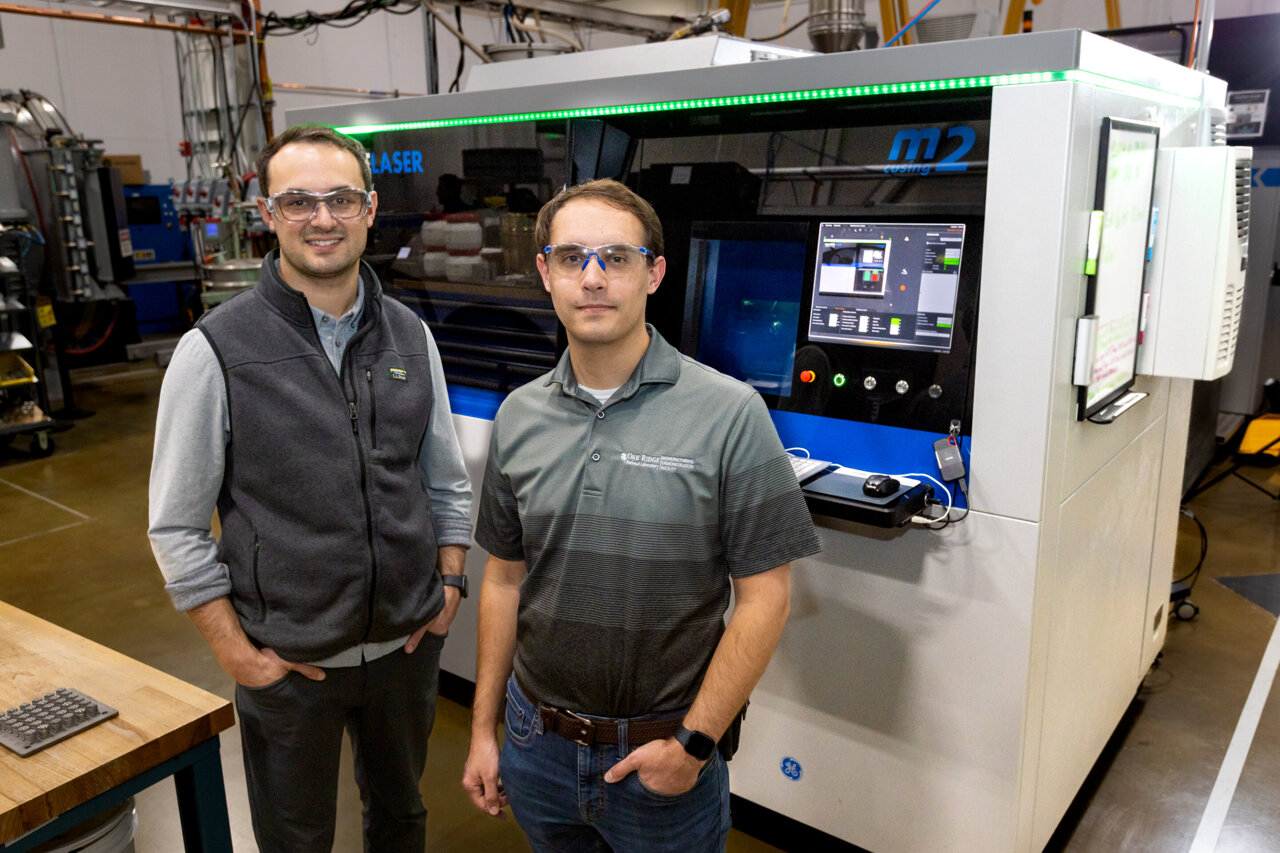
Advancements in Additive Manufacturing Through New Dataset
The Oak Ridge National Laboratory (ORNL) has made a significant breakthrough with the release of its most advanced dataset to date. This dataset, developed using the Peregrine software, is designed to monitor and analyze parts created through powder bed additive manufacturing. The dataset is now available for researchers and manufacturers to further enhance their understanding and application of this cutting-edge technology.
The dataset, titled "In situ Visible Light and Thermal Imaging Data from a Laser Powder Bed Fusion Additive Manufacturing Process Co-Registered to X-ray Computed Tomography and Fatigue Data," represents a major step forward in supporting the nation's additive manufacturing industry. As part of a study aimed at establishing strong correlations between manufacturing anomalies, internal defects, and mechanical performance, the Department of Energy's Manufacturing Demonstration Facility has produced this comprehensive resource.
This dataset offers state-of-the-art monitoring data for laser powder bed fusion (L-PBF), a process that uses a laser to melt and fuse metal powder into layers to create metal parts. It includes machine process parameters, sensor data, geometries, and detailed images of the 3D-printing process captured from multiple angles and lighting types. The dataset combines high-resolution visible and near-infrared imaging with X-ray scans of the printed parts, providing an extensive view of the manufacturing process.
Luke Scime, a researcher in the Manufacturing Systems Analytics Group at ORNL, explained how Peregrine works. "Peregrine takes images during printing, using AI to look for anomalies," he said. "You do that for every single layer, and you build up a three-dimensional map of all the locations that might have issues, and then you try to predict which of those might cause a problem in the final part."
The custom algorithm within the Peregrine software scrutinizes the composition of edges, lines, corners, and textures by analyzing pixel values of images. This allows the system to send alerts to operators about any problems during the printing process, enabling them to make quick adjustments. This proactive approach helps ensure the quality of the final product.
One of the key features of the Peregrine software is its Dynamic Multilabel Segmentation Convolutional Neural Network (DMSCNN). This network examines data from multiple sensors to detect problems and send alerts. For instance, L-PBF prints can experience spatter, where molten material is ejected as the laser melts the metal powder. These spattered particles can land elsewhere on the part, affecting the overall quality.
The new dataset includes all DMSCNN segmentation results and fatigue-tested specimens subjected to such spatter-induced perturbations. This comprehensive ensemble of information supports the development of AI models for digital qualification of additive manufacturing processes. By using the improved open-source Peregrine dataset, researchers and manufacturers can develop even smarter, adaptive quality assurance and quality control systems for their 3D-printed parts.
Other ORNL researchers who contributed to the new dataset include Zackary Snow, Chase Joslin, William Halsey, Andres Marquez Rossy, Amir Ziabari, Vincent Paquit, and Ryan Dehoff. Their collective efforts have helped create a valuable resource for the additive manufacturing community.
For more information, refer to the following publication: Zackary Snow et al, "In situ Visible Light and Thermal Imaging Data from a Laser Powder Bed Fusion Additive Manufacturing Process Co-Registered to X-ray Computed Tomography and Fatigue Data," Oak Ridge National Laboratory (ORNL), Oak Ridge, TN (United States). Oak Ridge Leadership Computing Facility (OLCF); Oak Ridge National Laboratory (ORNL), Oak Ridge, TN (United States) (2025). DOI: 10.13139/ornlnccs/2524534.

0 comments:
Ikutan Komentar