Showing posts with label quantum mechanics. Show all posts

Saturday, May 2, 2026

Japanese researchers use quantum entanglement to enhance robot balance

Featured Image

A New Approach to Robot Movement Using Quantum Computing

Researchers from Shibaura Institute of Technology, Waseda University, and Fujitsu have introduced a groundbreaking method that allows robots to move more smoothly and efficiently by leveraging the power of quantum computing. This innovation could significantly change how robots are designed and controlled, especially in complex environments.

Understanding the Challenge

When a robot moves, its computer must determine how each joint should bend so that the end of its limb—such as a hand or foot—reaches the correct position. This process is known as inverse kinematics, and it poses a significant challenge for humanoid robots due to the vast number of possible joint configurations. Traditional computers typically use trial-and-error methods to solve these problems, which can be time-consuming and require substantial computational resources.

The Quantum Solution

The team's new approach uses qubits to represent the position and orientation of each part of the robot. More importantly, they utilize quantum entanglement, a unique feature of quantum mechanics where particles are connected such that the movement of one affects the other. This concept mirrors how real robot joints function, where moving one joint influences the others.

Another key element of this research is the hybrid approach that combines classical and quantum computing. While forward kinematics—calculating where the robot’s hand or foot ends up given certain joint angles—is handled by quantum circuits, the inverse kinematics step is still managed by classical computers. This division of labor allows the system to benefit from the speed advantages of quantum computing while maintaining stability through traditional methods.

Faster and More Accurate Calculations

By implementing this hybrid model, the researchers were able to reduce the number of calculations needed. Tests on Fujitsu’s quantum simulator demonstrated that the method reduced errors by up to 43% compared to classical methods and operated faster. The results were further validated using a 64-qubit quantum computer developed with RIKEN.

In one test, the team attempted to calculate the movements of a full-body robot with 17 joints—similar to a human. Normally, this would require an impractical amount of computing power and take approximately 30 minutes to complete. With the new method, this task became significantly more manageable.

Implications for Future Robots

This breakthrough has important implications for future robots, particularly humanoid robots that work closely with humans. These robots need to move fluidly, respond quickly, and navigate complex environments in real time. Current methods often simplify the model, such as reducing the number of joints in the calculation from 17 to 7, which leads to stiff and less lifelike movements.

With the new quantum-based method, smoother and more realistic robot movement could become possible. Moreover, the technology is already compatible with today’s "NISQ" (Noisy Intermediate-Scale Quantum) computers—machines that are not yet perfect but are usable for specific tasks.

In the long term, this technology could enhance various robotic applications, including real-time control, obstacle avoidance, multi-joint manipulators, and energy optimization tasks.

Looking Ahead

The researchers believe that their approach could see further improvements if combined with advanced quantum algorithms, such as the quantum Fourier transform, which might accelerate calculations even more. By integrating quantum computing with robotics, the team has made a significant leap toward developing the next generation of intelligent, human-like robots.

Takuya Otani from the Shibaura Institute of Technology and Atsuo Takanishi from Waseda University collaborated on this research, alongside Nobuyuki Hara, Yutaka Takita, and Koichi Kimura from Fujitsu Limited. This research was published in the Scientific Reports journal.

Saturday, August 23, 2025

Advanced computer modeling predicts molecular-qubit performance

A qubit is the delicate, information-processing heart of a quantum device. In the coming decades, advances in quantum information are expected to give us computers with new, powerful capabilities and detectors that can pick up atomic-scale signals in medicine, navigation and more. The realization of such technologies depends on having reliable, long-lasting qubits.

Subscribe to our newsletter for the latest sci-tech news updates.

Now, researchers have taken an important step in understanding the rules necessary for the design of useful, efficient qubits.

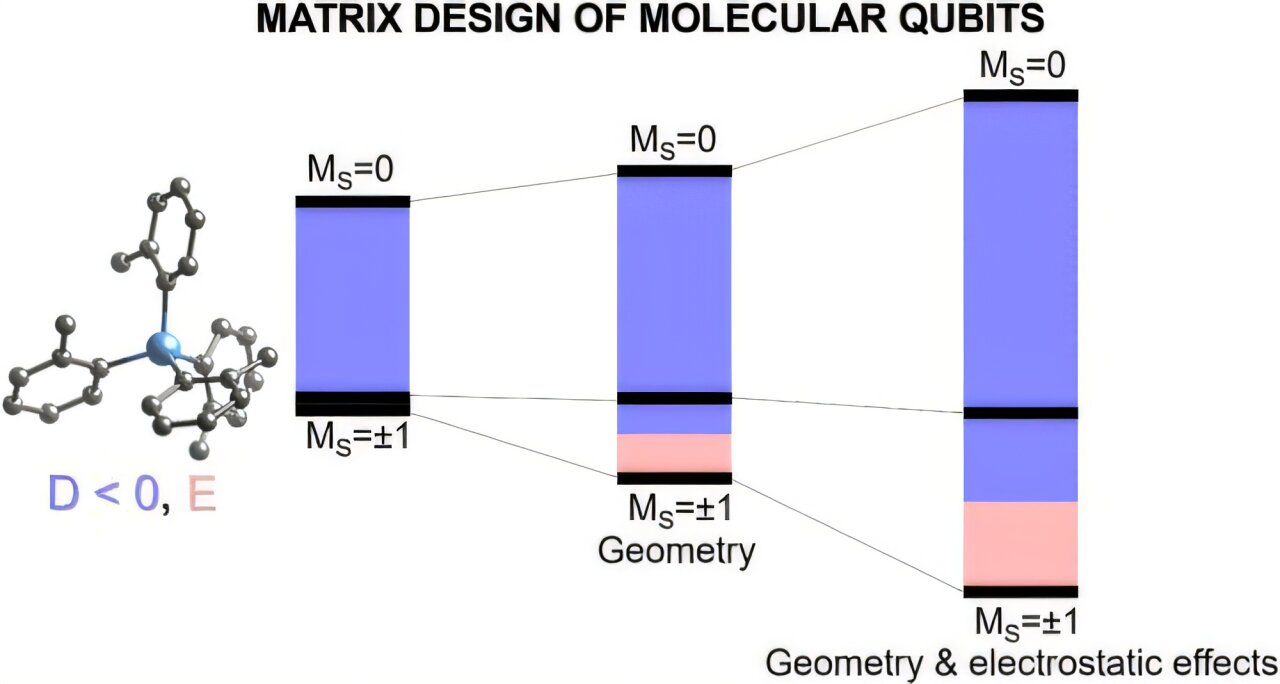
Using advanced computer modeling, the researchers came up with a way to accurately predict and fine-tune key magnetic properties of a type of device called a molecular qubit. They also figured out which factors in the material that the qubit sits in affect this tuning the most and calculated how long the qubits can live.

Their predictions matched what experiments see.

"I think this work will open new venues for the simulations of molecular qubits from first principles, and I see it as a real starting point for many new investigations to come, especially on the assembly of molecular qubits," said Giulia Galli, who led the team.

Galli is a senior scientist at the U.S. Department of Energy's (DOE) Argonne National Laboratory and the Liew Family professor of electronic structure and simulations in the Pritzker School of Molecular Engineering and the Department of Chemistry at the University of Chicago.

The group's work is published in the Journal of the American Chemical Society.

Designing qubits to spec

A molecular qubit is made of a molecule sitting inside a larger crystal. Galli's team focused on chromium-based systems.

Traditionally, scientists build molecular qubits by creating different materials, testing them and measuring their performance—like raising buildings of different materials and, once built, testing their stamina in different weather conditions.

It's a valid approach. But the team wanted to give direction on how to design molecular qubits to spec. Chromium-based qubits gave the research team an opportunity to develop a computational method that could predict how key qubit features would respond to different design choices.

"From a design perspective, we wanted to come up with rules to engineer different properties of qubits that are beneficial to our specific application, whether that's quantum communication, quantum sensing or quantum computing," said Argonne postdoctoral researcher Michael Toriyama.

"Through our work, we developed a fully computational method to figure out these engineering principles."

Split and spin

The star of the molecular qubit is something called "spin." It's a feature of every atom. Just as Morse code uses dots and dashes to carry messages, a molecular qubit uses spin to encode quantum information.

The spin of a chromium center can split into three magnetic energy levels. It's a phenomenon called "zero-field splitting," or ZFS. The energy levels change depending on how the atom is situated in the crystal. (The "zero" refers to the absence of outside electromagnetic fields.)

Scientists need to know the energies of each level to control the qubit precisely. Without knowing the ZFS values, controlling the qubit would be like trying to tune a radio without knowing a station's frequency.

The ability to set the ZFS is especially helpful in big quantum systems with many qubits, which need to have predictable, controllable energy differences to avoid unwanted interference. Controlling the ZFS also enables longer qubit lifetimes, or coherence times—more time for the qubit to process information before it disintegrates.

"We can predict the coherence time from the ZFS using our methods, enabling better design principles to extend the coherence of a qubit," Toriyama said. "It's like we're figuring out how to build better armor around the qubit to protect it."

The group's computational protocol for predicting the ZFS gives scientists a way to take full advantage of the molecular qubit's best asset: its tunability.

"In other qubit types, like diamond, for example, there are limited possibilities for modifications, whereas with molecules there is a lot you can do. You can tune properties to the application you need," said Diego Sorbelli, an assistant professor at the University of Perugia in Italy and a former postdoctoral researcher at the University of Chicago.

"It's kind of like using Lego blocks: Figure out which blocks go together and then get the final product with properties that you want," Toriyama said.

Qubit collaboration

How do you tune the ZFS of a molecular qubit? The Galli team highlighted two important dials for setting the ZFS just where it's needed: the geometry of the crystal surrounding the chromium center and the electric fields that arise from the crystal's chemical makeup.

The team's work is the first not only to provide a computational method for accurately predicting ZFS in chromium molecular qubits, but also the first to identify that ZFS can be controlled by manipulating the host crystal's electric fields.

"We give new design rules for modifying the composition of the environment to actively manipulate these spin structures, which we can accurately predict," said Lorenzo Baldinelli, first author of the paper, a graduate student at the University of Perugia, and a former visiting graduate student at the University of Chicago.

"So now, using our protocol, we can account not only for the electronic and spin properties of the qubit, but also of its surroundings."

It wasn't easy to do.

"These properties are extremely complicated to predict from first principle," Sorbelli said.

But the strong cross-disciplinary collaboration within Galli's group—chemists, materials scientists and physicists—helped tease out the most important dials in the chromium qubit's complex chemistry.

"I remember this was bugging me. How do we predict the zero-field splitting? What are the ingredients we need to be able to do this? Can we do this? I was very stubborn about it. And then Lorenzo came along, and we teamed up, eventually bringing Michael into the fold. From that point it was a steep learning curve, but it was also pretty smooth," Sorbelli said.

"Not too many groups are equipped to compute coherence properties of qubits. We leveraged the tools that our group has developed through years and years of research," Toriyama said.

"This was really a testament to how successful collaborations can be and how versatile our group is."

More information: Lorenzo Baldinelli et al, Design Rules to Engineer the Spin Structure of Cr4+ Molecular Qubits via Matrix Modularity, Journal of the American Chemical Society (2025). DOI: 10.1021/jacs.5c04004

Provided by Argonne National Laboratory

This story was originally published on The Shiro Copr.

Trapped calcium ions entangled with photons form scalable nodes for quantum networks

Researchers at the University of Innsbruck have created a system in which individual qubits - stored in trapped calcium ions - are each entangled with separate photons. Demonstrating this method for a register of up to 10 qubits, the team has shown an easily scalable approach that opens new possibilities for linking quantum computers and quantum sensors.

Subscribe to ournewsletterfor the latest science and technology news updates.

The work ispublishedinPhysical Review Letters.

Quantum networks are often described as the future of the internet—but instead of transmitting classical information in bits, they send quantum information carried by photons. These networks could enable ultra-secure communication, link together distant quantum computers into a single, vastly more powerful machine, and create precision sensing systems that can measure time or environmental conditions with unprecedented accuracy.

To make such a network possible, so-called quantum network nodes—that can store quantum information and share it via light particles—are needed. In their latest work, the Innsbruck team led by Ben Lanyon at the Department of Experimental Physics of the University of Innsbruck demonstrated such a node using a string of 10 calcium ions in a prototype quantum computer.

By carefully adjusting electric fields, the ions were moved one by one into an optical cavity. There, a finely tuned laser pulse triggered the emission of a single photon whose polarization was entangled with the ion's state.

The process created a stream of photons, each tied to a different ion-qubit in the register. In the future, photons could travel to distant nodes and be used to establish entanglement between separate quantum devices. The researchers achieved an average ion-photon entanglement fidelity of 92%, a level of precision that underscores the robustness of their method.

"One of the key strengths of this technique is its scalability," says Ben Lanyon.

While earlier experiments managed to link only two or three ion-qubits to individual photons, the Innsbruck setup can be extended to much larger registers, potentially containing hundreds of ions and more.

This paves the way for connecting entire quantum processors across laboratories or even continents.

"Our method is a step toward building larger and more complex quantum networks," says Marco Canteri, the first author of the study.

It brings us closer to practical applications such as quantum-secure communication, distributed quantum computing and large-scale distributed quantum sensing.

Beyond networking, the technology could also advance optical atomic clocks, which keep time so precisely that they would lose less than a second over the age of the universe.

Such clocks could be connected via quantum networks to form a worldwide timekeeping system of unmatched accuracy.

The work demonstrates not only a technical milestone but also a key building block for the next generation of quantum technologies.

More information:M. Canteri et al, Photon-Interfaced Ten-Qubit Register of Trapped Ions,Physical Review Letters(2025).DOI: 10.1103/v5k1-whwz

Provided by University of Innsbruck

This story was originally published onThe Shiro Copr.

Two quantum computers with 20 qubits manage to simulate information scrambling

Four RIKEN researchers have used two small quantum computers to simulate quantum information scrambling, an important quantum-information process. This achievement illustrates a potential application of future quantum computers. The results are published inPhysical Review Research.

Subscribe to ournewsletterfor the latest science and technology news updates.

Still in their infancy, quantum computers are only just beginning to be used for applications. But they promise to revolutionize computing when they become a mature technology.

One possible application for quantum computers is simulating the scrambling of quantum information—a key phenomenon that involves the spread of information in quantum systems ranging from strange metals to black holes.

After encoding information in one part of a quantum system, it becomes diluted over time through various processes. Eventually, it spreads out across the entire system.

The original information is not lost, but it is much harder to reconstruct since you need access to the entire system. The quantum-information scrambler par excellence is the black hole, which is the ultimate shredder when it comes to quantum information.

Understanding how information scrambling occurs is critical for addressing fundamental problems in quantum physics.

"Quantum-information scrambling is of interest to us because we can use it to perform some additional calculations, such as statistical physics calculations," says Kazuhiro Seki of the RIKEN Center for Quantum Computing (RQC).

One way to study quantum-information scrambling is to perform simulations, which is where quantum computers can help, since they are better suited for such simulations than conventional computers.

Now, Seki and Seiji Yunoki, also from RQC, along with two colleagues, have used two quantum computers with 20 qubits—the quantum equivalent of bits—to simulate quantum-information scrambling circuits.

For the simulation, the researchers used state-of-the-art quantum computers via the cloud, which are based on qubits formed from trapped ions. They used the quantum computers to perform three simulations, which included creating a scrambled state and using it to perform quantum statistical mechanical calculations.

While a powerful conventional computer could have been used to perform the simulation, the complexity of simulations is approaching the realm where quantum computers will be indispensable for such calculations.

We only used 20 qubits to conduct the simulations in this study," says Yunoki. "If we can use more than 50 qubits to perform similar calculations, it may be too difficult for a classical computer to handle.

A 20-qubit, trapped-ion quantum computer was installed at RIKEN in February 2025. "We're hoping to upgrade it in the next couple of years, so that it will have around 50 qubits," Yunoki notes.

More information:Kazuhiro Seki et al., Simulating Floquet Scrambling Circuits on Trapped-Ion Quantum Computers,Physical Review Research(2025).DOI: 10.1103/PhysRevResearch.7.023032

Provided by RIKEN

This story was originally published onThe Shiro Copr.

Hidden symmetries unlock new ways to control light in quantum materials

A team of researchers has discovered how a little-known type of symmetry in quantum materials, called nonsymmorphic symmetry, governs the way these materials interact with intense laser light.

Subscribe to ournewsletterfor the latest science and technology news updates.

The work ispublishedinPhysical Review AppliedAs a Letter. The findings reveal surprising effects—including the suppression of even-order response and striking polarization-dependent responses—that could enable the design of next-generation lightwave-based electronics and quantum devices.

When broken symmetry doesn't behave as expected

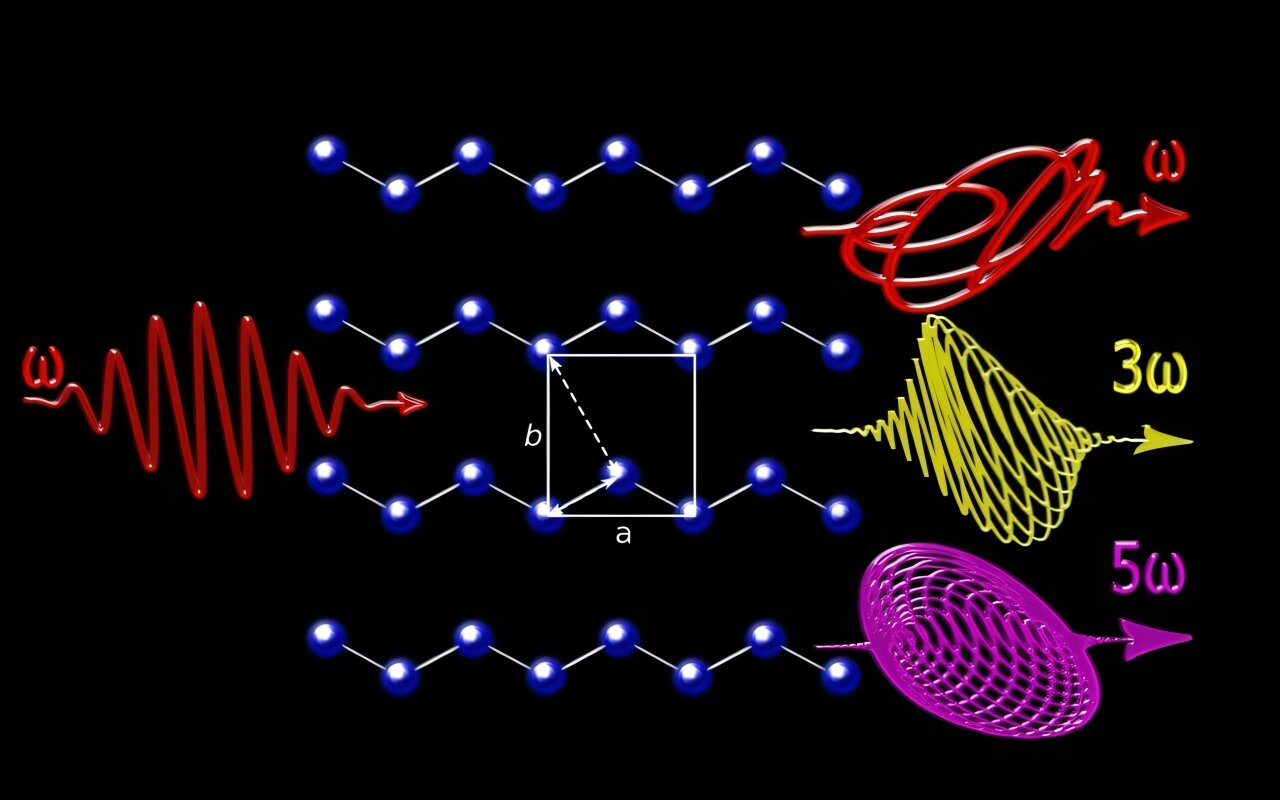
In most materials, breaking inversion symmetry (a mirror-like property) allows the generation of even-order responses, such as second-harmonic signals, when exposed to light. But in nodal-line semimetals (NLS), the researchers observed the opposite: All even-order responses vanish, leaving only odd-order optical responses.

This counterintuitive effect arises from nonsymmorphic symmetry, a subtle structural feature where mirror reflections are combined with fractional atomic shifts. Despite the lack of inversion symmetry, this hidden rule enforces the cancellation of even harmonics.

Light as a fingerprint of symmetry

The present study also uncovered striking patterns in how these quantum materials emit light. When driven by intense laser, the emitted light exhibits two-fold anisotropy, i.e., the response of the emitted light changes dramatically with light polarization, forming a "butterfly-like" emission pattern.

Additionally, some of the emitted signals appear along the direction of the incoming laser, while others emerge at right angles, reminiscent of the nonlinear Hall effect. Moreover, the intra-chain and inter-chain electrons in NLS motion leave different imprints on the emitted light, depending on laser orientation.

These results show how hidden crystal symmetries can control light-matter interactions in unexpected ways," said Prof. Gopal Dixit from IIT Bombay. "By tuning light polarization, we can selectively enhance or suppress optical signals, opening up powerful new possibilities for ultrafast technologies.

Quantum semimetals such as nodal-line, Dirac, and Weyl systems are already considered candidates for future electronic, optical, and quantum devices due to their unusual electronic properties. By demonstrating how nonsymmorphic symmetry uniquely shapes their nonlinear optical response, the study points to strategies for symmetry-engineered optoelectronic platforms.

Lightwave-driven devices are the frontier of ultrafast science," added Navdeep Rana, first author of the study. "The present work shows that the key to unlocking their full potential lies in the hidden symmetries of quantum materials.

The research bridges the fields of quantum materials, ultrafast laser science, and nonlinear optics, demonstrating how fundamental discoveries about symmetry can translate into real technological potential.

More information:Navdeep Rana et al., Nonlinear optical spectroscopy of nodal line semimetals,Physical Review Applied(2025).DOI: 10.1103/3xs5-km1v

Provided by Max Born Institute for Nonlinear Optics and Short Pulse Spectroscopy

This story was originally published onThe Shiro Copr.

Measuring a previously mysterious imaginary component of wave scattering

There has long been a mystery in calculating how an incoming light wave scatters off an object and becomes a modified, outgoing light wave. In particular, the time delay of the transition from one to the other comes out to be a complex number, a regular real number but with a nonzero imaginary part.

Subscribe to ournewsletterfor the latest science and technology news updates.

The imaginary part of thecomplex numberis a regular real number multiplied by the square root of -1, designated by "i." Physicists have found that the first part, the regular real number (usually a mathematical function of energy, or frequency), is well predicted, but they have been so puzzled by the imaginary part, and a bit embarrassed, that they deemed it "unphysical" and ignored it.

But now a pair of physicists from the University of Maryland in the U.S. have shown that the complex part does indeed have a meaning, related to the frequency shift of the transition from incoming to outgoing wave. Their work has beenpublishedinPhysical Review Letters.

The mathematical function that describes the linear transition from one wave function to the other is called the scattering matrix or S-matrix. The scattering matrix, a square array with as many rows and columns as the number of channels of the incoming wave, in principle contains all there is to know, scattering-wise, about the system doing the scattering, which may be glass such as a frosted window or lens, water, a fiber optic cable, atomic nuclei, atoms, molecules and many-body quantum systems.

Inside the system, the velocity of the light wave typically changes; such a system is called a "dispersive medium." In particular, the scattering matrix for a dispersive medium can provide the time delay of the wave's transition from incoming to outgoing—how long the wave stays in the system.

In turn, the time delay provides scientists, engineers and technicians with parameters such as the phase evolution of quantum waves, the delay of a wave group in an optical fiber cable and the group delay in waveguides, among other quantities.

But what to make of the imaginary parts of the scattering matrix? In a2016 paperinNature Communicationsby lead author M. Asano from Japan, a group of scientists from several countries around the world recognized that for light pulses that meet certain requirements, the imaginary part of the scattering matrix - more precisely, the real number before "i", the square root of -1 - represented the "frequency shift" of the transitioning wave due to its passage through the scattering system. In particular, it represents the shift of the frequency in the center of the pulse (shaped as a Bell curve, a Gaussian distribution) of the incoming light pulse.

The requirements are straightforward and not uncommon. The frequency bandwidth, or range of frequencies in the pulse, must be small and the scattering system must be linear and dispersive—that is, the outgoing wave channels are a linear sum of the incoming wave channels, proportional to each—and the properties of the scattering system depend on the incoming wave's frequency components. (It is equivalent when discussing the scattering system's effects in terms of wavelengths or energies.)

The co-authors of the current paper inPhysical Review Letters, Isabella L. Giovannelli and Steven M. Anlage of the Maryland Quantum Materials Center at the University of Maryland decided to test this theoretical prediction.

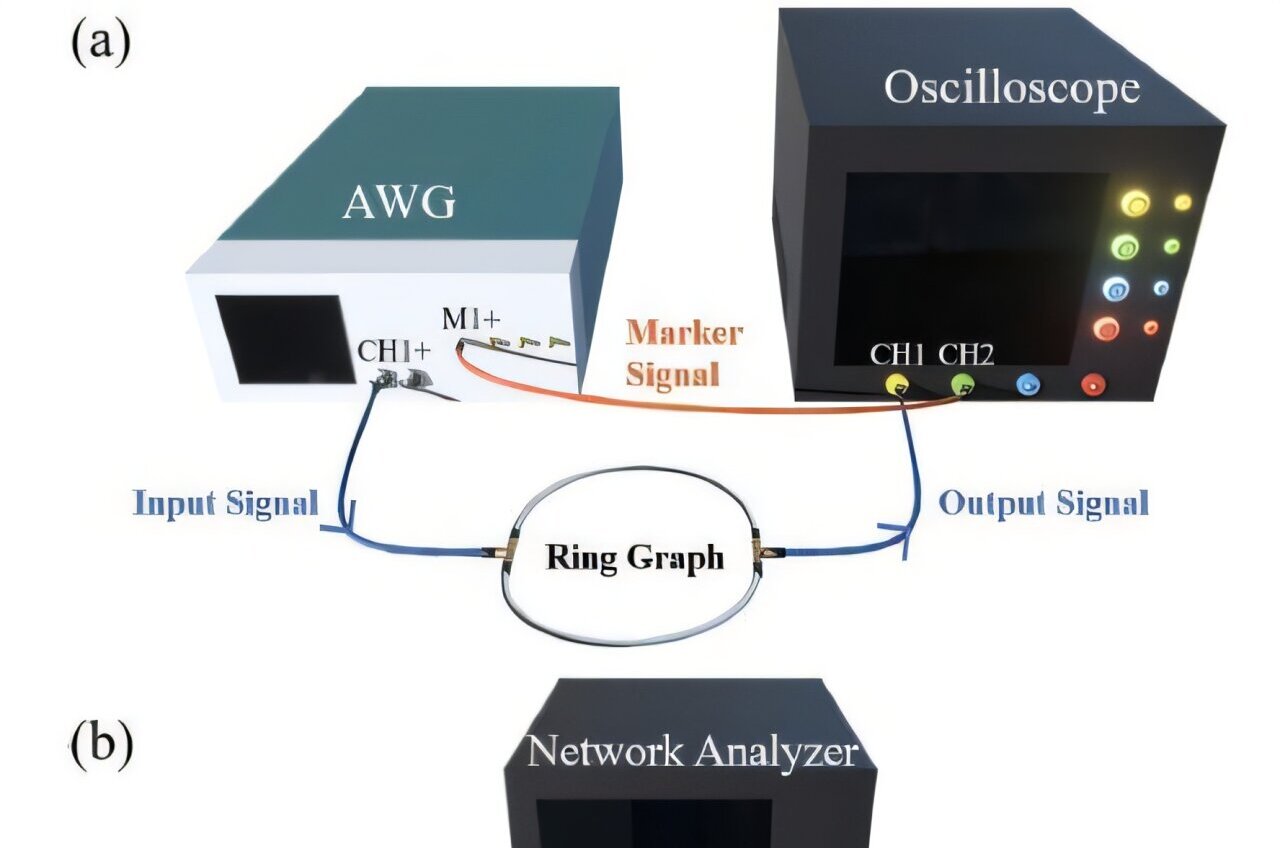
For their experiments, they used a two-port microwave ring graph as the scattering system. This device is a resonator, a closed loop waveguide in which electromagnetic waves circulate (the microwaves) and formstanding wavepatterns where the circumference of the ring is an integer number of wavelengths.

Ring graphs are often used as filters or switches. The actual ring consisted of two coaxial cables of different lengths, 28 cm and 31 cm long, and two T-junctions.

The microwave pulses sent through the ring graph had a center frequency of 5 gigahertz (a standard microwave oven uses microwaves of 2.45 GHz), with a narrow bandwidth of only 5 megahertz (0.005 GHz).

The experimentalists chose a frequency domain setup for their measurements, meaning the light pulses were analyzed as functions of frequency—how much of each frequency is present. The alternative is a time domain setup, where the signals are analyzed as functions of time— how the signal's amplitude changes over time. The frequency domain setup uses electronics which apply mathematical transforms to show amplitude and phase as functions of frequency.

In this way, the pair sent the 5 GHz microwaves through the resonator and measured the time delay of the wave pulse to be -7.95 nanoseconds (ns), and a frequency shift of the center of the pulse's Bell curve of 0.48 megahertz.

The prediction for the imaginary time delay, or frequency shift, is 3.03 radians per microsecond, which is 0.482 million cycles per second or 0.482 MHz. The measured frequency shift is, they write, "in excellent agreement with the predictions of Asano et al."

With the confirmed theory, 'we can now make predictions for reflection time delays, along with reflection time-delay difference,' they conclude, among other time delay differences in more complicated systems.

Written for you by our authorDavid Appell, edited bySadie Harley, and fact-checked and reviewed byRobert Egan—this article is the result of careful human work. We rely on readers like you to keep independent science journalism alive. If this reporting matters to you, please consider adonation(especially monthly).

More information:Isabella L. Giovannelli et al., Physical Interpretation of Imaginary Time Delay,Physical Review Letters(2025).DOI: 10.1103/nnk7-xy4v

© 2025 Science X Network

This story was originally published onThe Shiro Copr.

Scientists make qubits much easier to detect through coherence-stabilized sensing

Quantum scientists have taken a leap forward in sensing technology, revealing a new method to measure extremely small signals with greater accuracy. The approach tackles a long-standing challenge in quantum experiments—decoherence—without adding complex equipment or additional experimental steps. This advance could accelerate progress in fields from brain imaging to ultra-precise gravity mapping.

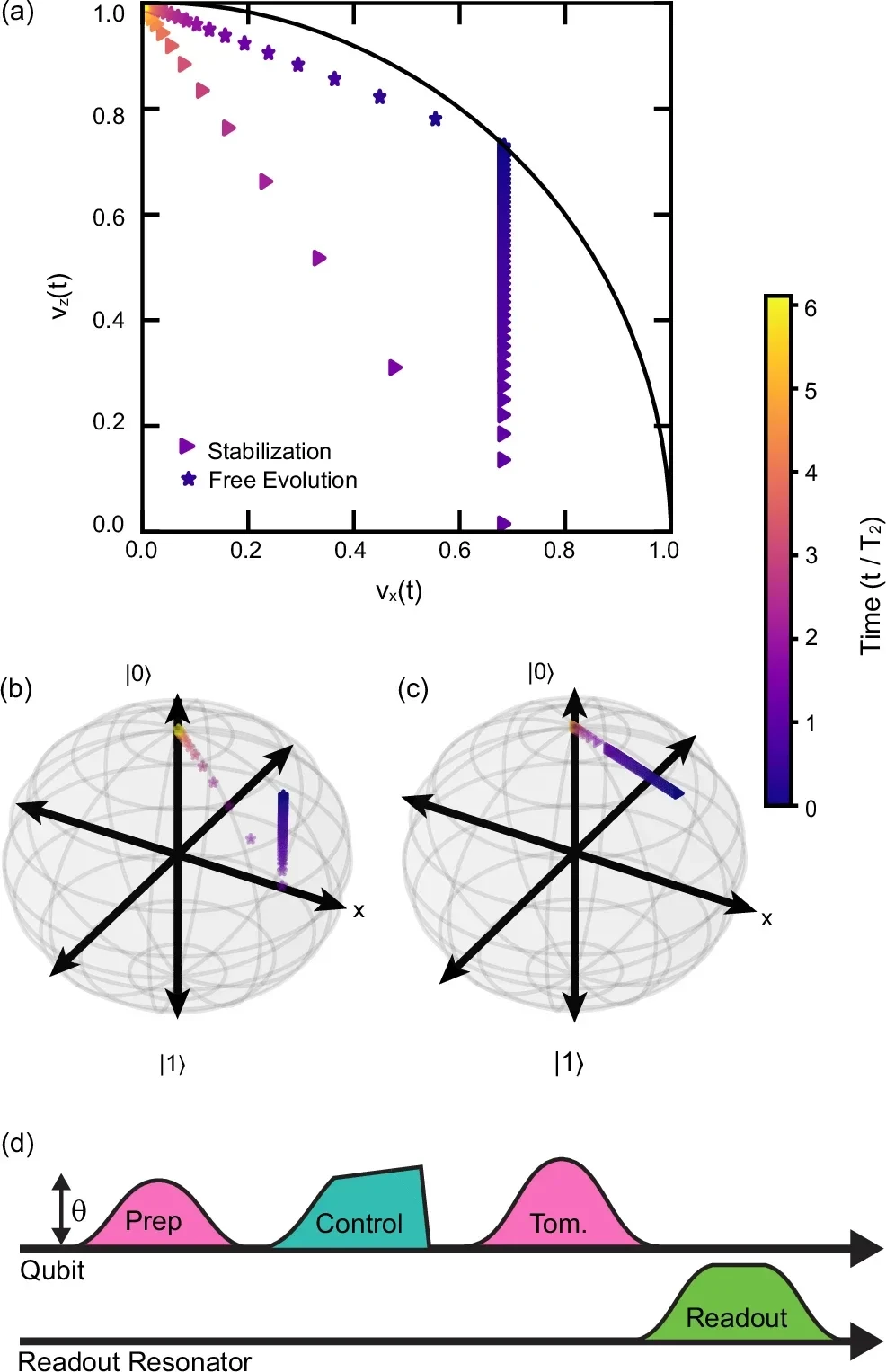
At the core of this breakthrough is a technique called a coherence-stabilized sensing protocol. Rather than letting aqubit—the basic unit of quantum information—loses stability due to environmental noise, the method applies a steady, calculated drive. This drive keeps part of the quantum state fixed, preventing certain effects of decoherence. The added stability allows the qubit's signal to grow stronger and become easier to detect.

Cracking the problem of decoherence

For decades, quantum sensing has promised extraordinary levels of precision. Quantum systems, such as atoms, photons, or superconducting qubits, can measure subtle physical quantities like temperature shifts,magnetic fields, or gravitational changes with sensitivity beyond classical devices. They do this by using quantum properties like superposition, coherence, and entanglement to capture details that ordinary sensors miss.

But there's a catch: the outside world constantly disrupts these fragile quantum states. This interference—known as decoherence—scrambles the information the sensor is trying to read. "Decoherence causes the state of a quantum system to become randomly scrambled, erasing any quantum sensing signal," explained Eli Levenson-Falk, the senior author of the study and a professor of physics, astronomy, electrical, and computer engineering at theUniversity of Southern California.

Standard sensing methods, such as Ramsey interferometry, can only go so far before decoherence erases too much of the signal. That limitation has slowed the pace of progress in practical applications, especially when detecting faint signals is essential.

How the coherence-stabilized protocol works

In the study, the USC team introduced a new driving technique to stabilize one component of the qubit's Bloch vector. The Bloch vector is a way of describing the full state of a quantum system. By locking this part in place, thequantum statekeeps coherence longer, allowing the detectable signal to grow stronger.

Related Stories

・Scientists unlock the full power of quantum computing with neglected particles

・Quantum breakthrough enables scientists to reverse the flow of time

This idea came from theoretical work by USC's Daniel Lidar and doctoral student Kumar Saurav. Lidar is a professor of engineering, chemistry, and physics. Their models predicted that a continuous driving force could counteract decoherence without extra hardware or complex feedback loops.

Lead author Malida Hecht, a physics doctoral student, compared quantum sensing to hearing a faint whisper in a noisy space. By amplifying the whisper instead of reducing the noise, the approach makes measuring tiny changes much easier. These include small shifts in a qubit's frequency that reveal critical information about the surrounding environment.

Record-breaking improvements in quantum sensing

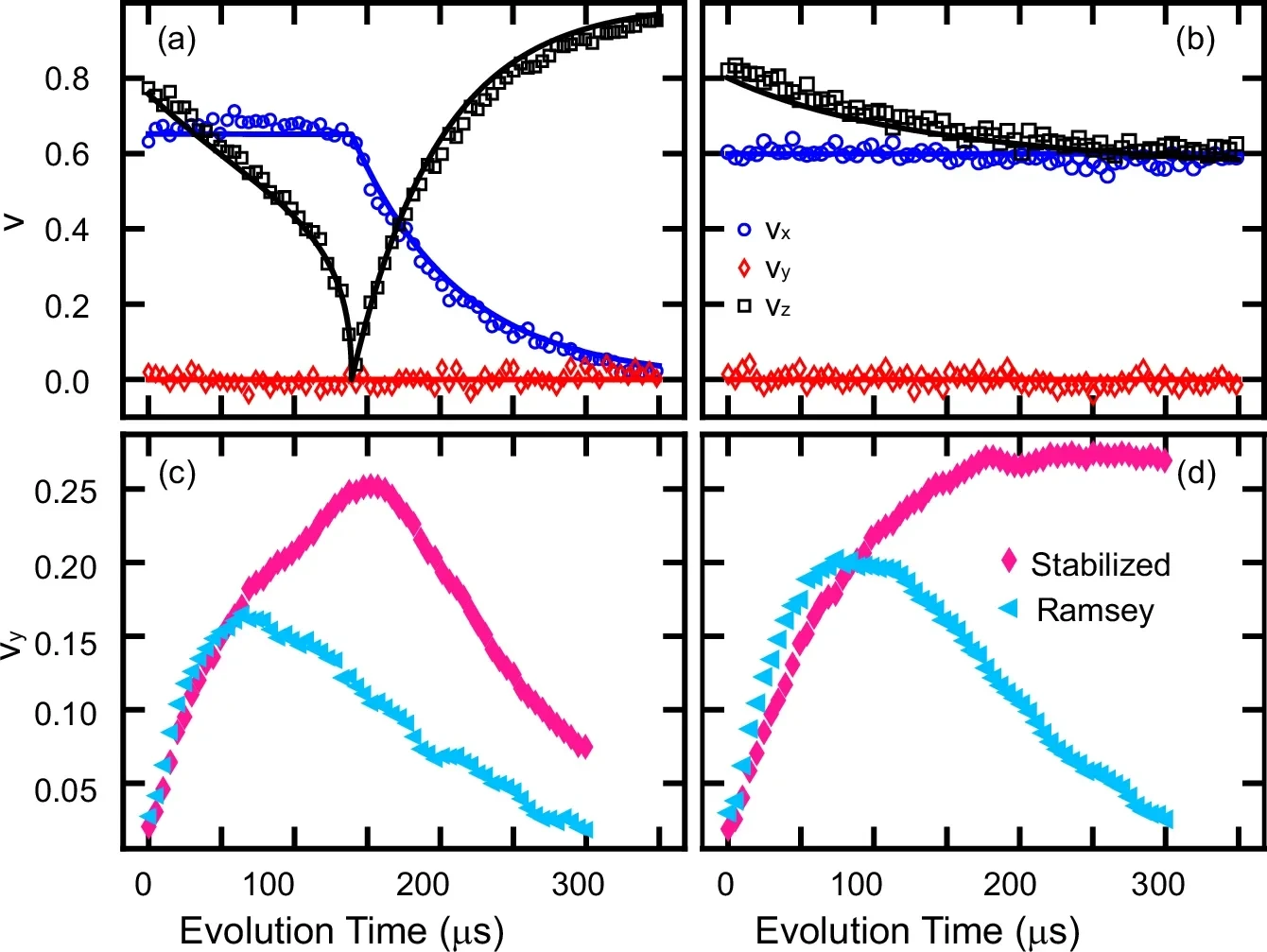
To test their method, the researchers applied it to a superconducting qubit, an essential building block forquantum computersand sensors. The results were striking: the coherence-stabilized sensing protocol improved measurement sensitivity per shot by 1.65 times compared to Ramsey interferometry. When measuring sensitivity across the full qubit evolution time, it still showed a 1.09-fold improvement.

Theoretical calculations suggest greater gains are possible in some systems—up to 1.96 times per shot and 1.18 times per evolution time. The method worked without precise fine-tuning, proving reliable even when calibration was not perfect. Levenson-Falk noted this improvement did not require adding sensors, feedback controls, or extra experimental complexity. "Our study gives the best sensitivity for detecting a qubit's frequency to date," he said. "Most importantly, our protocol requires no feedback or extra resources, making it useful across many quantum computing and sensing technologies."

Why this matters for real-world applications

Improving quantum sensor sensitivity is not just a laboratory achievement—it can directly enhance technologies that rely on detecting tiny changes in physical properties. This includes advanced medical imaging, navigation systems that work withoutGPS, and tools for probing the laws of physics at the smallest scales.

By increasing the strength of the signal before it gets lost to decoherence, the coherence-stabilized sensing protocol could extend the reach of quantum sensors into situations where signals are too faint for current technology to detect.

Levenson-Falk believes the breakthrough is only the beginning. "It also shows that we have not yet extracted all the possible information from these types of measurements," he said. "Even better sensing protocols are out there, and we could use them to make immediate real-world impacts."

The road ahead for coherence-stabilized sensing

Future research will explore how this method scales across different types of qubits and sensing environments. Because it does not rely on specialized equipment, the technique can be adapted for use in a wide variety of quantum devices already in development.

This opens the door to rapid adoption in both scientific research and industry, where better sensitivity could unlock discoveries in material science, climate studies,space exploration, and beyond. For quantum engineers, the message is clear: stabilizing part of a qubit's state isn't just possible—it's a game-changer.

Research findings are available online in the journalNature Communications.

Note: The article above provided above byThe Brighter Side of News.

Like these kind of feel good stories? GetThe Brighter Side of News' newsletter.

Scientists build first quantum device to measure volts, ohms, and amps together

For more than a century, scientists have relied on separate tools to measure the three core building blocks of electricity: volts, ohms, and amps. Each describes a different piece of how electricity behaves. The volt measures electrical pressure, the ohm measures resistance, and the amp measures current. Together they form the language of electronics, but until now, each has needed its own dedicated equipment.

Researchers at theNational Institute of Standards and Technology(NIST), working with colleagues atStanford University, theUniversity of Maryland, andUCLA, have found a way to merge all three into one machine. Their work, published inNature Electronics, shows how quantum science can deliver a new type of measuring instrument that is as accurate as the best calibration labs in the world.

The Science Inside the Box

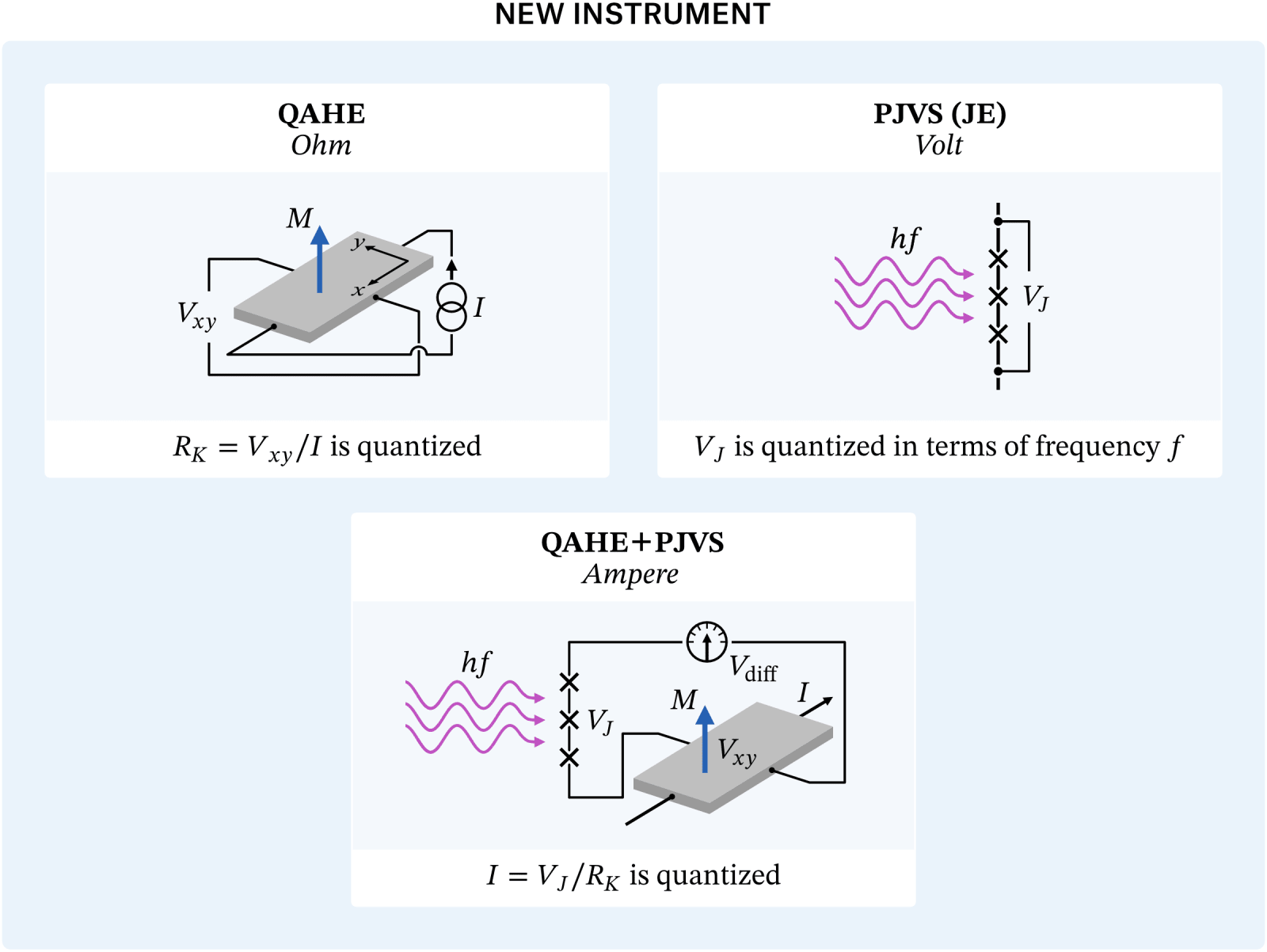
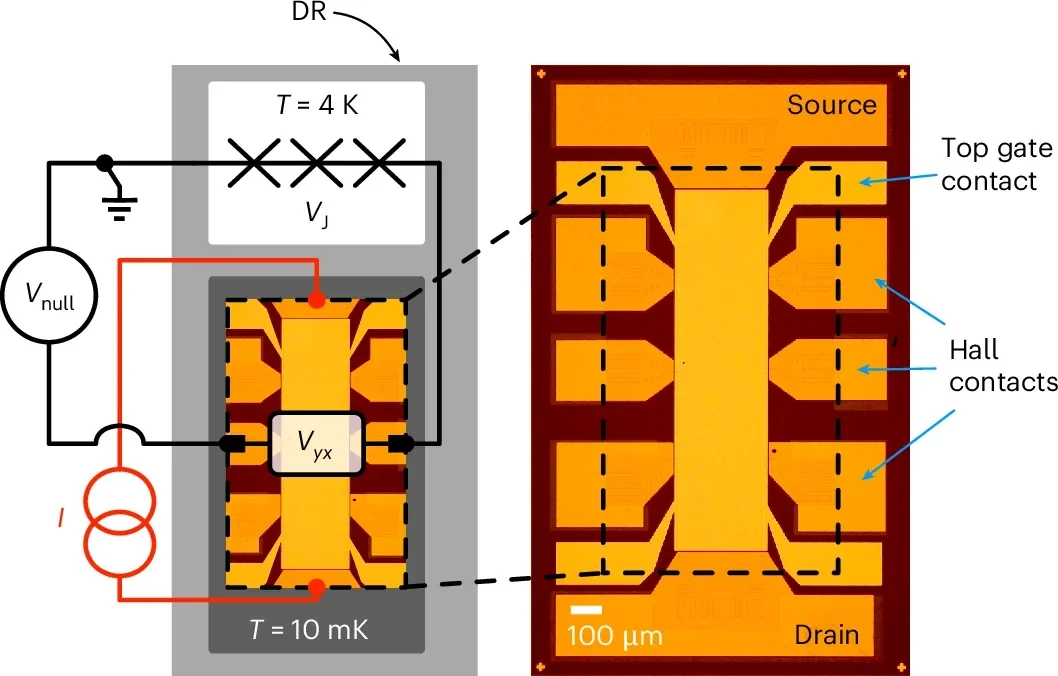
At the heart of the new device are two advanced quantum components placed in the same ultra-cold environment called a cryostat. One is the quantum anomalous Hall resistor, or QAHR. Unlike traditional resistors, the QAHR does not need a constant magnetic field to define resistance. Instead, it relies onexotic quantum behaviorin special materials cooled to just above absolute zero. With this, scientists can define the ohm with uncertainties so small—about one part in a million—that the result is nearly flawless by metrology standards.

The second component is the programmable Josephson voltage standard (PJVS). It uses the Josephson effect, a quantum process in which paired electrons tunnel across barriers between superconductors, producing voltages directly related to fundamental constants of nature. This means voltage can be set with astonishing accuracy. In the new device, the PJVS generated voltages between 0.24 millivolts and 6.5 millivolts with errors of only a few parts per million.

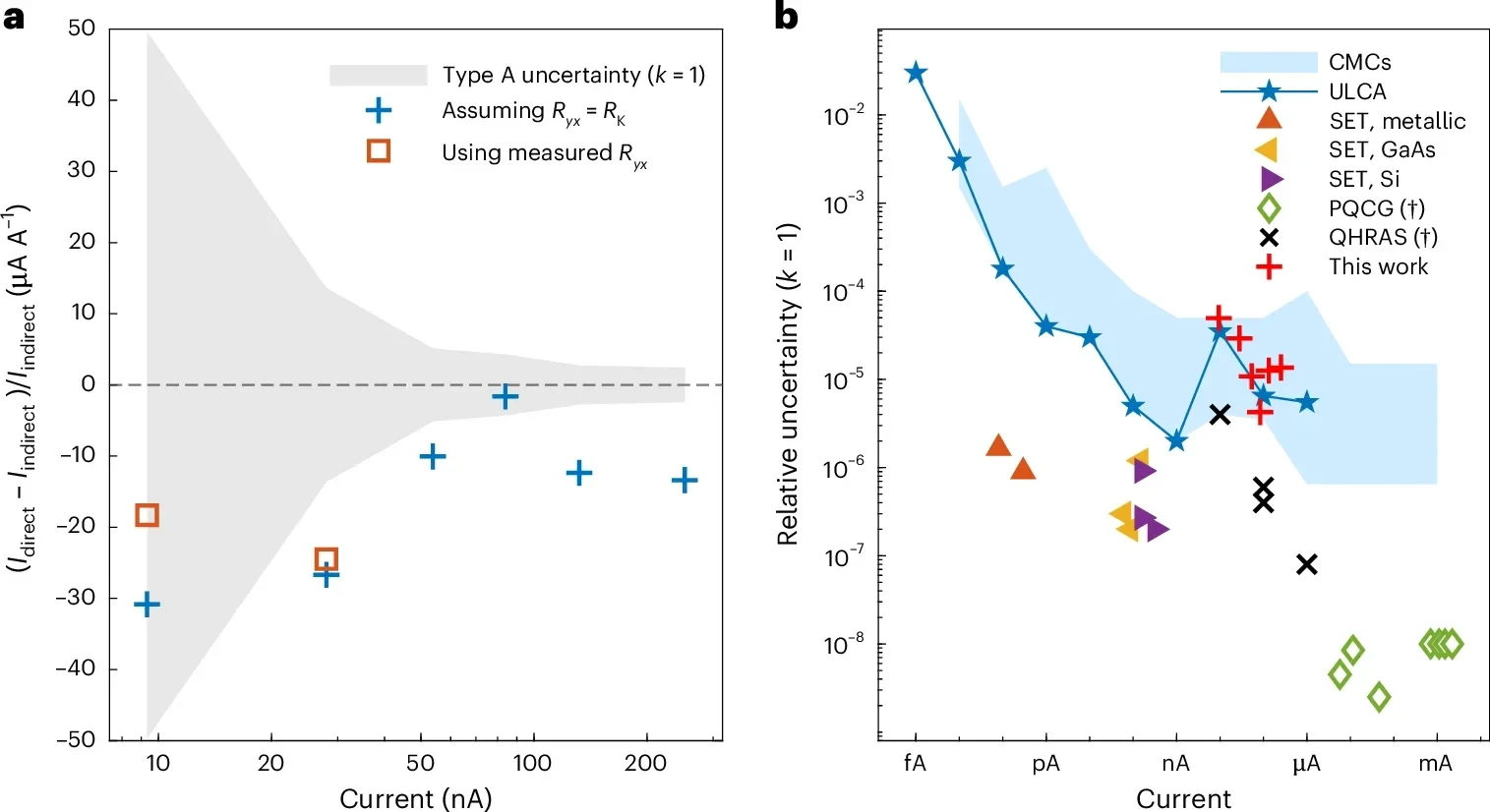
By combining the QAHR and PJVS in the same cryostat, the team created an instrument that could, for the first time, measure current directly as well. Using Ohm's law, which connectsvoltage, resistance, and current, the researchers passed a tiny current through the QAHR, measured the Hall voltage it produced, and compared it to the PJVS. This allowed them to calculate current values as small as 9.3 nanoamps, with their best uncertainty around 4.3 parts per million.

Overcoming Major Obstacles

Making this work was far from simple. For decades, scientists struggled to unify voltage, resistance, and current in one setup. The problem came from the fact that the traditional quantumHall effect, used to define the ohm, requires magnetic fields six to nine times stronger than those in a hospital MRI scanner. Those fields cause superconducting devices like the PJVS to fail.

Related Stories

・Caltech researchers use sound to extend quantum data storage 30 times longer

・Scientists unlock the full power of quantum computing with neglected particles

The breakthrough came in 2013, when researchers discovered the quantum anomalous Hall effect (QAHE). This version of the Hall effect only requires a small magnetic field to "set" the sample, and once magnetized, the field can be turned off. That opened the door to placing a QAHR and a PJVS in the same cryostat without them interfering with each other.

Even so, the new system still operates at extremeCryogenic temperatures—just one-hundredth of a degree above absolute zero. That requires a refrigeration system that occupies several square meters of lab space.

Jason Underwood, a NIST researcher involved in the project, called the prototype "proof that practical integration is feasible." But he also acknowledged that widespread adoption will take time, as scientists search for new materials that can exhibit QAHE at higher, easier-to-maintain temperatures.

Toward a Portable Standard

Despite its current size, the team envisions a future where the instrument shrinks into something far more compact. If new QAHE materials can function at higher cryogenic temperatures, the cooling systems could be reduced to fit in a standard rack of equipment—about the size of aHousehold refrigerator. That would make the tool portable and much easier for industry labs to use.

Right now, many companies that need highly accurate electrical calibration must ship their devices to NIST or similar labs abroad. With an integrated instrument like this, engineers could check their own equipment in-house, saving time and money. Even a simplified version of the device with slightly lower accuracy could still be useful for most calibration needs. As Underwood explained, "The uncertainties just have to be low enough to meet the customer's calibration goals."

Precision That Shapes the World

The importance of volts,ohms, and amps go far beyond textbooks. They underpin the functioning of power grids, the development of electronics, and the accuracy of medical devices. In 2019, the international metric system redefined these electrical units using fundamental constants rather than physical objects. That shift marked a move toward more universal standards, and the new quantum device fits perfectly into that framework.

By linking measurements directly to the constants of nature, scientists can ensure that values are the same everywhere in the world. This is vital for global trade, defense technology, and advanced research. In technical terms, the prototype achieves precision comparable to the best national metrology institutes worldwide. In practical terms, it could one day allow your phone, your car, or even your hospital equipment to rely on calibrations that trace back not to a laboratory artifact, but to the veryLaws of physics.

Practical Implications of the Research

This work could transform how electrical measurements are made and maintained. Instead of relying on large, separate, and expensive setups, labs might use a single rack-mounted device to define volts, ohms, and amps with quantum-level precision. That means faster and cheaper calibration for industries from electronics manufacturing to health care.

More reliable standards could improve everything from consumer devices tomilitary systems, while also advancing materials science as researchers strive to find compounds that exhibit the quantum anomalous Hall effect at higher temperatures.

Note: The article above provided above byThe Brighter Side of News.

Like these kinds of feel-good stories? GetThe Brighter Side of News' newsletter.

Friday, August 22, 2025

Scientists discover portal to other dimensions?

A groundbreaking discovery in the field of physics has scientists excited about the potential confirmation of a portal to other dimensions. While the concept seems like science fiction, recent findings suggest that our universe might be more interconnected than previously thought. This exploration delves into the scientific basis, implications, and future prospects of this astonishing discovery.

Theoretical Foundations of Dimensional Portals

The concept of dimensions in physics plays a crucial role in our understanding of the universe. Traditionally, we experience the world in three spatial dimensions and one temporal dimension, making up the fabric of our known universe. However, theories like String Theory propose the existence of additional dimensions beyond our perception. These theories suggest that our universe might be part of a larger multidimensional landscape, where these extra dimensions are compactified or hidden from direct observation.

Historically, the idea of multiple dimensions was relegated to theoretical physics until the advent of String Theory and its extension, M-theory. These frameworks suggest that the fundamental particles of our universe are not point-like but rather tiny, vibrating strings, and their modes of vibration determine the particles' properties. The success of these theories in unifying fundamental forces has led to serious consideration of the existence of other dimensions. Recent advancements in theoretical physics, particularly in quantum mechanics and cosmology, have paved the way for exploring the possibility ofdimensional portals.

The Discovery: A Closer Look

The recent discovery, which has sent ripples through the scientific community, is based on observations and experiments that hint at the existence of a portal to another dimension. Scientists have been examining anomalies in particle behavior that could indicate interactions with other dimensions. These findings are supported by cutting-edge technology such as particle accelerators and quantum computers, which allow researchers to probe beyond the limits of traditional physics.

Insights from the research teams involved reveal a meticulous process of observation and experimentation. Utilizing advanced methods such as high-energy particle collisions, scientists have gathered evidence that supports the potential existence of a dimensional portal. The credibility of these findings is bolstered by rigorous peer review and the involvement of reputable institutions. The scientific community’s reception to these findings has been one of cautious optimism, with many researchers calling for further investigation to confirm the results.

Potential Implications and Applications

The implications of this discovery are profound for our understanding of the universe and fundamental physics. If confirmed, the existence of a dimensional portal could revolutionize our conception of space and time, offering new insights into the nature of reality. The discovery could also have speculative applications in technology, communication, and transportation, potentially allowing for faster-than-light travel or instantaneous communication across vast distances.

However, the exploration and utilization of such portals come with significant ethical considerations and potential risks. The possibility of interacting with other dimensions raises questions about the impact on our own universe and the potential for unintended consequences. As humanity stands on the brink of a new frontier, careful consideration must be given to the ethical implications of such exploration. Discussions within the scientific community are ongoing, as researchers weigh the potential benefits against the risks of venturing into the unknown.

Challenges and Skepticism

Despite the excitement surrounding this discovery, significant scientific challenges and unanswered questions remain. One of the primary challenges is understanding how these portals function and the mechanisms that allow for interaction between dimensions. Additionally, the energy requirements and stability of such portals are areas of active research, with scientists striving to develop models that accurately describe these phenomena.

Criticism and skepticism from within the scientific community are an integral part of the process, ensuring that findings are robust and reliable. Some researchers argue that the evidence for dimensional portals is not yet conclusive and that alternative explanations for the observed phenomena must be considered. The role of peer review is crucial in this process, as it allows for independent verification and validation of the research. Further studies and experiments are needed to address these concerns and provide a more comprehensive understanding of the discovery.

Future Prospects and Exploration

As scientists continue to explore this intriguing possibility, the next steps involve expanding research efforts and collaboration between international research institutions and organizations. The potential of dimensional portals necessitates a multidisciplinary approach, drawing on expertise from fields such as physics, engineering, and computer science. Collaborative efforts will be essential in advancing our understanding and developing technologies to explore these portals safely and effectively.

Long-term visions for humanity's interaction with multiple dimensions are both exciting and daunting. If dimensional portals prove to be viable, they could open up new avenues for exploration and discovery, fundamentally altering our place in the cosmos. The journey ahead is one of great promise and potential, as we stand on the cusp of a new era in our understanding of the universe. Researchers and enthusiasts alike are encouraged to follow developments closely, as the unfolding story of dimensional portals continues to captivate and inspire.

Scientists Are About to Change the Way We Measure Electricity Forever

Here's what you'll learn when you read this story:

  • Scientists and engineers need reliable tools that can calculate the international standards for current, voltage, and resistance.
  • Typically, this requires laboratories to send equipment to the National Institute of Standards and Technology (NIST), who then use two types of quantum devices to calibrate these standards based on fundamental constants of nature.
  • But a new technique for measuring ohms, known as the quantum anomalous Hall effect (QAHE), makes the combination of these two devices possible.

Everything from high-flying planes to the smallest of microchips is reliant on accurateelectricalstandards, measurements based on the fundamental constants of nature that can help calibrate equipment used to power the foundation of our modern world. Typically, laboratories ship equipment to the National Institute of Standards and Technology (NIST) to test for voltage (volt), resistance (ohm), and current (ampere) for calibration. Each device would be tested with a separate cryostat—a device for maintaining the seriously cold temperatures necessary for calibration.

Now, this outdated system may soon become a relic of the past. In a new paper published in the journalNature Electronics, scientists at NIST successfully developed an all-in-one, four-square-meterdevicethat can calibrate ohms, amperes, and volts at the same time.

The quantum ampere (amp) standard is "the amount of charge carried by 6.24 billion billion electrons past a given point in one second," according to NIST, while volts require theProgrammable Josephson Voltage Standard, which uses specialized chips that produce hyper-accurate voltages once a microwave signal is applied. And since 1990, the unit of ohms has been based on thequantumHall effect (QHE), which describes how thin sheets (only one atom wide) take on quantized values based on nature. These sheets are cooled to 4 Kelvin, and a powerful magnetic field flows perpendicular to the current flow in the sheets.

This strongmagnetic fieldFor testing the ohm, this is why scientists have previously failed to create an all-in-one calibration device. But a new type of quantized resistance technique - known as quantum anomalous Hall effect (QAHE) - requires only one-fifth to one-fortieth of the magnetic field needed for QHE (though, the sheets need to be cooled even further, down to about 0.01 Kelvin). This "Swiss army knife for electrical standards," as NIST calls it, could finally allow scientists to calibrate instruments in their own laboratories to international standards.

This earlyprototype"is proof that practical integration is feasible," said Jason Underwood, a NIST researcher and co-author of the study,said in a press statementAlthough we always aim to reduce our uncertainties, a deployable calibration instrument does not necessarily have to achieve uncertainties as small as those of national metrology institute standards.

However, NIST emphasizes that laboratories probably will not see these devices in the near future, as the equipment used to producetemperaturesrequired for QAHE includes massive refrigeration systems. The hope is that experts will find future materials that display this effect at higher temperatures, which could make NIST’s prototype a more practical, portable cryostat for use in laboratories around the globe. And the good news is that the temperature wouldn't actually need to be increased by very much.

As the performance of QAHE materials improves, we can significantly reduce the size of the cryostat, especially if we can achieve a robust QAHE at temperatures above 0.1 Kelvin," Underwood said in a press statement. "The cryogenic hardware at those higher temperatures is much more compact and portable.

So, while missing one of the key features of aSwiss Army Knife—Portability—this QAHE-enabled calibration prototype proves that such a future machine is at least possible.

Imperfect light sources achieve new benchmark in secure quantum communication

A team of physicists at the Hebrew University of Jerusalem has made a breakthrough that could bring secure quantum communication closer to everyday use - without needing flawless hardware.

Subscribe to ournewsletterfor the latest science and technology news updates.

The research, led by Ph.D. students Yuval Bloom and Yoad Ordan, under the guidance of Professor Ronen Rapaport from the Racah Institute of Physics at Hebrew University in collaboration with researchers from Los-Alamos National Labs, andpublishedinPRX Quantum, introduces a new practical approach that significantly improves how we send quantum encrypted information using light particles—even when using imperfect equipment.

For four decades, the holy grail of quantum key distribution (QKD) - the science of creating unbreakable encryption using quantum mechanics - has depended on one elusive requirement: perfectly engineered single-photon sources. These are tiny light sources that can emit one particle of light (photon) at a time. But in practice, building such devices with absolute precision has proven extremely difficult and expensive.

To work around that, the field has relied heavily on lasers, which are easier to produce but not ideal. These lasers send faint pulses of light that contain a small, but unpredictable, number of photons—a compromise that limits both security and the distance over which data can be safely transmitted, as a smart eavesdropper can "steal" the information bits that are encoded simultaneously on more than one photon.

A better way with imperfect tools

Bloom, Ordan, and their team turned the tables. Instead of waiting for perfect photon sources, they developed two new protocols that work with what we have now - sub-Poissonian photon sources based on quantum dots, which are tiny semiconductor particles that behave like artificial atoms.

By dynamically engineering the optical behavior of these quantum dots and pairing them with nanoantennas, the team was able to tweak how the photons are emitted. This fine-tuning allowed them to suggest and demonstrate two advanced encryption strategies:

  • A truncated decoy state protocol: A new version of a widely used quantum encryption approach, tailored for imperfect single photon sources, that eliminates potential hacking attempts caused by multi-photon events.
  • A heralded purification protocol: A new method that dramatically improves signal security by "filtering" the excess photons in real time, ensuring that only true single photon bits are recorded.

In simulations and lab experiments, these techniques outperformed even the best versions of traditional laser-based QKD methods—extending the distance over which a secure key can be exchanged by more than 3 decibels, a substantial leap in the field.

A real-world test and a step toward practical quantum networks

To prove it wasn't just theory, the team built a real-world quantum communication setup using a room-temperature quantum dot source. They ran their new reinforced version of the well-known BB84 encryption protocol—the backbone of many quantum key distribution systems—and showed that their approach was not only feasible but superior to existing technologies.

What's more, their approach is compatible with a wide range of quantum light sources, potentially lowering the cost and technical barriers to deploying quantum-secure communication on a large scale.

This is a significant step toward practical, accessible quantum encryption," said Professor Rapaport. "It shows that we don't need perfect hardware to achieve exceptional performance—we just need to be smarter about how we use what we have.

Co-Lead author Yuval Bloom added, "We hope this work helps open the door to real-world quantum networks that are both secure and affordable. The cool thing is that we don't have to wait, it can be implemented with what we already have in many labs around the world"

More information:Yuval Bloom et al., Decoy-State and Purification Protocols for Superior Quantum Key Distribution with Imperfect Quantum-Dot-Based Single-Photon Sources: Theory and Experiment,PRX Quantum(2025)DOI: 10.1103/7fdd-m92n

Provided by the Hebrew University of Jerusalem

This story was originally published onThe Shiro Copr.