Showing posts with label electric batteries. Show all posts

Wednesday, May 27, 2026

Power Up Anytime: Milwaukee M18 HotShot Jump Starter

Featured Image

Milwaukee M18 HotShot Jump Starter: A Powerful Solution for Reviving Dead Batteries

Jump starters are essential tools for professionals and everyday users alike. Over the years, numerous models have been tested to determine their effectiveness in real-world situations. Many of these devices rely on a small self-contained battery, which is suitable for slightly undercharged batteries. However, the Milwaukee M18 HotShot Jump Starter takes a different approach, offering a unique combination of power, durability, and versatility.

The Milwaukee M18 HotShot Jump Starter stands out with its impressive specifications. It delivers up to 2000 peak amps, making it capable of jump-starting vehicles with engines as large as 8.1L for gas and 3.0L for diesel. This level of power ensures that even the most stubborn dead batteries can be revived with ease. The unit works with the full line of M18 batteries, allowing users to choose the battery size that best suits their needs.

Performance and Capabilities

One of the key features of the HotShot Jump Starter is its ability to operate in extreme temperatures, ranging from -4°F to 122°F. This makes it ideal for use in both cold winter mornings and hot summer days. The capacitors within the unit are rated for up to 500,000 cycles, ensuring long-term reliability and durability.

The HotShot’s power output is not dependent on the size of the battery used. Instead, the battery serves to pre-charge the capacitors, which then deliver the necessary power to the vehicle's battery. This means that even smaller M18 batteries can be used effectively, although larger batteries like the kitted 8.0Ah Forge battery will provide more jump start cycles.

Control Panel and User Interface

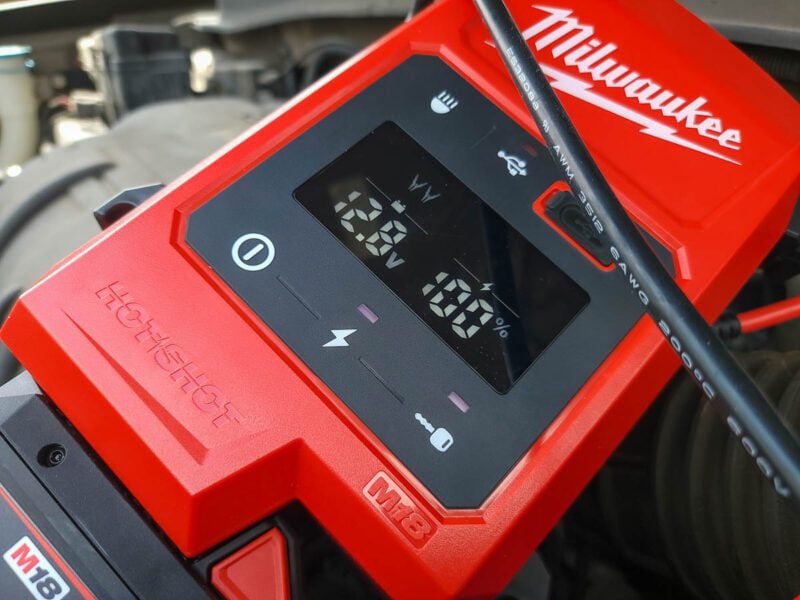
The control panel on the HotShot Jump Starter is designed to be user-friendly and informative. It displays the current charge level on the capacitors and provides a voltage reading for the vehicle battery. This feature is particularly useful, as it allows users to assess the condition of the battery before attempting a jump start.

Using the HotShot is straightforward. Start by pairing it with a fresh M18 battery and press the power button to activate the unit. Then, press the charge capacitor button, indicated by a lightning bolt symbol, and connect the clamps. Finally, press the jump start button, marked with a key, and start the car within 30 seconds.

It is important to follow the correct polarity when connecting the clamps: red to red and black to black. In case of accidental reverse polarity, the unit has built-in protection that alerts the user before any damage occurs.

Override Mode for Low Voltage

If the battery voltage reads below 1.2V, the user must manually engage the override mode. This involves following the same steps as outlined above and pressing and holding the “start engine” button until the override icon illuminates. A countdown timer will appear, giving the user a set amount of time to attempt the jump start.

Design and Build Quality

The Milwaukee 3841 model is designed with practicality in mind. It weighs 6.9 pounds as a bare tool and 9.3 pounds when paired with the 8.0Ah Forge battery. This makes it significantly lighter than many traditional lead-acid battery-powered jump starters, making it easier to handle and transport.

The cable management system is well-designed, with 22.5-inch cables that neatly stow away on either side of the unit. The clamps are equipped with high-strength springs and an aggressive tooth design, ensuring a secure connection with the battery terminals. Their narrow design also provides better access in tight engine bays and battery compartments.

Additional Features

Beyond its primary function, the HotShot Jump Starter offers several additional features. It includes a USB-C port for charging personal electronics, a retracting top handle for easy carrying, and impact-resistant construction. The unit is also IP65 rated, providing protection against dust and water. Additionally, it features a 500-lumen task light, which is useful for working in low-light conditions.

Price and Warranty

The Milwaukee M18 HotShot Jump Starter is available as a bare tool for $299 or as a kit that includes an 8.0Ah Forge battery and charger for $578. The product comes with a 3-year limited warranty, offering peace of mind to users.

Final Thoughts

Overall, the Milwaukee M18 HotShot Jump Starter is a powerful, durable, and user-friendly solution for reviving dead vehicle batteries in various environments. Its impressive power output, rugged construction, and smart design features make it a standout choice for both professionals and DIY enthusiasts. The ability to deliver peak power output using any M18 battery is a significant advantage over traditional jump packs, making it a compelling option for roadside crews and mechanics.

Saturday, November 22, 2025

Battery Tech Rivalry Drives EV Evolution

Featured Image

The Evolution of Battery Technology and Its Impact on the Future of Electric Vehicles

The global race to develop new battery technologies is accelerating, with startups and established companies alike exploring alternatives to traditional lithium-ion batteries. These innovations aim to reduce costs, minimize reliance on critical minerals, and support the growing demand for electric vehicles (EVs). As the EV market expands, so does the need for diverse and sustainable energy storage solutions.

Current Battery Technologies in Use

Several battery types are currently being used or explored for different applications. Some of these have been around for decades, while others are emerging as potential game-changers.

Lead Batteries

Lead batteries are commonly used in conventional internal combustion engine vehicles for starting the engine. They are inexpensive and perform well in extreme conditions. However, they are heavy and have low energy density, making them unsuitable for modern EVs.

Nickel-Cadmium (Ni-CD) and Nickel-Metal Hydride (Ni-MH)

Nickel-cadmium batteries are rechargeable but have largely been replaced by more advanced technologies. Nickel-metal hydride batteries were used in early hybrid vehicles, such as Toyota's first Prius in 1997. They offer better performance than Ni-CD but still fall short compared to newer options.

Sodium-Nickel Chloride

This type of battery has been used in the Venturi Automobiles fleet for the French postal service. It is compact and can be integrated into existing vehicle designs without major modifications. However, its top speed and range are limited, making it suitable for short-range applications.

Lithium Metal Polymer (LMP)

LMP batteries were used in the Bolloré Pininfarina BlueCar and Autolib car-sharing service in Paris, both of which have since been discontinued. Today, this technology is mainly used for stationary storage and public transportation. It offers a "dry" design that simplifies the manufacturing process, but it requires careful temperature control.

Lithium-Ion: The Dominant Force

Lithium-ion batteries are the most widely used today, found in everything from smartphones to electric cars. First commercialized in 1991 by Sony, they offer high energy density, fast charging capabilities, and no memory effect. However, they are sensitive to temperature changes and vibrations, and their liquid electrolyte poses risks of overheating.

Two key families of lithium-ion batteries dominate the EV market:

NMC (Nickel Manganese Cobalt)

NMC batteries provide high energy density, making them ideal for larger vehicles. However, they rely heavily on cobalt, which is primarily sourced from the Democratic Republic of Congo. The extraction of cobalt raises significant ethical and strategic concerns.

LFP (Lithium Iron Phosphate)

LFP batteries eliminate the need for cobalt, making them more affordable and safer. They are particularly suited for smaller vehicles. However, their energy density is lower than that of NMC batteries.

Emerging Alternatives

As the industry seeks alternatives to lithium-ion, several promising technologies are under development.

Sodium-Ion

Sodium-ion batteries replace lithium with sodium, which is more abundant and less expensive. They are non-flammable, can withstand up to 50,000 recharge cycles, and are easier to source. However, their energy density is lower, and the supply chain for this technology is still in its infancy.

LNMO (Lithium Nickel Manganese Oxide)

Renault is developing LNMO technology, which aims to combine the high energy density of NMC with the cost-effectiveness and safety of LFP. It also promises faster charging times. However, it is still in the development phase and not yet commercially available.

Lithium-Sulfur

Lithium-sulfur batteries have the potential to double the energy density of lithium-ion batteries. They also eliminate the need for nickel, cobalt, and manganese, reducing dependency on rare materials. This technology is backed by U.S. startup Lyten and is expected to be deployed by 2028.

Solid-State Batteries

Solid-state batteries use a solid electrolyte instead of a liquid one, offering higher energy density, lighter weight, and improved safety. Despite these advantages, they are still in the research and development stage, with no large-scale production yet.

The Road Ahead

As the automotive industry continues to evolve, the development of alternative battery technologies will play a crucial role in shaping the future of electric mobility. While lithium-ion remains dominant, the push for sustainability, cost reduction, and resource independence is driving innovation across the board. The coming years will likely see a diversification of battery options, each tailored to specific needs and applications.

Battery Tech Rivalry Drives EV Evolution

Featured Image

The Evolution of Battery Technology and Its Impact on the Future of Electric Vehicles

The global race to develop new battery technologies is accelerating, with startups and established companies alike exploring alternatives to traditional lithium-ion batteries. These innovations aim to reduce costs, minimize reliance on critical minerals, and support the growing demand for electric vehicles (EVs). As the EV market expands, so does the need for diverse and sustainable energy storage solutions.

Current Battery Technologies in Use

Several battery types are currently being used or explored for different applications. Some of these have been around for decades, while others are emerging as potential game-changers.

Lead Batteries

Lead batteries are commonly used in conventional internal combustion engine vehicles for starting the engine. They are inexpensive and perform well in extreme conditions. However, they are heavy and have low energy density, making them unsuitable for modern EVs.

Nickel-Cadmium (Ni-CD) and Nickel-Metal Hydride (Ni-MH)

Nickel-cadmium batteries are rechargeable but have largely been replaced by more advanced technologies. Nickel-metal hydride batteries were used in early hybrid vehicles, such as Toyota's first Prius in 1997. They offer better performance than Ni-CD but still fall short compared to newer options.

Sodium-Nickel Chloride

This type of battery has been used in the Venturi Automobiles fleet for the French postal service. It is compact and can be integrated into existing vehicle designs without major modifications. However, its top speed and range are limited, making it suitable for short-range applications.

Lithium Metal Polymer (LMP)

LMP batteries were used in the Bolloré Pininfarina BlueCar and Autolib car-sharing service in Paris, both of which have since been discontinued. Today, this technology is mainly used for stationary storage and public transportation. It offers a "dry" design that simplifies the manufacturing process, but it requires careful temperature control.

Lithium-Ion: The Dominant Force

Lithium-ion batteries are the most widely used today, found in everything from smartphones to electric cars. First commercialized in 1991 by Sony, they offer high energy density, fast charging capabilities, and no memory effect. However, they are sensitive to temperature changes and vibrations, and their liquid electrolyte poses risks of overheating.

Two key families of lithium-ion batteries dominate the EV market:

NMC (Nickel Manganese Cobalt)

NMC batteries provide high energy density, making them ideal for larger vehicles. However, they rely heavily on cobalt, which is primarily sourced from the Democratic Republic of Congo. The extraction of cobalt raises significant ethical and strategic concerns.

LFP (Lithium Iron Phosphate)

LFP batteries eliminate the need for cobalt, making them more affordable and safer. They are particularly suited for smaller vehicles. However, their energy density is lower than that of NMC batteries.

Emerging Alternatives

As the industry seeks alternatives to lithium-ion, several promising technologies are under development.

Sodium-Ion

Sodium-ion batteries replace lithium with sodium, which is more abundant and less expensive. They are non-flammable, can withstand up to 50,000 recharge cycles, and are easier to source. However, their energy density is lower, and the supply chain for this technology is still in its infancy.

LNMO (Lithium Nickel Manganese Oxide)

Renault is developing LNMO technology, which aims to combine the high energy density of NMC with the cost-effectiveness and safety of LFP. It also promises faster charging times. However, it is still in the development phase and not yet commercially available.

Lithium-Sulfur

Lithium-sulfur batteries have the potential to double the energy density of lithium-ion batteries. They also eliminate the need for nickel, cobalt, and manganese, reducing dependency on rare materials. This technology is backed by U.S. startup Lyten and is expected to be deployed by 2028.

Solid-State Batteries

Solid-state batteries use a solid electrolyte instead of a liquid one, offering higher energy density, lighter weight, and improved safety. Despite these advantages, they are still in the research and development stage, with no large-scale production yet.

The Road Ahead

As the automotive industry continues to evolve, the development of alternative battery technologies will play a crucial role in shaping the future of electric mobility. While lithium-ion remains dominant, the push for sustainability, cost reduction, and resource independence is driving innovation across the board. The coming years will likely see a diversification of battery options, each tailored to specific needs and applications.

Monday, November 17, 2025

Factbox: Battery Rivals Drive the EV Revolution

Featured Image

The Evolution of Battery Technology for Electric Vehicles

As the demand for electric vehicles (EVs) continues to grow, startups around the world are actively exploring new battery technologies that utilize materials like sodium and sulfur or other innovative chemistries. These efforts aim to reduce costs and decrease reliance on critical minerals, which have long been a point of concern in the EV industry.

China currently dominates the global battery cell production landscape, controlling 85% of the market. Additionally, it accounts for 90% of the processing of raw materials used in two lithium-ion variants that currently dominate the EV market. Despite this dominance, battery technology is evolving rapidly, though the fundamental principles remain largely unchanged. A typical battery consists of three key components: a cathode, an anode, and an electrolyte.

With carmakers evaluating long-term options, various battery types are either in use or under development. Let’s explore some of these technologies:

Lead Batteries

Lead batteries have been traditionally used in 6 or 12-volt systems to power car starters. They offer advantages such as being inexpensive and functional in extreme conditions. However, they are heavy and have low energy capacity, making them less suitable for modern EV applications.

Nickel-Cadmium (Ni-CD) and Nickel-Metal Hydride (Ni-MH)

Nickel-cadmium batteries are rechargeable and have been used in various applications. Nickel-metal hydride batteries were notably used in Toyota's first Prius model in 1997, serving as a precursor to hybrid technology.

Sodium-Nickel Chloride

This type of battery has found use in the Venturi Automobiles fleet for the French postal service. It offers advantages such as a smaller size, allowing it to be fitted into existing vehicles without requiring major modifications. However, its performance is limited, with a top speed of 100 km/h and a range of only 100 km.

Lithium-Metal Polymer (LMP)

Once used in models like the Bolloré Pininfarina BlueCar and the Parisian car-sharing service Autolib, LMP technology is now primarily used for stationary storage, buses, and trams. Its "dry" technology, based on the capacitor principle, makes it easier to produce industrially. However, it requires preheating and maintaining a specific temperature, which can be a drawback.

Lithium-Ion Batteries

Lithium-ion batteries are the most widely used today, found in phones, laptops, electric cars, and other devices. First commercialized in 1991 by Sony, they offer high energy density and versatile charging options. However, they are sensitive to external conditions like cold weather and vibrations, and their liquid nature poses risks of overheating.

Two Dominant Lithium-Ion Technologies

Two families of lithium-ion batteries dominate the EV market:

NMC (Nickel Manganese Cobalt)

NMC batteries offer high energy density but come at a higher cost, making them more suitable for larger vehicles. Cobalt, a key component, is mainly sourced from the Democratic Republic of Congo, where ethical and strategic concerns about mining practices persist.

LFP (Lithium Iron Phosphate)

LFP batteries eliminate the need for cobalt, offering a more affordable option suitable for smaller vehicles. However, their energy density is lower compared to NMC batteries.

Sodium-Ion Batteries

Sodium-ion batteries present a promising alternative by eliminating the need for lithium, nickel, and cobalt. These metals are currently in high demand, while sodium is more abundant and cheaper to extract. Sodium-ion batteries are non-flammable and can withstand up to 50,000 recharge cycles, significantly more than lithium-ion batteries. However, they currently face challenges with lower energy density and limited supply.

LNMO (Lithium Nickel Manganese Oxide)

Renault is developing LNMO technology, which aims to combine the energy density of NMC, the cost and safety of LFP, and fast recharge times of less than 15 minutes. While promising, this technology is still in the development phase.

Lithium-Sulfur Batteries

Lithium-sulfur batteries, backed by companies like Lyten, claim to offer more than twice the energy density of lithium-ion batteries. They also eliminate the need for nickel, cobalt, and manganese, providing greater independence due to the potential for local sourcing of raw materials. However, large-scale deployment is expected no earlier than 2028.

Solid-State Batteries

Solid-state batteries replace the liquid electrolyte in traditional lithium-ion batteries with a solid one, such as polymer or ceramic. This design offers higher energy density, lighter weight, and improved safety. However, they are still under development and have not yet reached large-scale production.

As the automotive industry continues to evolve, the development of new battery technologies will play a crucial role in shaping the future of electric mobility.

Factbox: Battery Rivals Drive the EV Revolution

Featured Image

The Evolution of Battery Technology for Electric Vehicles

As the demand for electric vehicles (EVs) continues to grow, startups around the world are actively exploring new battery technologies that utilize materials like sodium and sulfur or other innovative chemistries. These efforts aim to reduce costs and decrease reliance on critical minerals, which have long been a point of concern in the EV industry.

China currently dominates the global battery cell production landscape, controlling 85% of the market. Additionally, it accounts for 90% of the processing of raw materials used in two lithium-ion variants that currently dominate the EV market. Despite this dominance, battery technology is evolving rapidly, though the fundamental principles remain largely unchanged. A typical battery consists of three key components: a cathode, an anode, and an electrolyte.

With carmakers evaluating long-term options, various battery types are either in use or under development. Let’s explore some of these technologies:

Lead Batteries

Lead batteries have been traditionally used in 6 or 12-volt systems to power car starters. They offer advantages such as being inexpensive and functional in extreme conditions. However, they are heavy and have low energy capacity, making them less suitable for modern EV applications.

Nickel-Cadmium (Ni-CD) and Nickel-Metal Hydride (Ni-MH)

Nickel-cadmium batteries are rechargeable and have been used in various applications. Nickel-metal hydride batteries were notably used in Toyota's first Prius model in 1997, serving as a precursor to hybrid technology.

Sodium-Nickel Chloride

This type of battery has found use in the Venturi Automobiles fleet for the French postal service. It offers advantages such as a smaller size, allowing it to be fitted into existing vehicles without requiring major modifications. However, its performance is limited, with a top speed of 100 km/h and a range of only 100 km.

Lithium-Metal Polymer (LMP)

Once used in models like the Bolloré Pininfarina BlueCar and the Parisian car-sharing service Autolib, LMP technology is now primarily used for stationary storage, buses, and trams. Its "dry" technology, based on the capacitor principle, makes it easier to produce industrially. However, it requires preheating and maintaining a specific temperature, which can be a drawback.

Lithium-Ion Batteries

Lithium-ion batteries are the most widely used today, found in phones, laptops, electric cars, and other devices. First commercialized in 1991 by Sony, they offer high energy density and versatile charging options. However, they are sensitive to external conditions like cold weather and vibrations, and their liquid nature poses risks of overheating.

Two Dominant Lithium-Ion Technologies

Two families of lithium-ion batteries dominate the EV market:

NMC (Nickel Manganese Cobalt)

NMC batteries offer high energy density but come at a higher cost, making them more suitable for larger vehicles. Cobalt, a key component, is mainly sourced from the Democratic Republic of Congo, where ethical and strategic concerns about mining practices persist.

LFP (Lithium Iron Phosphate)

LFP batteries eliminate the need for cobalt, offering a more affordable option suitable for smaller vehicles. However, their energy density is lower compared to NMC batteries.

Sodium-Ion Batteries

Sodium-ion batteries present a promising alternative by eliminating the need for lithium, nickel, and cobalt. These metals are currently in high demand, while sodium is more abundant and cheaper to extract. Sodium-ion batteries are non-flammable and can withstand up to 50,000 recharge cycles, significantly more than lithium-ion batteries. However, they currently face challenges with lower energy density and limited supply.

LNMO (Lithium Nickel Manganese Oxide)

Renault is developing LNMO technology, which aims to combine the energy density of NMC, the cost and safety of LFP, and fast recharge times of less than 15 minutes. While promising, this technology is still in the development phase.

Lithium-Sulfur Batteries

Lithium-sulfur batteries, backed by companies like Lyten, claim to offer more than twice the energy density of lithium-ion batteries. They also eliminate the need for nickel, cobalt, and manganese, providing greater independence due to the potential for local sourcing of raw materials. However, large-scale deployment is expected no earlier than 2028.

Solid-State Batteries

Solid-state batteries replace the liquid electrolyte in traditional lithium-ion batteries with a solid one, such as polymer or ceramic. This design offers higher energy density, lighter weight, and improved safety. However, they are still under development and have not yet reached large-scale production.

As the automotive industry continues to evolve, the development of new battery technologies will play a crucial role in shaping the future of electric mobility.

Wednesday, August 27, 2025

GM's Groundbreaking Electric Vehicle Battery Overcomes EV Ownership Hurdles and Drives a Greener Future

Featured Image

The Growing Popularity of Electric Vehicles in the United States

The adoption of electric vehicles (EVs) in the United States is on the rise, with a growing number of consumers showing interest in transitioning to electric cars. According to a recent report, 28% of Americans expressed interest in purchasing an electric vehicle within the next year. This trend is driven by several factors, including the low operating costs and the environmental benefits associated with EV ownership.

Despite this increasing interest, the EV market still faces challenges that prevent widespread adoption. Many potential buyers are deterred by the higher upfront cost of electric vehicles, even though the long-term savings on fuel and maintenance can be significant. Additionally, concerns about battery longevity and the availability of convenient charging infrastructure remain key obstacles for many consumers.

These issues highlight the importance of advancements in battery technology, which is one of the most critical components affecting the viability and affordability of electric vehicles. Fortunately, recent developments in this area are offering promising solutions.

General Motors Unveils a Revolutionary Battery Technology

In a significant breakthrough, General Motors (GM) has introduced a new battery technology that could change the landscape of electric vehicles. This innovation centers around lithium manganese rich cathodes (LMR), a type of battery chemistry that has historically faced challenges in terms of reliability and longevity.

Previously, LMR batteries were not considered a viable option due to their shortcomings compared to other battery types. However, GM has overcome these limitations through its proprietary research and development. The company, in collaboration with LG Energy Solution, has engineered a solution that promises to deliver both long-range capabilities and lower costs for consumers.

One of the standout features of GM’s new battery technology is its ability to support longer driving ranges while keeping production costs down. For instance, the Chevrolet Silverado EV Work Truck, equipped with this new battery, boasts an EPA-rated range of 492 miles on a single charge. It also features one of the fastest charging systems on the market, with a capacity of 350 kW.

How the New Technology Works

The new battery technology builds upon GM’s existing nickel manganese cobalt aluminum oxide (NMCA) batteries, which are known for their impressive range and reliability. By integrating LMR into this system, GM has managed to maintain the same level of performance while reducing the reliance on more expensive materials like nickel and cobalt.

In traditional high-nickel battery cells, the composition is typically around 85% nickel, 10% manganese, and 5% cobalt. In contrast, LMR cells have a different chemical makeup—approximately 35% nickel, 65% manganese, and almost no cobalt. This shift is significant because manganese is not only cheaper but also more abundant than nickel or cobalt. As a result, the overall cost of the battery is significantly reduced.

Additionally, the design of LMR batteries allows for larger cell sizes, which further lowers system costs by minimizing the need for additional connective and structural components in the battery pack. This efficiency contributes to a more cost-effective and sustainable solution for EV manufacturers and consumers alike.

Advancements in Efficiency and Performance

Beyond cost savings, the new LMR battery technology also enhances efficiency and performance. The size and shape of these batteries allow for improved energy management, ensuring that power is delivered more effectively. Specialized coatings applied to the battery cells help maintain voltage levels over time, ensuring consistent performance and extending the lifespan of the battery.

These innovations position GM as a leader in the ongoing evolution of electric vehicle technology. As the company continues to refine and expand its use of LMR batteries, the path toward a more accessible and sustainable electric future becomes clearer.

With continued investment in research and development, the barriers to EV ownership are gradually being dismantled. This progress not only benefits American consumers but also has the potential to influence the global EV market, paving the way for a greener and more efficient transportation system.

GM's Groundbreaking Electric Vehicle Battery Overcomes EV Ownership Hurdles and Drives a Greener Future

Featured Image

The Growing Popularity of Electric Vehicles in the United States

The adoption of electric vehicles (EVs) in the United States is on the rise, with a growing number of consumers showing interest in transitioning to electric cars. According to a recent report, 28% of Americans expressed interest in purchasing an electric vehicle within the next year. This trend is driven by several factors, including the low operating costs and the environmental benefits associated with EV ownership.

Despite this increasing interest, the EV market still faces challenges that prevent widespread adoption. Many potential buyers are deterred by the higher upfront cost of electric vehicles, even though the long-term savings on fuel and maintenance can be significant. Additionally, concerns about battery longevity and the availability of convenient charging infrastructure remain key obstacles for many consumers.

These issues highlight the importance of advancements in battery technology, which is one of the most critical components affecting the viability and affordability of electric vehicles. Fortunately, recent developments in this area are offering promising solutions.

General Motors Unveils a Revolutionary Battery Technology

In a significant breakthrough, General Motors (GM) has introduced a new battery technology that could change the landscape of electric vehicles. This innovation centers around lithium manganese rich cathodes (LMR), a type of battery chemistry that has historically faced challenges in terms of reliability and longevity.

Previously, LMR batteries were not considered a viable option due to their shortcomings compared to other battery types. However, GM has overcome these limitations through its proprietary research and development. The company, in collaboration with LG Energy Solution, has engineered a solution that promises to deliver both long-range capabilities and lower costs for consumers.

One of the standout features of GM’s new battery technology is its ability to support longer driving ranges while keeping production costs down. For instance, the Chevrolet Silverado EV Work Truck, equipped with this new battery, boasts an EPA-rated range of 492 miles on a single charge. It also features one of the fastest charging systems on the market, with a capacity of 350 kW.

How the New Technology Works

The new battery technology builds upon GM’s existing nickel manganese cobalt aluminum oxide (NMCA) batteries, which are known for their impressive range and reliability. By integrating LMR into this system, GM has managed to maintain the same level of performance while reducing the reliance on more expensive materials like nickel and cobalt.

In traditional high-nickel battery cells, the composition is typically around 85% nickel, 10% manganese, and 5% cobalt. In contrast, LMR cells have a different chemical makeup—approximately 35% nickel, 65% manganese, and almost no cobalt. This shift is significant because manganese is not only cheaper but also more abundant than nickel or cobalt. As a result, the overall cost of the battery is significantly reduced.

Additionally, the design of LMR batteries allows for larger cell sizes, which further lowers system costs by minimizing the need for additional connective and structural components in the battery pack. This efficiency contributes to a more cost-effective and sustainable solution for EV manufacturers and consumers alike.

Advancements in Efficiency and Performance

Beyond cost savings, the new LMR battery technology also enhances efficiency and performance. The size and shape of these batteries allow for improved energy management, ensuring that power is delivered more effectively. Specialized coatings applied to the battery cells help maintain voltage levels over time, ensuring consistent performance and extending the lifespan of the battery.

These innovations position GM as a leader in the ongoing evolution of electric vehicle technology. As the company continues to refine and expand its use of LMR batteries, the path toward a more accessible and sustainable electric future becomes clearer.

With continued investment in research and development, the barriers to EV ownership are gradually being dismantled. This progress not only benefits American consumers but also has the potential to influence the global EV market, paving the way for a greener and more efficient transportation system.

GM's Groundbreaking Electric Vehicle Battery Overcomes EV Ownership Hurdles and Drives a Greener Future

Featured Image

The Growing Popularity of Electric Vehicles in the United States

The adoption of electric vehicles (EVs) in the United States is on the rise, with a growing number of consumers showing interest in transitioning to electric cars. According to a recent report, 28% of Americans expressed interest in purchasing an electric vehicle within the next year. This trend is driven by several factors, including the low operating costs and the environmental benefits associated with EV ownership.

Despite this increasing interest, the EV market still faces challenges that prevent widespread adoption. Many potential buyers are deterred by the higher upfront cost of electric vehicles, even though the long-term savings on fuel and maintenance can be significant. Additionally, concerns about battery longevity and the availability of convenient charging infrastructure remain key obstacles for many consumers.

These issues highlight the importance of advancements in battery technology, which is one of the most critical components affecting the viability and affordability of electric vehicles. Fortunately, recent developments in this area are offering promising solutions.

General Motors Unveils a Revolutionary Battery Technology

In a significant breakthrough, General Motors (GM) has introduced a new battery technology that could change the landscape of electric vehicles. This innovation centers around lithium manganese rich cathodes (LMR), a type of battery chemistry that has historically faced challenges in terms of reliability and longevity.

Previously, LMR batteries were not considered a viable option due to their shortcomings compared to other battery types. However, GM has overcome these limitations through its proprietary research and development. The company, in collaboration with LG Energy Solution, has engineered a solution that promises to deliver both long-range capabilities and lower costs for consumers.

One of the standout features of GM’s new battery technology is its ability to support longer driving ranges while keeping production costs down. For instance, the Chevrolet Silverado EV Work Truck, equipped with this new battery, boasts an EPA-rated range of 492 miles on a single charge. It also features one of the fastest charging systems on the market, with a capacity of 350 kW.

How the New Technology Works

The new battery technology builds upon GM’s existing nickel manganese cobalt aluminum oxide (NMCA) batteries, which are known for their impressive range and reliability. By integrating LMR into this system, GM has managed to maintain the same level of performance while reducing the reliance on more expensive materials like nickel and cobalt.

In traditional high-nickel battery cells, the composition is typically around 85% nickel, 10% manganese, and 5% cobalt. In contrast, LMR cells have a different chemical makeup—approximately 35% nickel, 65% manganese, and almost no cobalt. This shift is significant because manganese is not only cheaper but also more abundant than nickel or cobalt. As a result, the overall cost of the battery is significantly reduced.

Additionally, the design of LMR batteries allows for larger cell sizes, which further lowers system costs by minimizing the need for additional connective and structural components in the battery pack. This efficiency contributes to a more cost-effective and sustainable solution for EV manufacturers and consumers alike.

Advancements in Efficiency and Performance

Beyond cost savings, the new LMR battery technology also enhances efficiency and performance. The size and shape of these batteries allow for improved energy management, ensuring that power is delivered more effectively. Specialized coatings applied to the battery cells help maintain voltage levels over time, ensuring consistent performance and extending the lifespan of the battery.

These innovations position GM as a leader in the ongoing evolution of electric vehicle technology. As the company continues to refine and expand its use of LMR batteries, the path toward a more accessible and sustainable electric future becomes clearer.

With continued investment in research and development, the barriers to EV ownership are gradually being dismantled. This progress not only benefits American consumers but also has the potential to influence the global EV market, paving the way for a greener and more efficient transportation system.

GM's Groundbreaking Electric Vehicle Battery Overcomes EV Ownership Hurdles and Drives a Greener Future

Featured Image

The Growing Popularity of Electric Vehicles in the United States

The adoption of electric vehicles (EVs) in the United States is on the rise, with a growing number of consumers showing interest in transitioning to electric cars. According to a recent report, 28% of Americans expressed interest in purchasing an electric vehicle within the next year. This trend is driven by several factors, including the low operating costs and the environmental benefits associated with EV ownership.

Despite this increasing interest, the EV market still faces challenges that prevent widespread adoption. Many potential buyers are deterred by the higher upfront cost of electric vehicles, even though the long-term savings on fuel and maintenance can be significant. Additionally, concerns about battery longevity and the availability of convenient charging infrastructure remain key obstacles for many consumers.

These issues highlight the importance of advancements in battery technology, which is one of the most critical components affecting the viability and affordability of electric vehicles. Fortunately, recent developments in this area are offering promising solutions.

General Motors Unveils a Revolutionary Battery Technology

In a significant breakthrough, General Motors (GM) has introduced a new battery technology that could change the landscape of electric vehicles. This innovation centers around lithium manganese rich cathodes (LMR), a type of battery chemistry that has historically faced challenges in terms of reliability and longevity.

Previously, LMR batteries were not considered a viable option due to their shortcomings compared to other battery types. However, GM has overcome these limitations through its proprietary research and development. The company, in collaboration with LG Energy Solution, has engineered a solution that promises to deliver both long-range capabilities and lower costs for consumers.

One of the standout features of GM’s new battery technology is its ability to support longer driving ranges while keeping production costs down. For instance, the Chevrolet Silverado EV Work Truck, equipped with this new battery, boasts an EPA-rated range of 492 miles on a single charge. It also features one of the fastest charging systems on the market, with a capacity of 350 kW.

How the New Technology Works

The new battery technology builds upon GM’s existing nickel manganese cobalt aluminum oxide (NMCA) batteries, which are known for their impressive range and reliability. By integrating LMR into this system, GM has managed to maintain the same level of performance while reducing the reliance on more expensive materials like nickel and cobalt.

In traditional high-nickel battery cells, the composition is typically around 85% nickel, 10% manganese, and 5% cobalt. In contrast, LMR cells have a different chemical makeup—approximately 35% nickel, 65% manganese, and almost no cobalt. This shift is significant because manganese is not only cheaper but also more abundant than nickel or cobalt. As a result, the overall cost of the battery is significantly reduced.

Additionally, the design of LMR batteries allows for larger cell sizes, which further lowers system costs by minimizing the need for additional connective and structural components in the battery pack. This efficiency contributes to a more cost-effective and sustainable solution for EV manufacturers and consumers alike.

Advancements in Efficiency and Performance

Beyond cost savings, the new LMR battery technology also enhances efficiency and performance. The size and shape of these batteries allow for improved energy management, ensuring that power is delivered more effectively. Specialized coatings applied to the battery cells help maintain voltage levels over time, ensuring consistent performance and extending the lifespan of the battery.

These innovations position GM as a leader in the ongoing evolution of electric vehicle technology. As the company continues to refine and expand its use of LMR batteries, the path toward a more accessible and sustainable electric future becomes clearer.

With continued investment in research and development, the barriers to EV ownership are gradually being dismantled. This progress not only benefits American consumers but also has the potential to influence the global EV market, paving the way for a greener and more efficient transportation system.

Saturday, August 23, 2025

EV batteries could offer longer lifespan, increased safety with new Swedish technology

The lifespan of EV batteries has remained a challenging factor for their users. After continuous usage over years, the lifespan of these batteries decreases. But a new experiment offers hope for a longer lifespan of EV batteries.

An AI model developed at Uppsala University could reportedly offer improved safety and longer life for EV batteries. The model provides a much more accurate picture of battery aging.

Batteries in electric vehicles wear out too quickly

Being able to learn more about the life and ageing of batteries will benefit future control systems in electric vehicles. It also shows how important it is to understand what happens inside thebatteries," said Professor Daniel Brandell, who led the study and is in charge of the Angström Advanced Battery Centre atUppsala University.

If we stop looking at them as black boxes that are simply expected to provide power, and instead acquire a detailed picture of the processes, we can manage them so that they stay in good conditionlonger.”

Batteries in electric vehicles wear out too quickly and this is slowing down the electrification of the transport sector.

AI tool extends lifespan

This is a major waste of resources today and is holding back the transformation of the transport sector. To address this issue, the automotive industry is developing software, often based on AI, to optimize battery management and control. The latest tool by Canadian researchers is one of them.

Researchers also revealed that several years of battery testing were behind the study, carried out in collaboration with Aalborg University in Denmark. A database was built by collecting data from numerous very short charging segments. This was then combined with a detailed model of all the different chemical processes taking place inside the battery.

"Altogether, this gives us a very precise picture of the various chemical reactions that result in the battery generating power, but also of how it ages during use," says Wendi Guo, who conducted the study.

ML framework built on digital twin model

Researchers revealed that their work proposes the machine learning (ML) framework built on a digital twin model that links key design parameters to real-world behaviors of graphite/nickel–manganese–cobalt–oxide LiBs under a diverse range of fast charging protocols, depths of discharge, and dynamic discharge profiles representative of applications in Nordic climates.

Published in the Energy and Environmental Science journal, theresearchfocuses on a new framework that infers six key design parameters directly from short charging segments, enabling rapid health prediction within seconds.

Model improves the robustness of health, lifetime predictions

Notably, this approach improves the robustness of health and lifetime predictions by up to 65% and 69%, respectively, compared to baseline multi-layer perceptron and linear regression models, while also outperforming the baseline random forest model, with a training time of 1 second, according to researchers.

The research team also pointed out that the strong physical correlation between capacity variability and three design parameters—solid-state diffusion coefficient, particle radius, and electrode thickness—during fast charging highlights their vital role in determining the degradation pathways.

"The framework can be easily integrated into upstream workflows and battery management systems, enabling end users to customize usage patterns and guiding developers toward improved design strategies," said researchers in the study.

Friday, August 22, 2025

An ultra-thin smart filter can significantly extend EV battery life span

Car manufacturers and others who need light, safe, powerful batteries are eager to adopt lithium-sulfur (Li-S) batteries. Not only do they store more energy, and are safer and faster to charge than today's lithium-ion batteries—they're cheaper to make, too.

Subscribe to ournewsletterfor the latest science and technology news updates.

It's just that these next-generation wonder batteries have one big problem: They wear out very quickly. The reason is that they suffer from what is called the shuttle effect.

"It's about chemical substances, lithium polysulfides (LPS), that are formed when the battery is in operation. The substances move between the electrodes, the positive anode and the negative cathode, in the battery. It is these substances that cause LiS batteries to degrade quickly, lose capacity and have a short lifespan," said Önder Tekinalp, a postdoctoral fellow at NTNU's Department of Chemical Engineering.

This also explains why this type of battery has not yet moved into our electric cars.

New, thin, smart filter

Tekinalp and his colleagues have developed a super-thin coating with very special properties that can change this. They have patented the coating via a project called HiSep-II. The coating has been given the same name as the project.

Inside a battery there is also a separator. There is a partition between the electrodes, which makes it work effectively and prevents short circuits. When the HiSep II coating is applied on the outside of the wall, it acts as a smart filter.

This new invention could make today's heavy electric vehicle batteries lighter, safer, and increase their range. The researchers behind the technology believe it is also ideal for use in aviation, space travel, drones, and shipping.

Many people working to improve lithium-sulfur batteries focus on pure chemistry in the cathode and electrolytes. The NTNU researchers have thus focused on the partition instead.

"The coating blocks the harmful chemical substances and allows useful lithium ions to pass freely," Tekinalp said.

Slimmer, lighter battery pack

The lifespan of a battery is often measured in charge cycles. One cycle is the same as one full charge and one full discharge. The tests from the lab at Gløshaugen show that lithium-sulfur batteries equipped with HiSep-II can increase the number of charging cycles from 200 to 1,000. That lengthens the battery life by a factor of five.

The battery pack in an electric car consists of many parts. The researchers say the patented technology can reduce an 800-volt battery pack by more than 200 kilograms. That, in turn, means significantly better efficiency and a much longer range. The fact that this next generation of electric car batteries are made from sulfur, which is abundant, also makes them cheap to produce.

Real alternative for electric cars

Tekinalp believes their research is a breakthrough, which will contribute to making lithium-sulfur batteries a real alternative for electric vehicles.

"Although HiSep-II has not yet been used in electric cars, we have shown that it can handle the shuttle effect. It has been the major brake on commercial exploitation—until now," says the researcher.

HiSep-II patented the separator in 2023, and is working with NTNU Technology Transfer (TTO) to bring it to the market.

"The goal is to scale up the technology and license it to an industrial partner so that it can be used in everything from electric cars to storage of green energy," says Kristina Nydal, a business developer at TTO.

She believes Hi-Sep II can contribute to increased battery safety, and says that the technology is ideal for use in areas such as aviation, aerospace, electric cars, drones, and maritime transport.

"It is also an attractive and cost-effective alternative for storing energy. Especially where longevity and stability are crucial factors," she said.

The production process is environmentally friendly, the technology is designed to be easily scalable, and it can work with today's lithium-based batteries.

Scaling up and testing

Before they are ready for the market, external players must test the technology. The filter must be built into Li-S batteries, and its performance must be checked and confirmed by an independent third party. Documenting that the technology is reliable and stable in the long term is crucial. They must also ensure that the new smart filter can be produced safely, economically and with consistent quality.

Patent processes are costly and should be adapted to the industrial use of the technology. TTO is now looking for an interested licensee who can finance further patenting and commercialization and participate in the planned tests.

When asked how the technology differs from sulfur batteries, Tekinalp replied, "Many Li-S breakthroughs focus on improving cathode materials or electrolytes. The HiSep-II targets only the separator, or filter. It is a simpler, more scalable solution without using complex materials. The production process is environmentally friendly, the technology is designed to be easily scaled up, and it can work together with today's lithium-based batteries."

Provided by the Norwegian University of Science and Technology

This story was originally published onTech Xplore.