Showing posts with label blockchain. Show all posts

Friday, November 7, 2025

Meme Coins Need L2s to Survive—Layer Brett Leads with 100x Potential, Outpacing Dogecoin and Shiba Inu

Featured Image

The Evolution of Meme Coins and the Rise of Layer Brett

The world of meme coins has always been dynamic, driven more by innovation than just hype. In 2021, Shiba Inu made a name for itself as the “Dogecoin Killer” with its introduction of Shibarium, a Layer 2 network. However, as we approach the 2025 bull run, a new player is emerging that could potentially challenge Dogecoin’s dominance.

This project, known as Layer Brett (LBRETT), is gaining attention for its advanced technology and unique rewards structure. Analysts believe that its combination of Ethereum-based Layer 2 infrastructure and high-yield staking could make it the next big thing in the meme coin space.

Layer Brett: A New Era of Meme Coin Innovation

To truly be considered a “Dogecoin dominator” in 2025, a project needs more than just hype—it requires a standout feature. Layer Brett delivers on this front with a powerful mix of live Ethereum Layer 2 foundation and immediate, high-yield staking. Unlike previous projects, its utility isn’t an afterthought.

The platform offers near-instant transactions and fees that are just pennies. This technical backbone is why many enthusiasts are calling it the “Layer 2 that memes deserve,” designed for real-world utility rather than just speculation.

Analysts are already projecting a potential 200x return if adoption follows the roadmap. One market strategist noted, “Layer Brett has the meme power of Dogecoin with the tech backbone of Solana. That’s rare.”

Dogecoin: The Original Challenger Needs to Scale

Dogecoin's journey has been nothing short of remarkable. From being a joke about foreign money in 2013 to becoming a globally recognized cryptocurrency with billions in market capitalization, it has had its moments. Its surge to $0.73 in May 2021, fueled by Elon Musk’s tweets and retail excitement, remains a highlight in crypto history.

However, for Dogecoin to sustainably reach new heights, it would need significant new adoption, extended applications, or another wave of speculative interest. While it has the resources to scale, the question remains whether it’s too late.

Dogecoin is widely supported on exchanges, has a loyal community, and remains one of the most transacted meme coins. However, it lacks strong fundamentals beyond its cultural recognition, which limits its long-term growth compared to application-driven projects.

Even if Dogecoin manages to break through its resistance levels, the potential return might only be around 2x from current levels. This pales in comparison to the exponential potential of Layer Brett.

Shiba Inu: The Contender That Kept Giving but Still Fell Short

Shiba Inu entered the scene in 2021 as the “Dogecoin killer.” Since then, the token has struggled to maintain its momentum despite massive gains. Over the past year, SHIB has dropped more than 3%, leaving many holders dealing with losses even in a generally bullish market.

With a $7.6 billion market cap and a supply of 589 trillion tokens, meaningful price appreciation is becoming increasingly difficult for SHIB. Recent developments, such as Shibarium’s scaling efforts and new token burns, haven’t sparked significant bullish movement.

Conclusion: The Future of Meme Coins

Dogecoin and Shiba Inu carry nostalgia and hype, but as barriers tighten and technical challenges arise, holders are beginning to look for stronger foundations. The opportunity is clear: DOGE and SHIB lack the Layer 2 technology needed to scale, and their size makes meaningful progress seem like a distant dream.

In contrast, Layer Brett is still in its early stages, offering an asymmetric risk/reward profile that many meme coin traders find appealing. For those who missed out on Dogecoin in 2020 or Shiba Inu in early 2021, Layer Brett at $0.0047 could be the better choice of the decade.

Key Features of Layer Brett

  • Ethereum-Based Layer 2 Infrastructure: Provides fast and low-cost transactions.
  • High-Yield Staking: Offers immediate rewards for users.
  • Strong Utility Focus: Designed for real-world use, not just speculation.
  • Potential for Exponential Growth: Analysts predict up to 200x returns if adoption follows the roadmap.

For those interested in learning more about Layer Brett, you can explore its presale and community channels. The future of meme coins may be looking brighter with projects like Layer Brett leading the charge.


Meme Coins Need L2s to Survive—Layer Brett Leads with 100x Potential, Outpacing Dogecoin and Shiba Inu

Featured Image

The Evolution of Meme Coins and the Rise of Layer Brett

The world of meme coins has always been dynamic, driven more by innovation than just hype. In 2021, Shiba Inu made a name for itself as the “Dogecoin Killer” with its introduction of Shibarium, a Layer 2 network. However, as we approach the 2025 bull run, a new player is emerging that could potentially challenge Dogecoin’s dominance.

This project, known as Layer Brett (LBRETT), is gaining attention for its advanced technology and unique rewards structure. Analysts believe that its combination of Ethereum-based Layer 2 infrastructure and high-yield staking could make it the next big thing in the meme coin space.

Layer Brett: A New Era of Meme Coin Innovation

To truly be considered a “Dogecoin dominator” in 2025, a project needs more than just hype—it requires a standout feature. Layer Brett delivers on this front with a powerful mix of live Ethereum Layer 2 foundation and immediate, high-yield staking. Unlike previous projects, its utility isn’t an afterthought.

The platform offers near-instant transactions and fees that are just pennies. This technical backbone is why many enthusiasts are calling it the “Layer 2 that memes deserve,” designed for real-world utility rather than just speculation.

Analysts are already projecting a potential 200x return if adoption follows the roadmap. One market strategist noted, “Layer Brett has the meme power of Dogecoin with the tech backbone of Solana. That’s rare.”

Dogecoin: The Original Challenger Needs to Scale

Dogecoin's journey has been nothing short of remarkable. From being a joke about foreign money in 2013 to becoming a globally recognized cryptocurrency with billions in market capitalization, it has had its moments. Its surge to $0.73 in May 2021, fueled by Elon Musk’s tweets and retail excitement, remains a highlight in crypto history.

However, for Dogecoin to sustainably reach new heights, it would need significant new adoption, extended applications, or another wave of speculative interest. While it has the resources to scale, the question remains whether it’s too late.

Dogecoin is widely supported on exchanges, has a loyal community, and remains one of the most transacted meme coins. However, it lacks strong fundamentals beyond its cultural recognition, which limits its long-term growth compared to application-driven projects.

Even if Dogecoin manages to break through its resistance levels, the potential return might only be around 2x from current levels. This pales in comparison to the exponential potential of Layer Brett.

Shiba Inu: The Contender That Kept Giving but Still Fell Short

Shiba Inu entered the scene in 2021 as the “Dogecoin killer.” Since then, the token has struggled to maintain its momentum despite massive gains. Over the past year, SHIB has dropped more than 3%, leaving many holders dealing with losses even in a generally bullish market.

With a $7.6 billion market cap and a supply of 589 trillion tokens, meaningful price appreciation is becoming increasingly difficult for SHIB. Recent developments, such as Shibarium’s scaling efforts and new token burns, haven’t sparked significant bullish movement.

Conclusion: The Future of Meme Coins

Dogecoin and Shiba Inu carry nostalgia and hype, but as barriers tighten and technical challenges arise, holders are beginning to look for stronger foundations. The opportunity is clear: DOGE and SHIB lack the Layer 2 technology needed to scale, and their size makes meaningful progress seem like a distant dream.

In contrast, Layer Brett is still in its early stages, offering an asymmetric risk/reward profile that many meme coin traders find appealing. For those who missed out on Dogecoin in 2020 or Shiba Inu in early 2021, Layer Brett at $0.0047 could be the better choice of the decade.

Key Features of Layer Brett

  • Ethereum-Based Layer 2 Infrastructure: Provides fast and low-cost transactions.
  • High-Yield Staking: Offers immediate rewards for users.
  • Strong Utility Focus: Designed for real-world use, not just speculation.
  • Potential for Exponential Growth: Analysts predict up to 200x returns if adoption follows the roadmap.

For those interested in learning more about Layer Brett, you can explore its presale and community channels. The future of meme coins may be looking brighter with projects like Layer Brett leading the charge.

Friday, September 19, 2025

Blockchain's effect on scientific data

Featured Image

The Role of Blockchain in Enhancing Data Transparency

Blockchain technology has become a game-changer across various industries, offering new opportunities for improving transparency, security, and efficiency. In the field of scientific research, blockchain is set to revolutionize how data is managed and shared, addressing persistent challenges and driving innovation.

Immutable Data Records

One of the key features of blockchain is its immutability, meaning that once data is recorded on the blockchain, it cannot be altered. This characteristic is especially important in scientific research, where maintaining data integrity is crucial. Researchers can rely on an unchangeable ledger to ensure that their data remains authentic and untouched. For example, in clinical trials, this level of trust in data records can significantly impact regulatory compliance and patient safety.

Traceability and Auditability

Blockchain also enhances traceability and auditability by time-stamping every data entry and linking it to previous records. This provides a clear and transparent trail of data origins, making it easier for researchers to trace the source of data and audit the entire research process. In collaborative studies involving multiple institutions, blockchain ensures that all contributors are properly credited and that the research process is fully visible.

Open Access and Collaboration

Blockchain facilitates open access to data, which is essential for fostering collaboration and reproducibility in scientific research. By using blockchain, researchers can securely and transparently share data, allowing others to verify results and build upon existing work. This model can speed up scientific discovery by breaking down barriers to data sharing. Initiatives like those seen in platforms such as Nature highlight the potential for blockchain to democratize data access and promote a more inclusive research environment.

Improving Data Security and Privacy in Scientific Research

Decentralized Data Storage

Decentralized data storage is a major benefit of blockchain, as it reduces the risks associated with centralized data repositories. By distributing data across a network of nodes, blockchain minimizes the chances of data breaches and single points of failure. This approach enhances data security and makes sensitive research data less vulnerable to cyberattacks. It is particularly useful in fields like genomics, where large datasets require strong security measures.

Smart Contracts for Data Sharing

Smart contracts are self-executing agreements encoded on the blockchain that automate data sharing while ensuring compliance with privacy regulations. These contracts allow researchers to set predefined conditions for data access, ensuring that only authorized parties can view sensitive information. This automation streamlines the data-sharing process and reduces administrative burdens. For instance, smart contracts can facilitate secure data exchange in collaborative research projects, enabling partners to share data seamlessly and efficiently.

Encryption and Anonymity

Blockchain employs advanced cryptographic techniques to protect sensitive research data and maintain user anonymity. Through encryption, data stored on the blockchain becomes unreadable to unauthorized parties, safeguarding it from unauthorized access. Additionally, blockchain’s ability to anonymize user identities ensures that personal information remains confidential. These features are critical in research areas involving sensitive data, such as healthcare and clinical studies, where maintaining privacy is a top priority.

Streamlining Research Funding and Grants Tracking

Transparent Funding Processes

Blockchain can bring much-needed transparency to research funding processes, reducing instances of fraud and misallocation of funds. By recording all funding transactions on a transparent ledger, stakeholders can track how funds are allocated and spent. This transparency builds trust among funding agencies, researchers, and the public, ensuring that resources are used effectively. An example of blockchain’s potential in this area is its application in tracking public research grants, where transparency is essential for accountability.

Efficient Grant Disbursement

The efficiency of blockchain technology extends to the disbursement of research grants. By facilitating quicker and more efficient financial transactions, blockchain can reduce the time and administrative costs associated with grant management. Smart contracts can automate the release of funds based on predefined milestones, ensuring that researchers receive payments promptly. This efficiency is particularly beneficial for time-sensitive research projects, where delays in funding can hinder progress.

Impact Assessment and Reporting

Blockchain’s transparent record-keeping capabilities also enhance the tracking and reporting of research outcomes. By providing a verifiable record of research activities and results, blockchain enables more accurate impact assessments. Researchers and funding bodies can evaluate the effectiveness of research projects and make informed decisions about future investments. This capability is crucial in ensuring that research funding is directed toward projects with the greatest potential for positive impact.

Challenges and Limitations of Blockchain in Science Data

Scalability Concerns

Despite its numerous advantages, blockchain faces scalability challenges when applied to scientific data. The vast volumes of data generated in scientific research can strain blockchain networks, leading to slower processing times and increased costs. Addressing these scalability issues is essential for blockchain to be a viable solution for large-scale scientific data management. Innovations such as sharding and off-chain solutions are being explored to enhance blockchain scalability.

Interoperability with Existing Systems

Integrating blockchain with existing scientific data management systems presents technical and operational challenges. Many research institutions rely on legacy systems that may not be compatible with blockchain technology. Ensuring interoperability requires significant effort in terms of system upgrades and data migration. Collaborative efforts between blockchain developers and the scientific community are necessary to create seamless integration solutions that do not disrupt ongoing research activities.

Regulatory and Ethical Considerations

The adoption of blockchain in scientific research also raises regulatory and ethical considerations. Compliance with data protection regulations, such as GDPR, is essential when implementing blockchain solutions. Additionally, ethical concerns related to data ownership and consent must be addressed to ensure that blockchain adoption aligns with ethical research practices. Ongoing dialogue between policymakers, researchers, and technologists is crucial in navigating these complex issues.

Future Prospects and Innovations in Blockchain for Science

Emerging Use Cases

Blockchain is already being piloted in various innovative use cases within scientific research. For example, blockchain is being used to create decentralized networks for sharing genomic data, enabling researchers to collaborate while maintaining data privacy. These pilot projects demonstrate blockchain’s potential to transform research practices and pave the way for broader adoption. As more use cases emerge, blockchain’s role in science is likely to expand significantly.

Integration with Emerging Technologies

The potential synergies between blockchain and other emerging technologies, such as AI and IoT, hold exciting possibilities for scientific discovery. By integrating blockchain with AI, researchers can enhance data analysis capabilities, enabling more accurate and efficient research outcomes. Similarly, combining blockchain with IoT can facilitate real-time data collection and sharing, opening new avenues for research in fields like environmental monitoring and healthcare. Companies like IBM are exploring these synergies to advance scientific innovation.

Long-term Vision for a Blockchain-Enabled Scientific Ecosystem

Looking ahead, the widespread adoption of blockchain in scientific research could lead to the development of a comprehensive blockchain-enabled scientific ecosystem. In this ecosystem, data sharing, funding, and collaboration are seamlessly integrated, fostering a more efficient and transparent research environment. This long-term vision aligns with the goals of open science and has the potential to accelerate scientific discovery on a global scale. As researchers and institutions continue to explore blockchain’s capabilities, its transformative potential in science becomes increasingly apparent.

Blockchain's effect on scientific data

Featured Image

The Role of Blockchain in Enhancing Data Transparency

Blockchain technology has become a game-changer across various industries, offering new opportunities for improving transparency, security, and efficiency. In the field of scientific research, blockchain is set to revolutionize how data is managed and shared, addressing persistent challenges and driving innovation.

Immutable Data Records

One of the key features of blockchain is its immutability, meaning that once data is recorded on the blockchain, it cannot be altered. This characteristic is especially important in scientific research, where maintaining data integrity is crucial. Researchers can rely on an unchangeable ledger to ensure that their data remains authentic and untouched. For example, in clinical trials, this level of trust in data records can significantly impact regulatory compliance and patient safety.

Traceability and Auditability

Blockchain also enhances traceability and auditability by time-stamping every data entry and linking it to previous records. This provides a clear and transparent trail of data origins, making it easier for researchers to trace the source of data and audit the entire research process. In collaborative studies involving multiple institutions, blockchain ensures that all contributors are properly credited and that the research process is fully visible.

Open Access and Collaboration

Blockchain facilitates open access to data, which is essential for fostering collaboration and reproducibility in scientific research. By using blockchain, researchers can securely and transparently share data, allowing others to verify results and build upon existing work. This model can speed up scientific discovery by breaking down barriers to data sharing. Initiatives like those seen in platforms such as Nature highlight the potential for blockchain to democratize data access and promote a more inclusive research environment.

Improving Data Security and Privacy in Scientific Research

Decentralized Data Storage

Decentralized data storage is a major benefit of blockchain, as it reduces the risks associated with centralized data repositories. By distributing data across a network of nodes, blockchain minimizes the chances of data breaches and single points of failure. This approach enhances data security and makes sensitive research data less vulnerable to cyberattacks. It is particularly useful in fields like genomics, where large datasets require strong security measures.

Smart Contracts for Data Sharing

Smart contracts are self-executing agreements encoded on the blockchain that automate data sharing while ensuring compliance with privacy regulations. These contracts allow researchers to set predefined conditions for data access, ensuring that only authorized parties can view sensitive information. This automation streamlines the data-sharing process and reduces administrative burdens. For instance, smart contracts can facilitate secure data exchange in collaborative research projects, enabling partners to share data seamlessly and efficiently.

Encryption and Anonymity

Blockchain employs advanced cryptographic techniques to protect sensitive research data and maintain user anonymity. Through encryption, data stored on the blockchain becomes unreadable to unauthorized parties, safeguarding it from unauthorized access. Additionally, blockchain’s ability to anonymize user identities ensures that personal information remains confidential. These features are critical in research areas involving sensitive data, such as healthcare and clinical studies, where maintaining privacy is a top priority.

Streamlining Research Funding and Grants Tracking

Transparent Funding Processes

Blockchain can bring much-needed transparency to research funding processes, reducing instances of fraud and misallocation of funds. By recording all funding transactions on a transparent ledger, stakeholders can track how funds are allocated and spent. This transparency builds trust among funding agencies, researchers, and the public, ensuring that resources are used effectively. An example of blockchain’s potential in this area is its application in tracking public research grants, where transparency is essential for accountability.

Efficient Grant Disbursement

The efficiency of blockchain technology extends to the disbursement of research grants. By facilitating quicker and more efficient financial transactions, blockchain can reduce the time and administrative costs associated with grant management. Smart contracts can automate the release of funds based on predefined milestones, ensuring that researchers receive payments promptly. This efficiency is particularly beneficial for time-sensitive research projects, where delays in funding can hinder progress.

Impact Assessment and Reporting

Blockchain’s transparent record-keeping capabilities also enhance the tracking and reporting of research outcomes. By providing a verifiable record of research activities and results, blockchain enables more accurate impact assessments. Researchers and funding bodies can evaluate the effectiveness of research projects and make informed decisions about future investments. This capability is crucial in ensuring that research funding is directed toward projects with the greatest potential for positive impact.

Challenges and Limitations of Blockchain in Science Data

Scalability Concerns

Despite its numerous advantages, blockchain faces scalability challenges when applied to scientific data. The vast volumes of data generated in scientific research can strain blockchain networks, leading to slower processing times and increased costs. Addressing these scalability issues is essential for blockchain to be a viable solution for large-scale scientific data management. Innovations such as sharding and off-chain solutions are being explored to enhance blockchain scalability.

Interoperability with Existing Systems

Integrating blockchain with existing scientific data management systems presents technical and operational challenges. Many research institutions rely on legacy systems that may not be compatible with blockchain technology. Ensuring interoperability requires significant effort in terms of system upgrades and data migration. Collaborative efforts between blockchain developers and the scientific community are necessary to create seamless integration solutions that do not disrupt ongoing research activities.

Regulatory and Ethical Considerations

The adoption of blockchain in scientific research also raises regulatory and ethical considerations. Compliance with data protection regulations, such as GDPR, is essential when implementing blockchain solutions. Additionally, ethical concerns related to data ownership and consent must be addressed to ensure that blockchain adoption aligns with ethical research practices. Ongoing dialogue between policymakers, researchers, and technologists is crucial in navigating these complex issues.

Future Prospects and Innovations in Blockchain for Science

Emerging Use Cases

Blockchain is already being piloted in various innovative use cases within scientific research. For example, blockchain is being used to create decentralized networks for sharing genomic data, enabling researchers to collaborate while maintaining data privacy. These pilot projects demonstrate blockchain’s potential to transform research practices and pave the way for broader adoption. As more use cases emerge, blockchain’s role in science is likely to expand significantly.

Integration with Emerging Technologies

The potential synergies between blockchain and other emerging technologies, such as AI and IoT, hold exciting possibilities for scientific discovery. By integrating blockchain with AI, researchers can enhance data analysis capabilities, enabling more accurate and efficient research outcomes. Similarly, combining blockchain with IoT can facilitate real-time data collection and sharing, opening new avenues for research in fields like environmental monitoring and healthcare. Companies like IBM are exploring these synergies to advance scientific innovation.

Long-term Vision for a Blockchain-Enabled Scientific Ecosystem

Looking ahead, the widespread adoption of blockchain in scientific research could lead to the development of a comprehensive blockchain-enabled scientific ecosystem. In this ecosystem, data sharing, funding, and collaboration are seamlessly integrated, fostering a more efficient and transparent research environment. This long-term vision aligns with the goals of open science and has the potential to accelerate scientific discovery on a global scale. As researchers and institutions continue to explore blockchain’s capabilities, its transformative potential in science becomes increasingly apparent.

Saturday, August 23, 2025

Aave expands to Aptos in first-ever non-EVM integration

Aave, one of the largest lending protocols in decentralized finance, has officially taken its first step outside the Ethereum ecosystem. The protocol haslaunched on Aptos, a Move-based Layer 1 blockchain, marking its first-ever deployment on a non-EVM chain.

While the expansion has had little impact on the prices of AAVE and APT tokens, it signals a pivotal shift in Aave's strategy as it seeks to establish itself as a universal liquidity engine across multiple blockchain environments.

A major milestone for Aave and Aptos

The launch of Aave V3 on Aptos underscores the protocol's ambition to go beyond Ethereum and EVM-compatible networks after more than five years of exclusivity.

Aptos, built with the Move programming language, offers high throughput, sub-second finality, and low transaction costs. These features make it an attractive destination for developers and users seeking scalable, decentralized finance solutions.

For Aave, the integration provides access to Aptos's growing stablecoin economy, which is valued at about $1.3 billion and dominated by USDT.

At launch, the Aptos market on Aave supports native USDC, USDT, APT, and sUSDe, with borrowing and supply caps designed to expand as demand grows.

The Aptos Foundation has also committed liquidity incentives and user rewards to stimulate adoption, while Chainlink provides secure price feeds to support lending markets.

Rewriting Aave for a new chain

Deploying Aave V3 on Aptos required far more than a simple migration.

According to apostMade by Aave, because Aptos is not compatible with the Ethereum Virtual Machine, Aave Labs had to re-implement its entire protocol in Move.

The team also built a new interface and SDK, while adapting the protocol's business logic to the Aptos virtual machine.

This effort was not only a technical milestone but also a statement of intent.

By rebuilding its infrastructure for Aptos, Aave demonstrated its willingness to cross technical boundaries in pursuit of a multichain future.

The deployment also underwent multiple architecture reviews and independent audits by firms including Zellic, Ottersec, SpearBit, and Certora.

A mainnet capture-the-flag competition organized by Cantina further tested the system's resilience.

In addition, Aave introduced a $500,000 bug bounty, payable in its GHO stablecoin, to encourage ongoing scrutiny from security researchers.

Aave@aave·FollowReplying to @aave

This is Aave's first expansion beyond the EVM, with the entire protocol rewritten in Move, a safe and secure programming language. It has undergone multiple audits, a CTF competition by@cantinaxyz, and has a $500,000@GHOBug bounty.

6:32 PM · Aug 21, 202524Reply

Read 1 reply

This layered approach reflects the high stakes of deploying on a new virtual machine and reinforces Aave's commitment to safeguarding user funds.

Unlocking new opportunities on Aptos

In addition to supporting stablecoins, Aave and Aptos see significant potential in liquid staking tokens as collateral.

Current data shows that only about 8.1% of APT is represented in liquid staking tokens, while more than three-quarters of the supply remains directly staked.

By enabling borrowing and lending markets around these assets, Aave could help unlock fresh liquidity and deepen participation in the Aptos ecosystem.

For developers, the launch delivers direct access to Aave's proven lending infrastructure, complete with MEV-resilient oracle feeds and full tooling support.

This paves the way for new financial applications to be built on Aptos, potentially revitalizing on-chain activity, which has slowed over the past year.

Setting the stage for future non-EVM deployments

The expansion into Aptos reflects Aave's broader vision of becoming a global liquidity protocol spanning diverse blockchains.

Historically, chains that integrate Aave have seen faster growth in total value locked compared to those without it.

Aptos will seek to replicate that trend as it positions itself as a hub for consumer apps, stablecoins, and real-world assets.

Both Aave and Aptos have framed the launch as the beginning of a longer journey.

More assets will be added over time, risk parameters will evolve with market maturity, and security programs will continue to strengthen.

The move also sets a template for future Aave deployments on other non-EVM chains, with governance decisions by the Aave DAO determining the next frontiers.

The postAave expands to Aptos in first-ever non-EVM integrationappeared first onThe Shiro Copr

Friday, August 22, 2025

SUBBD token presale raises $1M as AI app cryptos surge

The allure of artificial intelligence (AI) in the crypto market has faded in recent months, with AI agents and infrastructure projects losing momentum. However, a new wave of AI cryptocurrencies is emerging and showing serious potential.

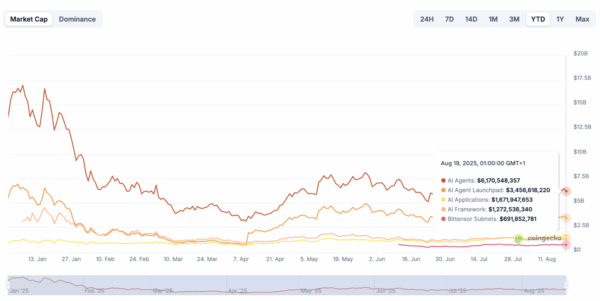
AI applications—blockchain programs that use artificial intelligence to improve or automate tasks—have outperformed some infrastructure-oriented tokens in recent weeks. Market trackers show that while AI agent and framework sectors posted losses in the past day, application-focused coins collectively advanced.

Unlike infrastructure projects, AI applications are end-user products that people can interact with directly. If there were to ever be a crypto-AI version of Facebook or Google, analysts say it would fall into this category.

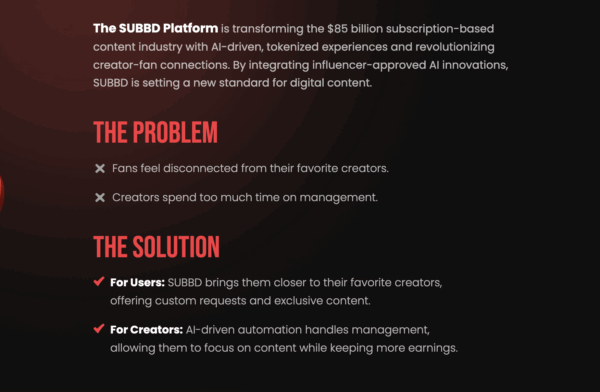
This evolving market dynamic is significantly benefitingSUBBD Token ($SUBBD), a new cryptocurrency that powers an AI-driven content subscription app. The app seeks to disrupt the $85 billion subscription-based creator economy by offering crypto and AI incentives, including faster and more private payments, automated account management, and increased monetization opportunities.

The presale for Subbd Token is underway, with the token currently priced at approximately $0.056225 and set to increase in less than three days, according to the project's website. Interested participants canbuy $SUBBDDuring this presale phase, although terms and pricing may change as the sale progresses. The project also notes that staking options will be available for token holders, with further details provided on its website.

AI app sector shows growth in 2025 — Is $SUBBD positioned to benefit?

If Subbd achieves its goal of targeting the subscription-based creator economy, its $SUBBD token — which the project says provides access to platform features and benefits — could capture value within the growing AI applications category.

Sector trackers report that while AI agent and framework tokens have declined in market value since the start of 2025, AI application projects have expanded. Analysts note this shift suggests investors are showing greater interest in application-level tools that have clearer pathways to real-world use.

Supporters argue that application-driven platforms like Subbd are positioned to benefit from this trend, although the outlook remains speculative and depends on adoption, market conditions and execution of the project's roadmap.

While AI agents and infrastructure projects exploded in late 2024, investors are recognizing that the true potential lies in application-level AI. There can only be so many decentralized LLMs and agentic analysts before interest wanes.

AI applications, on the other hand, offer nearly limitless possibilities – SUBBD and its approach to penetrating the subscription-based creator economy is a prime example.

With that in mind, analysts have high expectations for the$SUBBD presale. Some commentators, including YouTube analyst ClayBro, have speculated that $SUBBD could rise significantly after listings, although such forecasts remain speculative and are not guarantees.

SUBBD's 250 million combined follower network

According to the company, the platform has attracted a broad range of high-profile partners and creators. According to the project's website, its creators have a combined audience of 250 million followers, highlighting the scale at which the project operates.

SUBBD has managed to attract such prominent influencers thanks to its unique advantages, such as automated account management, seamless payments, and AI-driven fan interactions.

The roadmap includes features such as an AI avatar generator that would allow users to create digital avatars, produce content and monetize it behind a paywall. The public site indicates that a beta is planned rather than a fully operational launch.

Given that the project has raised $1 million so far, this signals early-stage investor interest, though future price movements remain uncertain.

Earn up to 20% staking rewards and inherent utility with $SUBBD

Holding$SUBBD tokenoffers potential benefits for holders, including access to exclusive content, platform discounts, loyalty rewards, and beta testing of new features. $SUBBD holders can also stake their tokens to earn passive rewards over time. According to the project's website, staking currently offers a 20% annual percentage yield (APY), though returns may vary depending on market conditions and smart-contract risks.

These utilities create real demand sources that could support $SUBBD price growth, in addition to the usual hype and speculation tailwinds that fuel bull market rallies.

And despite challenges in the broader AI coin sector, the AI app market is thriving right now. This creates a favorable environment for $SUBBD and could contribute to gains similar to those seen by AI agents and framework projects in late 2024.

However, the $SUBBD presale price will increase throughout the campaign, giving early investors a significant advantage. The current price is $0.056225, with the next increase scheduled in less than three days. So if you have not joined yet, the current presale phase offers a lower entry price compared to later stages, according to the project's website.

Visit SUBBD Token Presale

Disclaimer:This article is sponsored and for informational purposes only. It does not constitute investment advice, an offer to sell, or a solicitation to buy any security or digital asset. Crypto assets are volatile and involve risk, including total loss. Staking yields are not guaranteed and may change. Conduct your own research and consult a qualified adviser before making financial decisions.