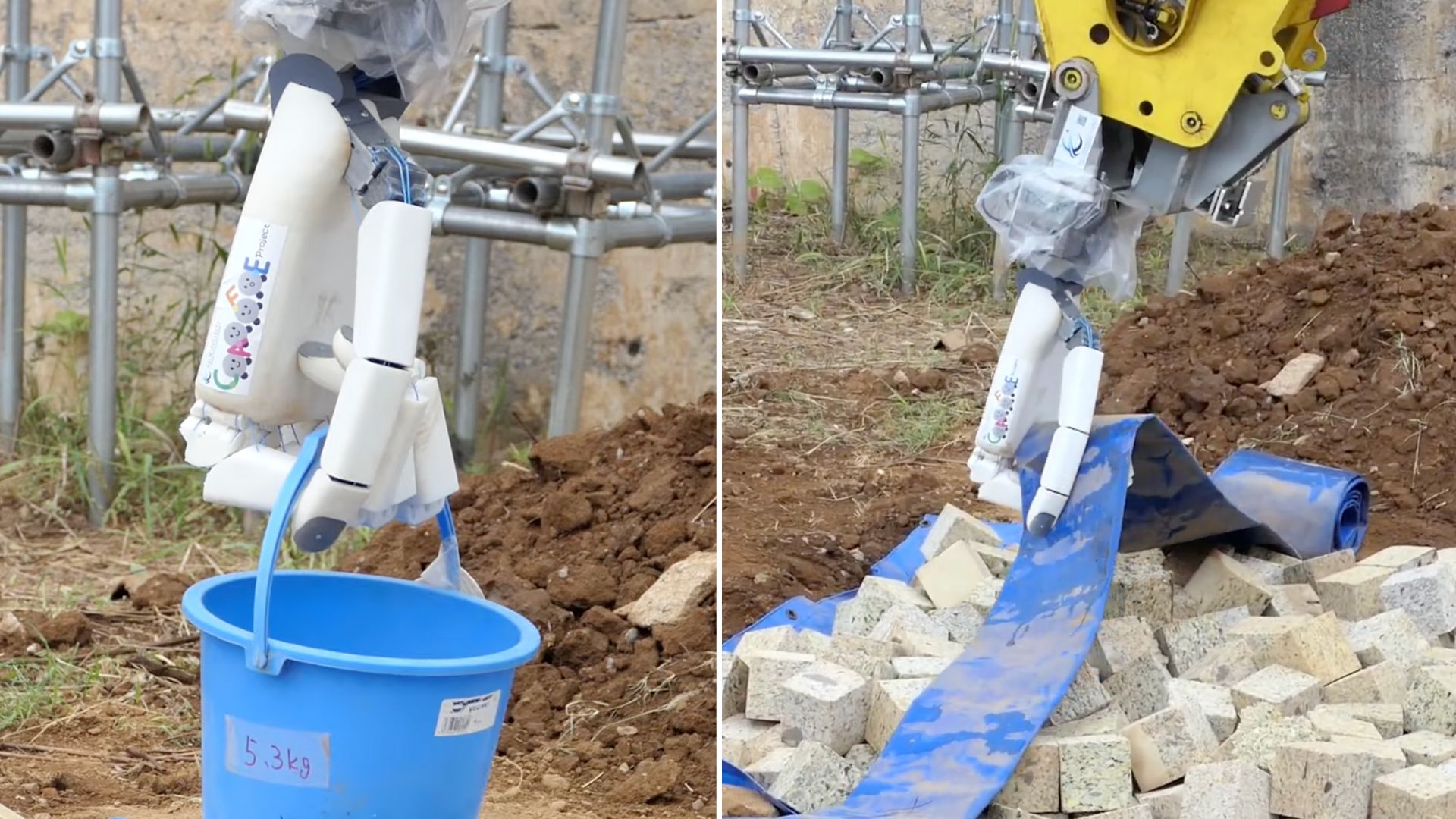
A Revolutionary Robotic Hand for Disaster Response
In a groundbreaking development, researchers from Japan and Switzerland have unveiled a giant robotic hand that has the potential to revolutionize how communities prepare for and respond to natural disasters. This innovative machine is the result of a collaborative effort between Kumagai Gumi, Tsukuba University, Nara Institute of Science and Technology, and ETH Zurich. The project, known as CAFE (Collaborative AI Field Robot Everywhere), is funded by Japan’s Cabinet Office and the Japan Science and Technology Agency.
The initiative has been in development for five years and is designed to bring enhanced safety and precision to disaster zones, which are often filled with unstable debris, flooded areas, and collapsed cliffs. The robotic hand stands out due to its ability to adapt its grip to different objects, making it an essential tool in chaotic environments.
Advanced Robotics and Artificial Intelligence
Developed with expertise from ETH Zurich’s soft robotics research, the robotic hand is engineered to handle both fragile and heavy objects with equal skill. This is achieved using pneumatic actuators, which function like air-powered muscles. These actuators allow the hand to adjust its grip based on the object's characteristics.
Sensors embedded in the fingertips and palm provide real-time data to the system, enabling the hand to determine how tightly or gently to hold an object. During a demonstration in Tsukuba, the hand successfully picked up soft foam blocks and jagged metal pieces without causing any damage or losing control. It could instantly switch from a delicate grip to a firm hold, showcasing its versatility in handling unpredictable disaster debris.
The hand is also built to withstand demanding environments such as eroded riverbeds or blocked valleys. With a weight limit of 3 tons, the apparatus can be deployed into areas where traditional heavy equipment cannot reach. This mobility offers a safer and more effective option for clearing obstacles in remote or hazardous terrain.
AI-Driven Excavation for Natural Dams
One of the primary challenges the CAFE project aims to address is the formation of natural dams. When landslides caused by earthquakes or heavy rainfall block rivers, entire communities face significant flooding risks. Traditionally, workers had to manually dig channels or set up pumps in dangerous conditions, as seen after the Niigata-Chuetsu earthquake in 2004.
The CAFE team’s solution involves combining the robotic hand with an AI-driven excavation system. Researchers at Nara Institute of Science and Technology developed this software using Sim-to-Real reinforcement learning. The AI first trains in digital simulations, learning to dig, identify obstacles, and adjust actions. Once tested, it applies those skills in real-world disaster environments.
Instead of following fixed commands, the system learns and adapts in real time. It decides how deep to dig, how much pressure to apply, and how to remove hidden objects without destabilizing the environment. This adaptive approach is crucial when working in unpredictable conditions where traditional machinery or human labor would be unsafe.
From Controlled Tests to Real-World Deployment
The August 2025 demonstration in Tsukuba showcased the project at Technology Readiness Level (TRL) 4, proving that the robotic hand and AI could function in a controlled environment. The next goal is TRL 5, which means demonstrating that the system can operate under more realistic conditions. By November 2025, the team aims to be ready for real-world testing and eventual deployment.
The collaboration brings together strengths from multiple fields. Kumagai Gumi provides practical expertise in construction and heavy equipment, while ETH Zurich contributes advanced robotics design, particularly in soft robotics. Tsukuba University and Nara Institute of Science and Technology focus on integrating artificial intelligence, making the system an autonomous problem-solver rather than just a tool.
If successful, the robotic hand could become a vital component of disaster management strategies worldwide. From clearing blocked rivers to carefully removing debris after earthquakes, the machine is designed to reduce risks to human workers and speed up recovery operations. Its potential impact on global disaster response efforts is significant, offering a safer and more efficient way to tackle the challenges posed by natural disasters.

0 comments:
Ikutan Komentar