Innovations in Carbon Capture Technology
Researchers at the University of Houston have made significant strides in improving carbon capture systems, proving that sometimes simpler solutions can lead to more effective results. Led by Professor Mim Rahimi from the Cullen College of Engineering, the team has developed two groundbreaking methods that could drastically reduce the cost and energy requirements of capturing harmful emissions from power plants. These advancements represent a crucial step forward in the fight against climate change.
Membraneless Electrochemical Process
The first breakthrough, published in Nature Communications, introduces a membraneless electrochemical process that significantly reduces the energy needed for amine-based carbon dioxide (CO₂) capture. Traditional systems rely on ion-exchange membranes, which are both costly and prone to performance issues. By replacing these membranes with gas diffusion electrodes, the researchers achieved over 90% CO₂ removal, nearly 50% more than conventional EMAR (Electrochemically Mediated Amine Regeneration) approaches.
This innovation not only cuts down on costs but also streamlines the overall workflow. According to Ph.D. student Ahmad Hassan, who led the research, this method makes the system more efficient and easier to integrate into existing industrial setups. The capture cost is estimated at around $70 per metric ton of CO₂, making it competitive with current amine scrubbing techniques.
Vanadium Redox Flow System
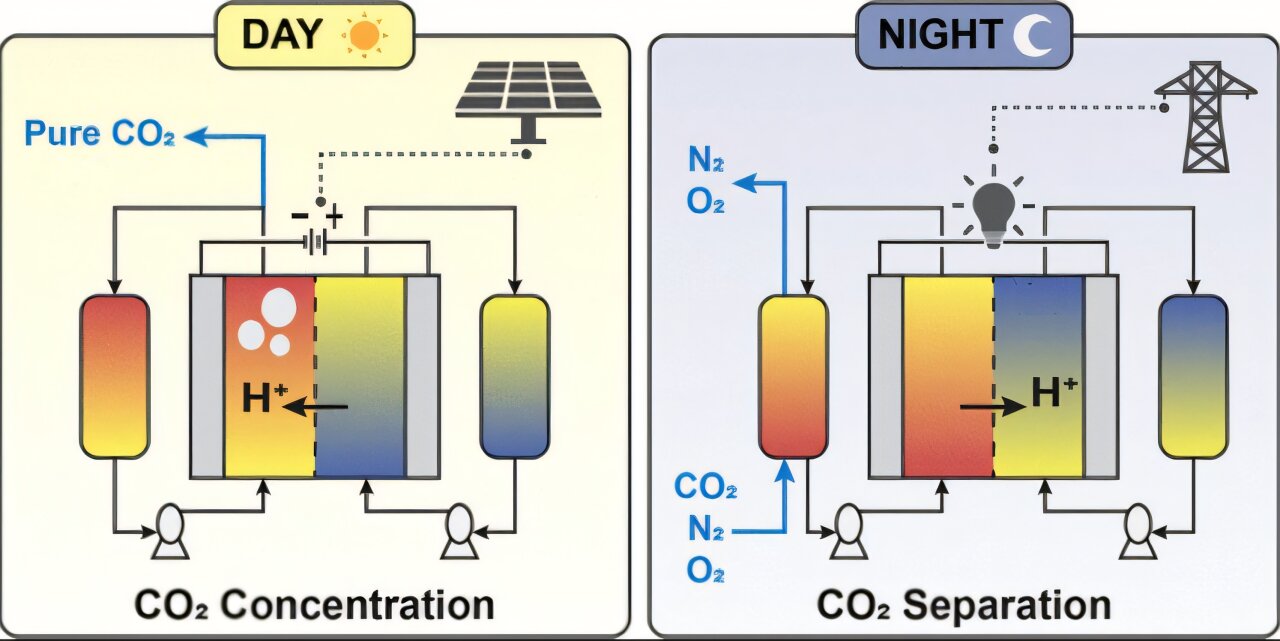
Building on this success, fellow Ph.D. student Mohsen Afshari introduced a second innovation featured on the cover of ACS ES&T Engineering. His research presents a vanadium redox flow system capable of both capturing carbon and storing renewable energy. This reversible flow battery architecture absorbs CO₂ during charging and releases it upon discharge, offering a dual benefit.
The use of vanadium chemistry ensures strong cycle stability and high capture capacity, making the technology suitable for grid balancing when paired with intermittent renewable sources. Afshari highlighted that integrating carbon capture directly into a redox flow battery allows for addressing two major challenges simultaneously—reducing emissions and managing energy storage.
Implications for Climate Change Mitigation
These discoveries have the potential to revolutionize carbon capture technology and the energy industry as a whole. Rahimi emphasized the importance of such innovations in reducing the carbon footprint associated with various sectors. "From membraneless systems to scalable flow systems, we're charting pathways to decarbonize hard-to-abate sectors and support the transition to a low-carbon economy," he said.
The research underscores the group's commitment to fundamental electrochemical innovation and real-world applicability. By focusing on cost-effective and energy-efficient solutions, the team is paving the way for more sustainable industrial practices.
Future Prospects
Looking ahead, the implications of these breakthroughs are far-reaching. The membraneless electrochemical process and vanadium redox flow system offer practical solutions that can be adapted for widespread use. As industries continue to seek ways to reduce their environmental impact, these technologies provide viable options that align with global sustainability goals.
With further development and implementation, these innovations could play a pivotal role in mitigating climate change and supporting a cleaner, more sustainable future. The work done by the University of Houston team serves as a testament to the power of scientific research in addressing some of the most pressing challenges of our time.

0 comments:
Ikutan Komentar