Understanding What Attracts Birds to Feeders
Living in the woods of Northern Ontario, Canada, my wife and I get to enjoy lots of natural beauty, including many woodland creatures who occasionally visit our cabin site. Some of our favorite visitors are the birds who love to perch on our bird feeders regularly. “What attracts birds to feeders, generally, is the type of food you have available, as well as the type of feeder it is,” explains Maria Kincaid, an ornithology research specialist for a smart bird feeder manufacturer.
The color of your feeder isn’t that important for something like a seed feeder, while it is very important for a hummingbird feeder. Hummingbirds have evolved with flowers, and while they’re attracted to flowers of many colors, they’ve evolved with red flowers. This is why many hummingbird feeders are red.
The trouble is, most birds attracted to our standard feeders are too skittish to let us get close-up view in order to snap decent photos with our smartphones. My wife’s been trying for years and has discouragingly few good bird pictures to show for it. She did eventually convince a particularly brave chickadee to land in her seed-filled hand for a few moments last year, but this took months of coaxing.
Luckily for us and other bird lovers around the world, there’s an easier way — the smart bird feeder.
What Is a Smart Bird Feeder?
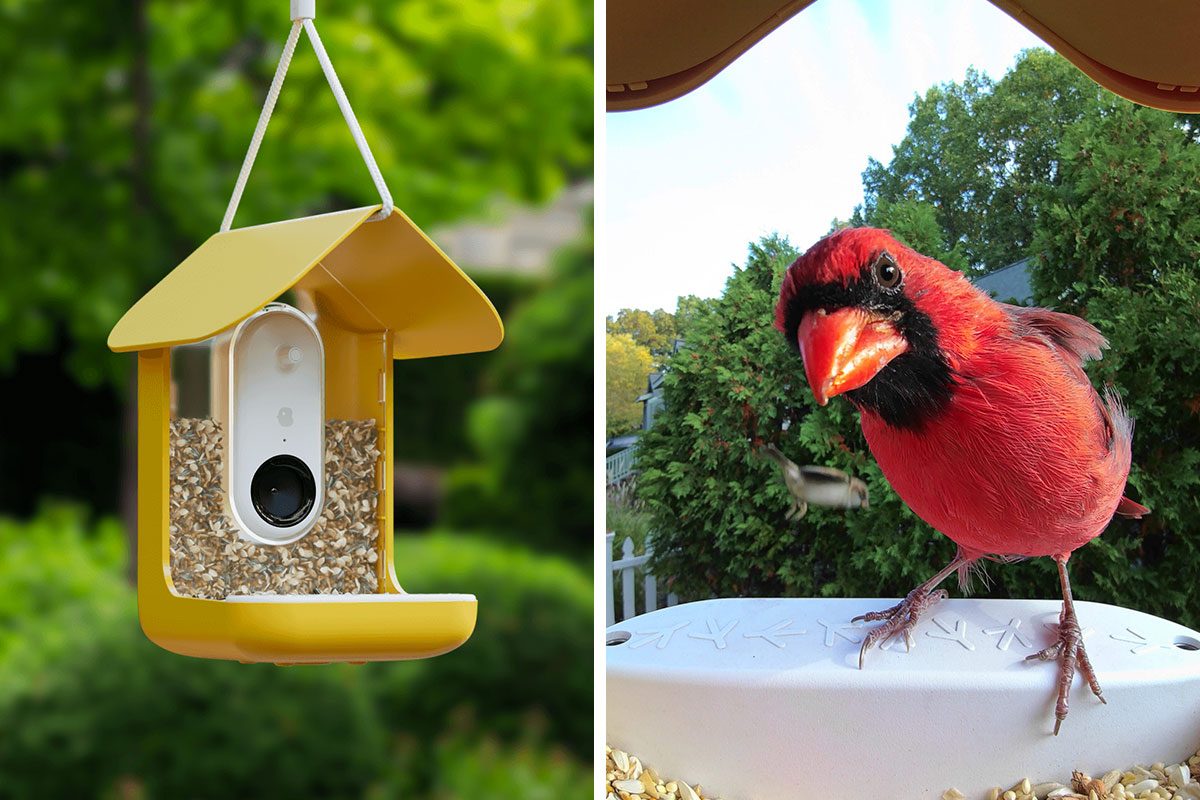
A smart bird feeder is a bird feeder with a camera built in that sends images and also sometimes videos of birds that visit your feeder to your phone via an app, Kincaid explains. Essentially, smart feeders make it much easier to enjoy birds without scaring them off and captures some stunning visuals of your feathered friends in the process.
“I love that I can see all the different species of birds that are coming to my FeatherSnap feeders without having to watch it constantly,” Kincaid says. “Sometimes, especially during the spring migration, there are birds that stop by just for a few hours, and when they stop at my feeder, I’ve got a record of it.”
There are many different smart bird feeders on the market that boast unique features. One example is the Bird Buddy Feeder, an elegant, modern-looking 9×6-inch bird feeder which we tested out. The feeder itself is weatherproof, sturdy, and well-built. It has a protective roof and transparent walls on two sides, making it super easy for birds to spot the tasty seeds within. The Bird Buddy holds just under 4 cups of feed and has an openable rear door to make refilling simple.
Speaking of seeds, the way you should select how to fill a smart bird feeder is no different than your standard feeder. “The type of seed that you use in your feeder will attract different birds, so look into the favorite foods of what you’re hoping to attract,” Kincaid says. “One of my favorite features of the FeatherSnap Seed Feeder is that it’s got dual feeder bins, allowing me to put in two different types of bird seed, and increase the types of birds I’m attracting to my feeder.”
How Do Smart Bird Feeders Work?
The rechargeable camera built into a smart bird feeder works with a custom app that alerts homeowners when birds are at their feeder. It uses your home’s Wi-Fi connection to stream closeup photos and videos to your mobile device. Once your mobile device receives and processes images of your latest feathered visitors, most smart bird feeder apps now use AI to identify each bird photographed by species.
Feathersnap feeders boast this type of AI functionality and take things a step further to help new bird watchers increase their knowledge. “You can use AI or the manual bird identification to ID the birds coming to your feeder, and learn more about them via the Bird Book, which includes seed preferences, the ranges they’re found in, and fun facts about each species,” Kincaid says.
Tips for Getting the Most Out of a Smart Bird Feeder
Excited to get your own smart feeder? We don’t blame you. Here are some pro tips for making the switch from a standard bird feeder to smart bird feeder:
- Be patient. “First, it’s important to note that it may take some time for the birds in your yard to find your feeder and deem it safe, especially if you don’t have any other bird feeders available,” Kincaid says. Give your bird friends time to find your new feeder and don’t get discouraged if it takes a week or two.
- Keep your feeder clean. Whether it’s a smart feeder or not, it’s important to keep your bird feeder cleaned and maintained regularly for the safety of the birds and to avoid the spread of disease, Kincaid says.
- Occasionally move feeder locations. “I find that moving feeders, even from one side of the yard to the other, changes the types of birds that visit regularly,” Kincaid says. “I’ve also found that even with all my knowledge and practice, sometimes the birds just don’t like the location I’ve chosen for the feeder.”
- Make the most of your photos. “I’m definitely a bird nerd, so I like to use the photos I save to keep track of the spring and fall migration in my area, as the birds that come through my yard at that time are different from what I see during the summer and winter,” Kincaid says. “I can also see what kinds of birds are attracted to my yard which I use to influence my landscaping decisions.”
Kincaid has also seen many FeatherSnap users share the images and videos they’re collecting with friends and family. “I particularly enjoy seeing the memes and edits people make of the images and videos collected from their smart feeders,” Kincaid says. “What you can do with the collection of images you’re gathering is limited only by your imagination!”
Frequently Asked Questions
Do smart feeders deter squirrels or pests?
Not necessarily. While there may be aspects of a smart feeder meant to deter squirrels and other feeder pests, like having movable perches or squirrel sirens, the best way to keep pests off any feeder is to consider where you’re placing it, Kincaid says. “Squirrels are incredibly agile little critters, and can jump long distances and climb like you wouldn’t believe,” she says. “There’s a rule called the ‘5-7-9 rule’ for deterring squirrels from feeders, which means placing the feeder at least five feet off the ground, seven feet away from trees or fences squirrels could jump from, and nine feet away from overhanging branches or other structures.”
Can I view the feeder remotely?
Absolutely! “Smart feeders, like the FeatherSnap, connect to a dedicated app on your phone or other device via your WiFi, and send HD images and videos of the activity at your feeder,” Kincaid says. Some smart bird feeders also allow for a live view, which lets you log into your feeder’s camera to see what’s going on in real-time, she adds.
About the Expert
Maria Kincaid is the in-house Ornithology Research Specialist for a smart bird feeder manufacturer. She studied Natural Resource Ecology and Management at Louisiana State University.

0 comments:
Ikutan Komentar