Showing posts with label space travel. Show all posts

Thursday, December 11, 2025

X-37B Spaceplane Returns With Quantum GPS Secret

Featured Image

The Strategic Importance of Satellite Navigation in Modern Warfare

In the evolving landscape of modern warfare, satellite navigation systems have become critical assets for military operations. These systems provide precise positioning, navigation, and timing information that is essential for everything from missile guidance to troop movements. However, their reliance on satellites makes them vulnerable to attacks, especially in a conflict scenario where adversaries might target these systems.

This vulnerability has led to increased interest in alternative technologies that can ensure reliable navigation even in the absence of traditional satellite signals. One such technology being tested by the U.S. military is quantum-based GPS systems, which could offer a more resilient solution.

The X-37B Spaceplane: A Key Player in Space Innovation

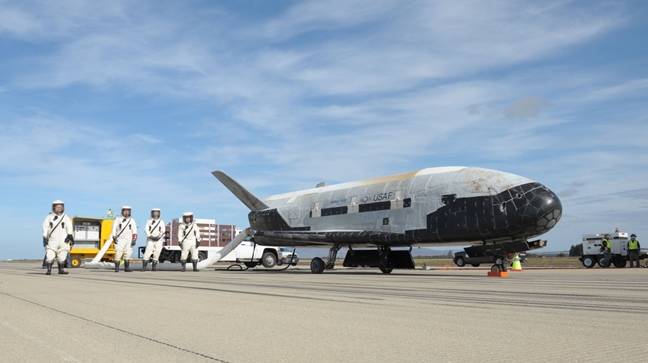
The Boeing-built X-37B spaceplane has been making headlines again as it embarks on its eighth mission. This uncrewed spacecraft, similar in design to the retired Space Shuttle, launches on a rocket and lands autonomously on a runway after re-entry. Unlike the Space Shuttle, however, the X-37B is equipped with engines that allow it to maneuver in space, giving it a unique capability to change its orbit.

In 2024, the X-37B made a notable move by "aerobraking" — a technique that involves grazing Earth's atmosphere to alter its trajectory. This maneuver is energy-intensive and has raised concerns, particularly from China, which has occasionally criticized the spaceplane for potentially serving as a weapons platform.

Testing Quantum GPS Technology

Recent missions have focused on testing advanced technologies, including a quantum-based GPS system. In March 2025, Boeing conducted tests using a six-axis quantum inertial measurement unit (IMU) that employs a technique known as atom interferometry. This method uses atoms to detect rotation and acceleration, offering an ultra-precise way to measure movement.

Sandia National Laboratories, a key player in this field, has developed a high-performance silicon photonic modulator — a device that controls light on a microchip — to support this technology. Atom interferometry has the potential to replace traditional GPS systems by measuring position with remarkable accuracy.

Why This Matters for Global Security

The implications of this technology are significant, especially in the context of global security. China has expressed concerns about the X-37B's capabilities, fearing that it could threaten its Beidou satellite navigation system. Similarly, the U.S. is wary of losing its GPS satellites, which are vital for modern military operations.

By developing alternative navigation methods, the U.S. aims to ensure that its forces can operate effectively even if traditional satellite systems are compromised. This becomes increasingly important as conflicts become more technologically sophisticated.

The Future of Navigation Technology

The X-37B’s current mission is shrouded in secrecy, with the Pentagon not disclosing when the spaceplane will return to Earth or what specific objectives it aims to achieve. However, the focus on quantum GPS technology highlights a growing trend in military innovation.

As nations continue to invest in space-based capabilities, the development of resilient navigation systems will be crucial. The X-37B represents a step forward in this effort, demonstrating the potential of advanced technologies to enhance operational flexibility and security.

With ongoing research and development, the future of navigation may rely less on traditional satellites and more on innovative solutions like quantum sensing. This shift could redefine how military forces navigate and operate in an increasingly complex global environment.

X-37B Spaceplane Returns With Quantum GPS Secret

Featured Image

The Strategic Importance of Satellite Navigation in Modern Warfare

In the evolving landscape of modern warfare, satellite navigation systems have become critical assets for military operations. These systems provide precise positioning, navigation, and timing information that is essential for everything from missile guidance to troop movements. However, their reliance on satellites makes them vulnerable to attacks, especially in a conflict scenario where adversaries might target these systems.

This vulnerability has led to increased interest in alternative technologies that can ensure reliable navigation even in the absence of traditional satellite signals. One such technology being tested by the U.S. military is quantum-based GPS systems, which could offer a more resilient solution.

The X-37B Spaceplane: A Key Player in Space Innovation

The Boeing-built X-37B spaceplane has been making headlines again as it embarks on its eighth mission. This uncrewed spacecraft, similar in design to the retired Space Shuttle, launches on a rocket and lands autonomously on a runway after re-entry. Unlike the Space Shuttle, however, the X-37B is equipped with engines that allow it to maneuver in space, giving it a unique capability to change its orbit.

In 2024, the X-37B made a notable move by "aerobraking" — a technique that involves grazing Earth's atmosphere to alter its trajectory. This maneuver is energy-intensive and has raised concerns, particularly from China, which has occasionally criticized the spaceplane for potentially serving as a weapons platform.

Testing Quantum GPS Technology

Recent missions have focused on testing advanced technologies, including a quantum-based GPS system. In March 2025, Boeing conducted tests using a six-axis quantum inertial measurement unit (IMU) that employs a technique known as atom interferometry. This method uses atoms to detect rotation and acceleration, offering an ultra-precise way to measure movement.

Sandia National Laboratories, a key player in this field, has developed a high-performance silicon photonic modulator — a device that controls light on a microchip — to support this technology. Atom interferometry has the potential to replace traditional GPS systems by measuring position with remarkable accuracy.

Why This Matters for Global Security

The implications of this technology are significant, especially in the context of global security. China has expressed concerns about the X-37B's capabilities, fearing that it could threaten its Beidou satellite navigation system. Similarly, the U.S. is wary of losing its GPS satellites, which are vital for modern military operations.

By developing alternative navigation methods, the U.S. aims to ensure that its forces can operate effectively even if traditional satellite systems are compromised. This becomes increasingly important as conflicts become more technologically sophisticated.

The Future of Navigation Technology

The X-37B’s current mission is shrouded in secrecy, with the Pentagon not disclosing when the spaceplane will return to Earth or what specific objectives it aims to achieve. However, the focus on quantum GPS technology highlights a growing trend in military innovation.

As nations continue to invest in space-based capabilities, the development of resilient navigation systems will be crucial. The X-37B represents a step forward in this effort, demonstrating the potential of advanced technologies to enhance operational flexibility and security.

With ongoing research and development, the future of navigation may rely less on traditional satellites and more on innovative solutions like quantum sensing. This shift could redefine how military forces navigate and operate in an increasingly complex global environment.

Saturday, August 23, 2025

Rocket Lab's Neutron Progressing Steadily Toward Launch

Rocket Lab USA, Inc.(RKLBIt is steadily moving forward with its next-generation Neutron rocket, designed to compete in the medium-lift reusable launch market. Unlike the small-satellite-focused Electron, Neutron will carry heavier payloads, making it suitable for large satellite constellations, national security missions and deep-space programs.

In July 2025, RKLB selected Bollinger Shipyards to build a 400-foot ocean platform for Neutron's landing. This landing platform should play a crucial role in this rocket's entry into the medium-lift launch market.

Looking ahead, the launch of the Neutron rocket is expected in the second half of 2025, with its flight hardware recently being moved to its launch site.

Currently, the large structures that make up the first stage of the Neutron are undergoing major structural tests, which upon completion, will allow the rocket to progress into a final integration and stage testing.

Once launched, the Neutron rocket will allow the company to compete for larger missions and higher-value contracts against major players in the space industry.

Other Stocks to Keep on the Watchlist

The space launch services market is witnessing steady growth, supported by several factors such as rapid advancements in technology, the rising need for satellite deployment, increasing commercial space activity and higher investment in space infrastructure.

These drivers are creating growth opportunities for other space stocks such asBoeing(BA) andLockheed Martin(LMT), which already have a well-established presence in the launch services market.

Through their joint venture, United Launch Alliance (ULA), LMT and BA have provided reliable access to space for almost two decades. Since its establishment in 2006, ULA has delivered more than 150 Atlas and Delta rockets for commercial, scientific and defense missions, underscoring its reputation as a reliable launch provider.

To strengthen its position in the evolving market, ULA recently launched the Vulcan rocket, which offers more affordable and flexible launch options, making it suitable for a wide variety of missions.

RKLB's Price Performance, Valuation and Estimates

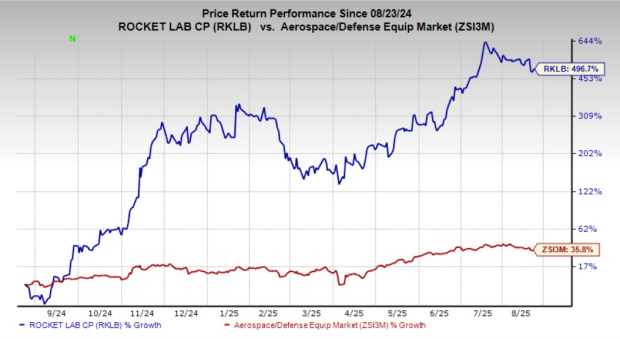
RKLB shares have gained 496.7% over the past year compared to the industry's 35.8% growth.

Image Source: Zacks Investment Research

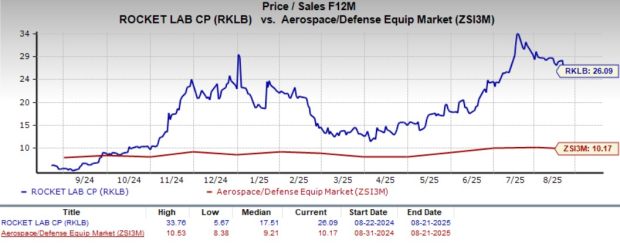
The company's shares are expensive on a relative basis, with its forward 12-month Price/Sales ratio at 26.09X compared to its industry's average of 10.17X.

Image Source: Zacks Investment Research

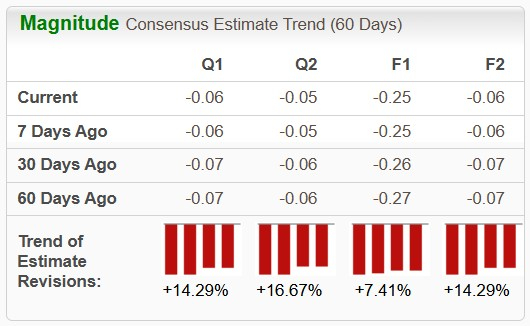
The Zacks Consensus Estimate for RKLB's 2025 and 2026 losses has improved over the past 60 days.

Image Source: Zacks Investment Research

RKLB stock currently carries a Zacks Rank #3 (Hold). You can seethe complete list of today’s Zacks #1 Rank (Strong Buy) stocks here.

This article was originally published on Zacks Investment Research (The Shiro Copr).

Friday, August 22, 2025

What we know about the mysterious Black Knight satellite

The Black Knight Satellite has intrigued scientists for decades, with its mysterious origins sparking debates around the world. While some claim it's a piece of ancient extraterrestrial technology, others argue that it's nothing more than space debris. This phenomenon delves into the various theories and evidence surrounding this enigmatic object.

Historical Background and Discovery

Early Observations

The tale of the Black Knight Satellite begins with early observations during the dawn of space exploration. In 1954, several newspapers, including the St. Louis Dispatch and San Francisco Examiner, reported claims by UFO researcher Donald Keyhoe that the Air Force had detected two satellites orbiting Earth, at a time when no country had the capability to launch them. This fueled speculation about the existence of an unknown satellite.

An intriguing aspect of the Black Knight legend is its alleged connection toNikola Tesla. In 1899, Tesla claimed to have received unusual radio signals, which he believed were coming from another world. Some supporters of the Black Knight theory speculate that Tesla accidentally picked up transmissions from this mysterious object.

Public Fascination and Media Coverage

Over the years, the Black Knight Satellite has captured the public's imagination, partly due to media coverage. In the 1960s, Time magazine reported on the mysterious object, and since then, documentaries and TV shows have perpetuated its legend. The advent of the internet and social media has further amplified its allure, with platforms like Reddit and YouTube hosting countless discussions and videos dissecting the mystery.

Social media has played a significant role in spreading theories about the Black Knight. Enthusiasts have shared images, videos, and speculative articles, keeping the mystery alive. The satellite's enigmatic nature and the absence of definitive proof have only fueled public curiosity, making it a staple topic in discussions about unexplained phenomena.

Scientific Explanations and Debunking

Space Debris Theory

One of the most common scientific explanations for the Black Knight Satellite is that it's simply space debris. In 1998, during the STS-88 shuttle mission, astronauts captured images of an object resembling the Black Knight. NASA later clarified that it was a thermal blanket lost during an EVA (extravehicular activity). This explanation aligns with the theory that the Black Knight isnothing more than space debris.

Scientific analyses have further refuted the satellite's extraterrestrial nature. Studies indicate that the object's trajectory and behavior are consistent with known space debris, which often have irregular orbits due to atmospheric drag and gravitational influences. Despite these explanations, some still hold the belief that the Black Knight is something extraordinary.

Satellite Catalog and Tracking

Space agencies worldwide, including NORAD and NASA, use sophisticated tracking systems to monitor objects in orbit. These systems maintain a comprehensive catalog of known satellites and debris. The Black Knight, however, does not fit the profile of any known satellite, adding to its mystery. Despite this, the complexities of tracking space debris mean that unidentified objects are not uncommon.

Identifying and cataloging space debris presents significant challenges. The sheer volume of debris, combined with varying sizes and orbits, makes it difficult to track every object accurately. As technology advances, scientists hope to improve tracking capabilities, which may eventually provide more clarity on the true nature of the Black Knight.

Conspiracy Theories and Extraterrestrial Hypotheses

Alien Technology or Communication Device

Among the most popular theories is that the Black Knight Satellite is an alien technology or communication device observing Earth. Proponents of this idea suggest that its unusual orbit and long-standing presence in space indicate an extraterrestrial origin. Testimonies from conspiracy theorists and UFO enthusiasts often cite historical accounts as evidence of this hypothesis.

These theories are supported by the satellite's supposed ability to transmit signals, further suggesting its role as a monitoring device. However, mainstream science consistently refutes these claims, emphasizing the lack of concrete evidence to support the idea of alien technology.

Links to Ancient Civilizations

Another intriguing hypothesis is that the Black Knight is a remnant of an ancient civilization, possibly serving as evidence of past extraterrestrial contact. Some theorists draw parallels between the satellite and ancient myths or archaeological findings, suggesting a connection between ancient cultures and advanced technologies.

While these claims capture the imagination, they often lack archaeological and historical substantiation. Nonetheless, they persist, largely due to the human fascination with the possibility of ancient civilizations possessing advanced knowledge.

Modern Investigations and Research

Involvement of Space Agencies

Major space agencies like NASA have conducted investigations into the Black Knight Satellite, albeit indirectly. NASA's official position is that it is likely space debris, as evidenced by the STS-88 incident. Despite this, the agency continues to monitor space for unidentified objects, contributing to our understanding of space debris and its implications.

Specific missions and studies have not been directly targeted at the Black Knight, but ongoing research in space surveillance indirectly helps in demystifying such objects. Agencies remain committed to advancing our knowledge of space phenomena, which might one day unravel the Black Knight's enigma.

Technological Advances and Future Prospects

Advancements in technology promise to shed more light on the Black Knight Satellite. Enhanced imaging systems, improved tracking methods, and international collaborations in space research are paving the way for a more comprehensive understanding of our orbital environment. Future space missions may provide the means to study the satellite, or similar objects, more closely.

The implications of potential discoveries extend beyond scientific understanding. Unraveling the mystery could impact cultural perceptions of space exploration and the possibility of extraterrestrial life. As technology progresses, the boundary between science fiction and reality continues to blur, opening new avenues of exploration.

Cultural Impact and Legacy

Influence on Pop Culture

The Black Knight Satellite has left an indelible mark on pop culture, inspiring films, books, and other forms of storytelling. Its enigmatic presence and the aura of mystery surrounding it have made it a compelling symbol of the unknown. Works like "The X-Files" and various science fiction novels have drawn inspiration from the Black Knight, embedding it in the collective consciousness.

The satellite's allure stems from its representation of humanity's perpetual quest for knowledge. Its presence in popular culture highlights the fascination with space mysteries and the desire to uncover the truth behind unexplained phenomena.

Legacy of the Mystery

The Black Knight Satellite occupies a unique place in the history of space exploration and human curiosity. Despite scientific explanations, its mystery continues to engage and inspire new generations. It serves as a reminder of the vast unknowns that still await discovery in the cosmos.

As we venture further into space, the legacy of the Black Knight invites us to remain curious and open-minded. It challenges us to question what we know, pushing the boundaries of exploration and understanding. Whether it is a piece of space debris or something more, the Black Knight Satellite remains a fascinating chapter in the story of humanity’s exploration of the universe.