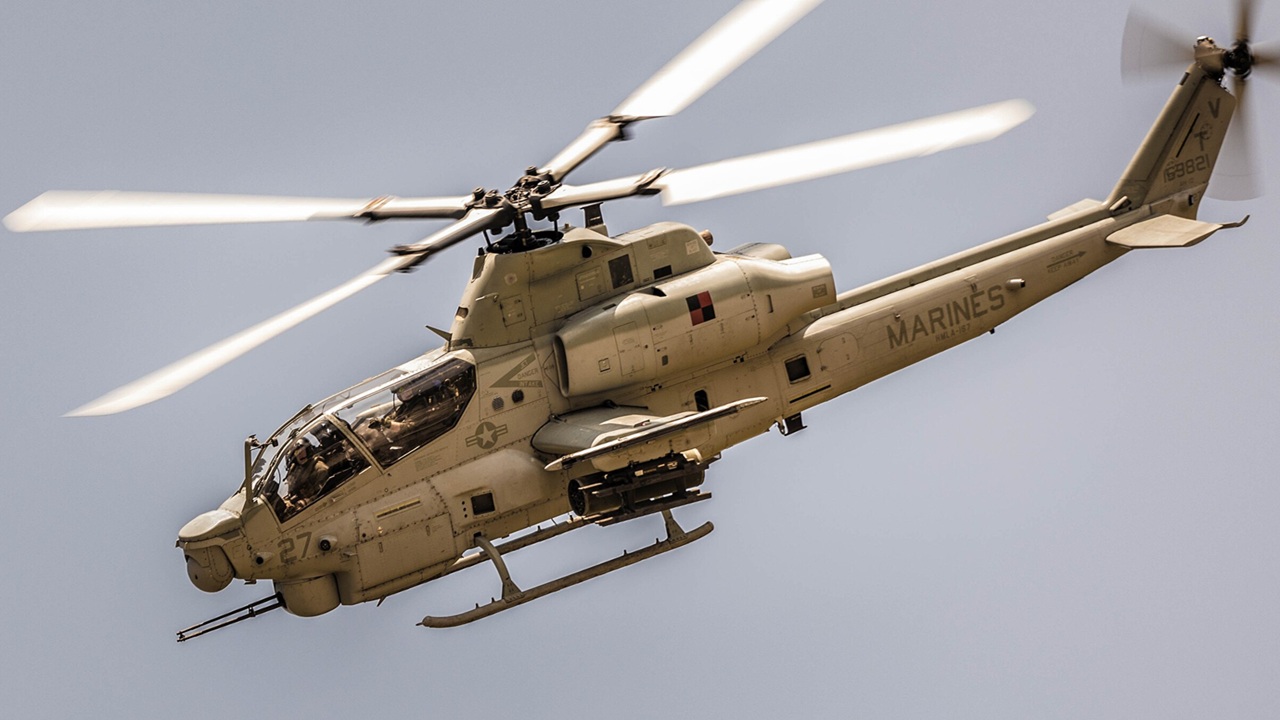
While the SuperCobra served as a guardian angel, hovering above Marines, the Viper is a sensor-shooter platform that can integrate with drones, F-35s, and surface ships.
The long-serving Bell AH-1W SuperCobra was recently phased out in favor of the Bell AH-1Z Viper. Together, the two aircraft demonstrate the successivegenerationsof the US Marine Corps attack helicopter lineage. Each platform was designed to provide close air support (CAS), armed escort, and battlefield dominance for Marines on the ground. However, the two helicopters are decades apart in terms of technology, operational demands, and application philosophy.
The Super Cobra Led the Marines to Victory for Decades
Introduced in the 1980s, the SuperCobra was a twin-engine evolution of the original Cobra design, specifically tailored to the demands of the Marine Corps. Serving as the workhorse of Marine Corps aviation during the Gulf War, Iraq, and Afghanistan, the SuperCobra came to be affectionately known as the “Whiskey Cobraby Marines who appreciated the helicopter's ability to operate from amphibious assault ships and austere forward bases, all while carrying a wide variety of ordnance, including TOW and Hellfire missiles, Hydra rockets, Sidewinders, and a three-barrel 20-mm cannon.
Designed for agility, reliability, and lethality, the SuperCobra proved adept at supporting Marines on the ground. While the SuperCobra was not optimized for heavier, tank-busting duties, the aircraft performed a variety of valuable roles, including providing valuable CAS in littoral and expeditionary environments, escorting troop transports, protecting landing zones, and flying low-level attack runs.
The AH-1Z Viper: A Worthy Successor to the Cobra
The Viper entered service in the 2010s, forcing the gradual phase-out of the venerable SuperCobra platform. While the Viper closelyresemblesthe SuperCobra, with its distinctly narrow fuselage and tandem cockpit, the helicopter has undergone heavy modernization compared to its predecessor.
Featuring a four-bladed composite rotor that reduces vibration and improves lift, the Viper is capable of carrying heavier payloads and deploying weapons with higher stability. The aircraft's avionics suite is fully digital, with glass cockpits, integrated helmet-mounted displays, and advanced targeting systems such as the AN/AAQ-30 Target Sight System. The upgrades greatly improved the Viper pilot's situational awareness, target acquisition, and engagement rates compared to those of the SuperCobra. And like many modern platforms, the Viper is designed for networked warfare, meaning the helicopter can share targeting data with ground forces, other aircraft, and ships. In effect, the Viper serves not only as a direct shooter but also as a node of battlefield information.
Furthermore, theViperis used differently compared to its predecessor. Whereas the SuperCobra was built primarily for CAS, flying low and slow close to Marine ground forces, the Viper is a more comprehensive war-fighting platform, viewed as part of the Marines’ expeditionary advanced base operations (EABO) concept. The Viper can operate from ships, forward bases, and maritime environments with the range, sensors, and weapons to integrate into a joint all-domain fight. In contrast to the SuperCobra, which served as a guardian angel, hovering above Marines, the Viper is a sensor-shooter platform that can integrate with drones, F-35s, and surface ships to help shape the battlespace.
The SuperCobra and the Viper: A Head-to-Head Comparison
About the Author: Harrison Kass
Harrison Kassis a Senior Defense and National Security Writer at The National Interest. Kass is an attorney and former political candidate who joined the US Air Force as a pilot trainee before being medically discharged. He focuses on military strategy, aerospace, and global security affairs. He holds a JD from the University of Oregon and a master's in Global Journalism and International Relations from NYU.
Image: Wikimedia Commons.

0 comments:
Ikutan Komentar