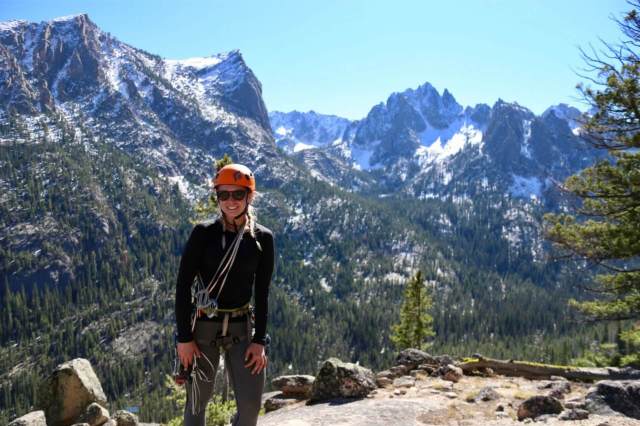
As a 24-year-old recent college graduate, I often hear my Gen Z peers express a deep sense of hopelessness aboutClimate change. But as someone who has been studying and working on climate solutions for the past four years, I feel the opposite. I don't feel discouraged; I feel inspired — because I've seen the ideas, innovations, and people driving real progress.
I grew up in a mountain town in Idaho, experiencing firsthand the realities of climate change — from erratic weather patterns to increasing summertimewildfiresand smoke. Yet despite the uncertainties and daunting headlines, I remain optimistic. Not because the challenge has gotten any smaller or less urgent — it hasn't — but because our ability to meet it continuously grows.
I remember sitting in an auditorium at what was then the Office of Fossil Energy and Carbon Management at the Department of Energy headquarters in D.C., listening to my peers present their summer research. I was blown away by the range of solutions already in development to address the climate crisis — from scientific breakthroughs and new technologies to creative policy approaches.
That moment made me realize we already have so many of the pieces we need to solve the climate crisis — it's just a matter of putting the puzzle together. In that auditorium, there was more innovation, energy, and opportunity to contribute to solutions than there were reasons to dwell in doom and gloom.
Things we once considered theory are now tangible realities. One area I'm particularly enthused about is carbon dioxide removal — physically taking carbon out of the atmosphere and storing it long-term in the ocean or underground.
Although not a substitute for rapidly reducing emissions, carbon removal still plays a crucial role in meeting global climate targets and is the only way to address the carbon we have already released into the atmosphere from over 200 years of burning fossil fuels. We now have a growing set of measurable, scalable, and effective ways to remove carbon — now the question is how quickly we can implement them on a large scale.
When I talk about the concept of carbon offsetting, people often meet my enthusiasm with skepticism. Historically, carbon markets have struggled with issues of quality and integrity. Some offsets were tied to projects that would have happened anyway, offering little to no additional climate benefit. Others lacked transparent accounting, making it difficult to prove the claimed carbon reductions were real, measurable, or permanent. Additionally, there has often been little to no direct connection between those purchasing offsets and the actual practices or effects on the ground.
There's no doubt that early carbon markets made mistakes. Today's carbon markets are learning from those missteps with new standards that are grounded in science and independently verified — to ensure that each ton of carbon removed is truly additional, durable, and accurately accounted for. This includes subtracting all emissions associated with the project itself, like energy use and transportation, from the total so that only the net carbon removal is credited.
This skepticism fades when I frame these carbon removal activities in a local context. When I shift the conversation to how various stakeholders in a community can work together to minimize waste, develop innovative end-of-life uses for materials, reduce fire risk, support local farmers, and remove greenhouse gases in the process, the response is overwhelmingly positive.
With billions of tons of carbon removals needed to reach climate goals, carbon removal needs to move beyond an abstract concept occurring in places disconnected from the communities they ultimately serve.
To make this move, to scale these solutions, carbon removal must be made tangible, visible, and relevant. I am optimistic that when these efforts are grounded in and supported by communities, they can scale as practical tools.
| Do you think your city has good air quality? Certainly Somewhat Depends on the time of year Not at all Click your choice to see results and speak your mind. |
I am optimistic about a future where carbon removal is integrated into communities. Two methods that I'm particularly excited about for their ability to integrate into existing infrastructure or processes occurring in the Mountain West arebiocharandEnhanced weathering.
Both innovations draw on community-based approaches while using existing waste streams and infrastructure to deliver tangible benefits. Talking about these technologies and seeing them implemented in real-world settings makes you wonder why we haven't been doing this all along.
Biochar
Biochar is a carbon-rich material produced by heating organic waste (such as low-quality timber or waste wood) in a low-oxygen environment. Not only does this process sequester carbon for hundreds to thousands of years, but the resulting material also improves soil health, enhances water retention, and reduces nutrient runoff.
Imagine a world in which fire prevention efforts — clearing waste wood, removing low-quality timber, and managing trees infected and dying from bark beetle diseases — are in step with durable carbon removal. Better forest management practices can go hand-in-hand with carbon removal, reducing transportation emissions and costs, creating a value-added product that increases soil resilience to drought.
Now imagine this scheme occurring across the country. Community-supported biochar projects put carbon removal on display for locals and deliver tangible environmental and climatic benefits from the ground up.
Enhanced weathering
Enhanced weathering accelerates a natural geological process in which silicate- and carbonate-containing rocks - such as basalt or limestone - react with carbon dioxide and convert it into bicarbonate. Bicarbonate is a stable, harmless form of carbon that eventually flows into the ocean, where it can remain stored for thousands of years.
Instead of rock weathering occurring over centuries or millennia, this process is enhanced, or accelerated, by using finely ground rock powders. Basalt and limestone are abundant, and the powdered material is often a byproduct of existing operations.
Diverting this waste material from an existing quarry, mining, or aggregate operation to agricultural fields, lawns, roads, or even ski slopes, allows for this reaction to proceed, sequestering carbon as the rock powder weathers and delivering vital mineral nutrients back to the soil.
In addition to removing carbon from the atmosphere, enhanced weathering also raises soil pH, reduces the need for synthetic fertilizers, improves soil health, reduces acidity, and even increases crop yields. These co-benefits translate into meaningful economic and ecological resilience, thus improving farmer livelihoods. Enhanced weathering directly benefits the regions where it is implemented.
Putting it all together
Biochar and enhanced rock weathering's ability to deliver measurable climate impact while improving local soils, livelihoods, and ecosystems makes them some of the most compelling tools we have at our disposal today.
When I think about urgency or involvement in climate solutions such as these, I equate it with fighting wildfires. When a fire ignites in a dry forest, it intensifies and burns.
If you had the tools, thetechnology, the team, or even just the motivation or hope to start putting it out, would you sit back and watch it spread? Or would you do everything in your power to reduce its impact and minimize the damage it could cause? In this context, the answer seems obvious.
My home, along with many others, would have been lost without the collective effort of firefighters and the broader community in 2007, when a roaring wildfire tore through our town. Just as putting out wildfires can feel small or incremental on the ground, like applying fire retardant or creating fire breaks, those efforts collectively save entire towns.
So too can climate solutions feel modest in the moment, yet have far-reaching impacts when scaled and coordinated. Each act, whether small or gradual, contributes to a broader response and can be the catalyst for something greater. In the face of a crisis, we have two options: to stand by, or to unite, rally those around us, and make progress — even if it seems small in the broader global context.
As someone working and building in this space, I thrive on the possibility that my colleagues, collaborators, academics, institutions, and the broader community can help amplify what we're doing — what we are ambitious to accomplish — and in doing so, help initiate that ripple and inspire others to believe that progress is both possible and worth fighting for.
And for that, I'm optimistic. Though there's quite a ways to go, carbon removal is a tool in the broader portfolio of solutions we have at our fingertips to reimagine what the future can look like. Carbon removal can be community-oriented, tangible, and a part of everyday operations.
Lizzy Vanderkloot is an entrepreneur and co-founder of a climate startup working to translate carbon removal research into practical, community-driven solutions. She has held roles across the carbon removal space, including with CREW Carbon at Yale University and Lithos Carbon, where she contributed to research and innovation in climate technologies. She was selected as a Mickey Leland Energy Fellow with the U.S. Department of Energy, where she conducted research at Lawrence Berkeley National Laboratory. Lizzy holds a degree in Earth and Climate Sciences from Middlebury College and is a published author on enhanced rock weathering.
Join ourfree newsletterforGood newsanduseful tips, and don't missthis cool listof easy ways to help yourself while helping the planet.
Recent college graduate refuses to drown in 'doom and gloom' about the future: 'I remain optimistic'first appeared onThe Cool Down.