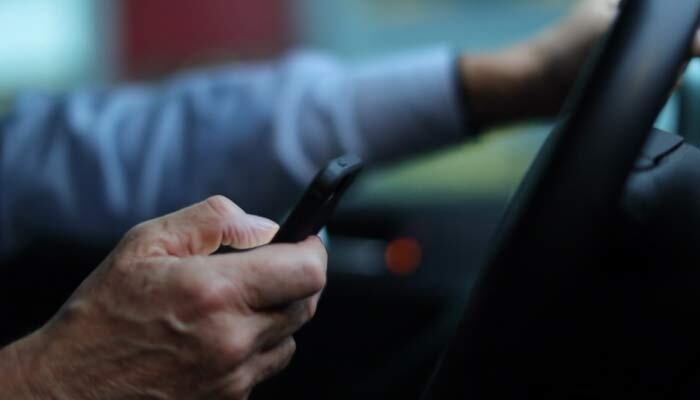
IOWA CITY, Iowa (IOWA CAPITAL DISPATCH) - The signs of a driver not fully focused on the road can be subtle — how and where eyes move, pupil dilation and reaction time, how tense or relaxed their face is — and these indicators can point to a number of causes.
As technology improves and more monitors for driving are being introduced, researchers from the University of Iowa are working to determine differences in types of driving distractions to better address them.
Researchers at the UI Driving Safety Research Institute are testing drivers' abilities under a range of impairments to see if unique tells can be spotted by technology, with the overall goal of turning people's attention back to the road.
Timothy Brown, director of drugged driving research at the UI, said technology for identifying whether someone is driving while unable to do so safely is evolving and becoming more common, especially in industries where fleets of vehicles are employed and supervised.
"There are a lot of forms of impairment out there, and I think there's a renewed focus on trying to keep people safe on the roads and reducing impairment-related crashes," Brown said.
Types of impairment Brown mentioned included those from alcohol, drugs, drowsiness and general distraction. The UI researcher and professor said he has studied "driver monitoring" and identification of different kinds of impairment on and off since the 1990s, diving into whether vehicle signals could indicate an impaired driver and more.
Technology has improved over time, he said, going from eye movement detectors that cost as much as $60,000 to single-camera systems that can track everything from eye movement to facial expressions to how relaxed or tight someone's skin is.
However, many signs of general impairment can point to multiple causes, and Brown said he hopes the research he is conducting will provide information on whether there are specific indicators that can be isolated and categorized with their problem.
"Right now we're looking at the ability to actually detect and differentiate from other forms of impairment," Brown said.
How to handle these impairments will be up to car manufacturers if they want to implement monitoring technology, Brown said. Industries most interested in this technology include construction and other areas where employees operate vehicles and heavy machinery.
UI researchers will study people's driving under different forms of impairment over three sessions, Brown said — two tests where people will drive after consuming enough alcohol to be over the legal limit and one where they will drive sober and alert, then again sober and drowsy. Distraction testing will also be incorporated into the tests.
Participants have already started coming in, Brown said, and he hopes the team will complete data collection in November and analysis by early next summer.
Brown said steps have been taken at the federal and state level to address different types of impaired driving. State lawmakers passedlegislationIn spring, a ban on the use of phones and other handheld electronic devices while driving will be implemented if not in voice-activated or hands-free mode, with police currently issuing warnings to violators. The law is set to take full effect, making this violation a simple misdemeanor, at the start of the new year.
When testing technology to detect impairments, Brown said it's necessary to consider the possibility of people using it for the wrong reasons. The goal of such technology is to prevent people from driving drowsy, distracted or drunk, not for them to rely on it "as a crutch."
This is really meant to help people when they are not able to make those judgments appropriately, rather than for them to use them to say, 'Oh, the car says I'm safe to drive,' " Brown said. "That's not the intent of the systems, it's not the way they will be implemented, but it is an important consideration from a research perspective as we go through it, to make sure that the technologies don't open themselves up to misuse.

0 comments:
Ikutan Komentar