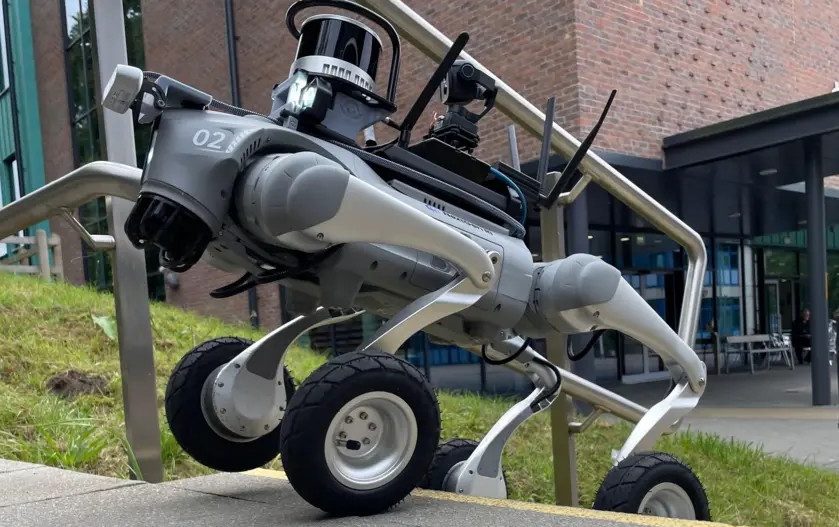
A robot police dog will be trialled in the UK for the first time to hunt criminals.
Nottinghamshire Police say the remote-controlled dog, which is equipped with thermal imaging cameras, could be in service as soon as next year.
The remote-controlled robot is able to produce detailed three-dimensional scans of internal spaces, which will enable officers to accurately map entry and exit routes in dangerous situations.
Thefour-legged unitHas the ability to climb stairs and can operate in complete silence.
The device, funded by the Office of the Chief Scientific Adviser, will be put through a rigorous programme of testing by the force's firearms training unit.
Over the next 12 weeks, it will be inserted into various training scenarios which may include armed sieges, hostage negotiations, and building searches.
The results will then be fed back to the Home Office, along with recommendations on how it can be used in frontline policing.
The robot was designed by Nathan Wallace, 22, from Gedling, Nottinghamshire.
He said: "It can be used like a land-based drone and is equipped with several cameras which could prove an asset to officers."
We have an AI camera which can detect weapons - so handguns, knives, baseball bats, hammers, that sort of thing.
The robot is also equipped with a loudspeaker allowing officers to issue commands to a suspect remotely, and a detection system which can accurately scan internal spaces and its surroundings.
It essentially uses lasers and pings them out against a wall," said Mr. Wallace. "Then on the back, we've got cameras which are all viewable by the remote, so we've got a kilometre of range there.
Enhance officer and public safety
The Nottinghamshire force, which hopes the robot could be used for reconnaissance during an incident involving chemical or biological agents, said there were "absolutely no plans" to fit theRobot with weaponsand they would not replace traditional police dogs.
Supt Louise Clarke said: "While"still in its infancy, it is not hard to see how thistechnologycan and will be used in the future to protect and serve the public.
In the right circumstances this equipment can enhance officer and public safety but will always complement the appropriate deployment of armed officers to safeguard the public.
In the unlikely event of an incident involving chemical or biological agents, for example, we would have access to another form of reconnaissance to gather vital information about a dangerous situation.
It is really exciting to be at the forefront of what could be a revolution in policing.technology.”
Sign up to the Front Page newsletter for free: Your essential guide to the day's agenda from The Telegraph - direct to your inbox seven days a week.

0 comments:
Ikutan Komentar