A New Era of Manufacturing at Hyundai’s Ellabell Plant
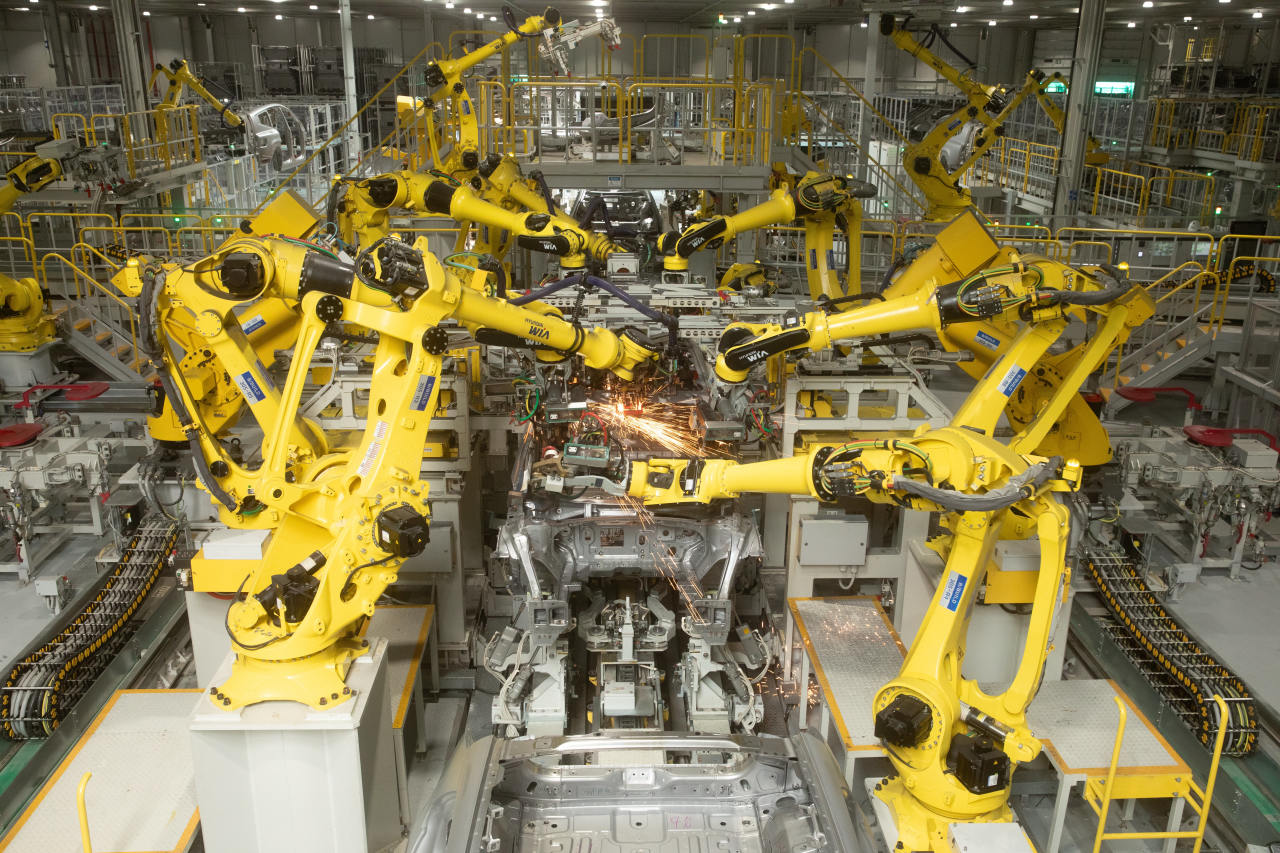
In the heart of Georgia, near Savannah, a state-of-the-art automobile manufacturing facility has taken shape. This is the new plant operated by the Hyundai Motor Group, a hub of innovation where technology and human expertise converge. The factory is home to an impressive array of robotic systems that perform a wide range of tasks, from moving materials and attaching doors to conducting nearly all welding operations.
Among the most eye-catching features are the dog-like robots equipped with cameras, which roam the floor to inspect partially assembled Ioniq electric vehicles. These robots are part of a larger system that includes 750 robots, not counting the hundreds of autonomous guided vehicles (AGVs) that navigate the facility. Approximately 1,450 employees work alongside these machines, maintaining a human-to-robot ratio of about 2-to-1, significantly lower than the U.S. auto-industry average of 7-to-1.
While robots handle many tasks, humans still play a crucial role in certain areas. They are responsible for identifying imperfections such as burrs or trim issues, installing fabric door panels, connecting electrical components, and accessing tight spaces to secure seats and shock absorbers. According to Hyundai Motor Co. CEO José Muñoz, the design of the plant ensures that robots tackle dangerous, repetitive, or physically demanding tasks, while humans focus on troubleshooting, quality monitoring, and adding craftsmanship to the process.
Unice Youmans exemplifies this human touch. She works on the metal-finishing line, removing dents, sanding imperfections, and cleaning frames before they move to the paint shop. “I don’t think it’s something that a machine can do because we have to be very hands-on with these cars,” she says.
Hyundai has committed to hiring 8,500 people at the Ellabell site by 2031 as part of a $2 billion incentive package from the state of Georgia. However, some workers express concerns about job security given the prevalence of robots. Salem Elzway, a postdoctoral fellow at Vanderbilt University, notes that automation increases when human labor becomes more costly or less efficient.
The integration of robots into the workplace is not a new phenomenon. Industrial robotics began in 1961 when General Motors introduced Unimate, a claw-handed robot, into a New Jersey factory. Since then, the use of robots in manufacturing has expanded significantly, particularly in countries like South Korea, which has one of the lowest birthrates globally. This demographic trend has driven the adoption of automated systems.
Despite the high level of automation, the U.S. still faces a shortage of over 400,000 manufacturing jobs. Hyundai claims its Ellabell factory is meeting its hiring goals, offering a starting hourly wage of $23.66 for entry-level positions—higher than local averages. New hires undergo training at a state-funded center, learning to program robots to trace patterns and manipulate objects. They also develop manual skills, such as checking for scratches and selecting the correct number of bolts by feel.
Trainees often have mixed feelings about their robotic counterparts. Some fear being blamed for a robot's mistake, while others worry about job displacement. Stephanie Redmon, who moved from Houston to join the factory, sees the opportunity as exciting. “I just think it’s going to be really cool,” she said.
The Role of Advanced Robotics in Manufacturing
The human workforce is sparse in many parts of the Hyundai plant. Metal arms move steel slabs through presses that stamp out vehicle components, and an array of robots weld these parts together without human oversight. It is only after the frames emerge from the paint shop that people take over, working along two assembly lines to add seats, dashboards, and other components.
At one station, a robot installs the powertrain beneath the frame, fastening it with large bolts, while two workers add additional fasteners. Jerry Roach, head of the factory’s general assembly department, explains that tasks requiring tactile feedback, adaptability, and problem-solving are best handled by humans.
Hyundai plans to introduce humanoid robots known as Atlas, developed by Boston Dynamics—a company in which Hyundai holds a controlling stake. Videos show Atlas sorting and carrying parts, but details about its potential role in the Ellabell plant remain unclear.
Experts believe a complete robot takeover is still decades away. Jorgen Pedersen, CEO of the Advanced Robotics for Manufacturing Institute, points out that robots struggle with flexible materials like fabric and lack the adaptability of humans. He emphasizes that human capabilities in handling complex tasks are often underestimated.
Quality control remains a critical responsibility for human workers, both during and after the assembly process. Vehicles undergo final inspections on a test track outside the factory, where team leader Chico Murphy drives Ioniqs over uneven pavement, checks brakes, and listens for loose parts. He believes that as long as people drive cars, they will value human verification.
“I think they like knowing that a human is there,” Murphy said. “It makes them feel a little safer than just relying on some machine.”

0 comments:
Ikutan Komentar