Breakthrough in Artificial Photosynthesis Research
A team of researchers from the University of Basel has made significant progress in developing a molecule inspired by the natural process of photosynthesis. This new molecule is capable of storing two positive and two negative charges simultaneously when exposed to light. The ultimate goal of this research is to convert sunlight into carbon-neutral fuels, offering a sustainable alternative to traditional energy sources.
Photosynthesis is a vital biological process that enables plants to transform carbon dioxide into energy-rich molecules like sugar. This process not only sustains plant life but also forms the basis of the food chain for animals and humans. Through respiration, organisms break down these carbohydrates, releasing energy and producing carbon dioxide again, thus completing the cycle.
Inspired by this natural mechanism, scientists are working on creating artificial systems that mimic photosynthesis. These systems aim to produce high-energy compounds such as hydrogen, methanol, and synthetic gasoline using sunlight. If burned, these fuels would emit only the same amount of carbon dioxide that was used to create them, making them carbon-neutral.
A Molecule with Unique Properties
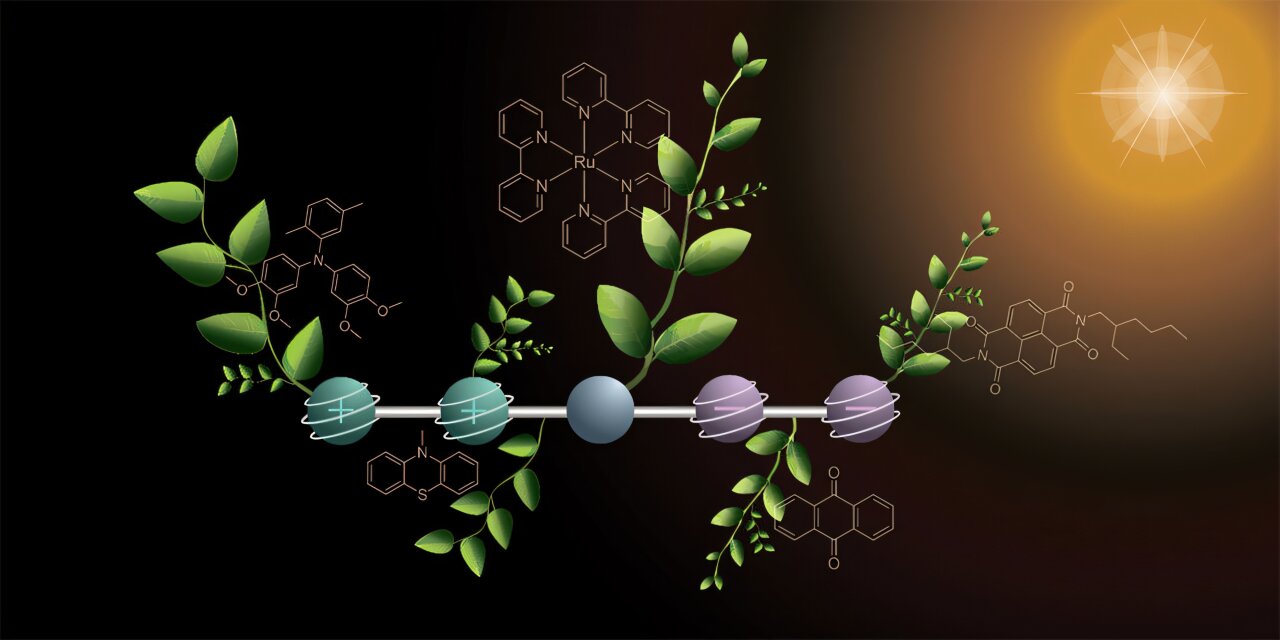
In a recent study published in Nature Chemistry, Professor Oliver Wenger and his doctoral student Mathis Brändlin introduced a groundbreaking molecule designed to store multiple charges at once. This molecule can hold four charges—two positive and two negative—when exposed to light. The ability to store multiple charges is crucial for converting sunlight into usable chemical energy, as these charges can drive various reactions, such as splitting water into hydrogen and oxygen.
The structure of the molecule consists of five distinct parts arranged in a sequence, each with a specific role. One side of the molecule contains two components that release electrons, resulting in a positive charge. On the opposite side, two other components absorb electrons, leading to a negative charge. In the center, a component captures sunlight and initiates the electron transfer process.
Two Steps Using Light
To generate the four charges, the researchers employed a stepwise approach involving two flashes of light. The first flash triggers a reaction that creates one positive and one negative charge. These charges then move toward the ends of the molecule. A second flash of light causes the same reaction again, resulting in two positive and two negative charges being stored within the molecule.
This method allows the use of significantly dimmer light than previously required, bringing the technology closer to practical applications under natural sunlight conditions. Earlier methods relied on intense laser light, which was not feasible for real-world implementation. Additionally, the charges generated in the molecule remain stable long enough to be utilized in further chemical processes.
Potential for Sustainable Energy
While the current molecule does not yet form a complete artificial photosynthesis system, it represents an important milestone in the field. "We have identified and implemented an essential piece of the puzzle," says Wenger. The findings from this study enhance our understanding of the electron transfer processes critical to artificial photosynthesis.
Researchers hope that this advancement will contribute to the development of sustainable energy solutions. By mimicking the efficiency of natural photosynthesis, future technologies could provide clean, renewable energy sources that reduce dependence on fossil fuels.
Future Implications
The research conducted by the University of Basel team highlights the potential of molecular engineering in addressing global energy challenges. As scientists continue to refine these systems, the possibility of creating efficient, carbon-neutral fuels becomes increasingly viable.
This breakthrough underscores the importance of interdisciplinary collaboration between chemistry, biology, and engineering. With continued innovation and investment, the vision of artificial photosynthesis may soon become a reality, paving the way for a more sustainable and environmentally friendly energy future.

0 comments:
Ikutan Komentar