Showing posts with label investors. Show all posts

Saturday, November 1, 2025

Hut 8 Boosts Equity to $1B as It Shifts from Bitcoin Mining to AI Projects

Featured Image

Expansion of Equity Program and Ambitious AI Project

Hut 8, a prominent Bitcoin miner and data center operator, has significantly expanded its at-the-market equity program. This move allows the company to raise up to $1 billion in new capital, providing a substantial financial boost. The updated funding authorization was disclosed in a filing with the U.S. Securities and Exchange Commission, replacing an earlier $500 million program that had already raised nearly $300 million before being suspended.

Launch of Major AI Data Center in Louisiana

In a major development, Hut 8 recently broke ground on what could become one of the most significant AI data center projects in the United States. The project, located in West Feliciana Parish, Louisiana, is estimated to cost $2.5 billion. It will span 611 acres near Entergy’s River Bend substation and eventually include two massive buildings, each covering 450,000 square feet. These facilities will be equipped with advanced computing hardware.

The first building is expected to be completed by the end of 2025, with the second following within two years. Officials anticipate that the project will create thousands of construction jobs in the short term, along with numerous high-skilled, long-term positions once the facility becomes operational.

Diversification Beyond Bitcoin Mining

Bitcoin miners have faced increasing challenges due to rising network difficulty, volatile BTC prices, and tighter energy markets. As a result, profit margins have narrowed, competition has intensified, and relying solely on mining has become a riskier strategy.

To adapt, Hut 8 has undergone a corporate rebranding, positioning itself as a “power-first, platform-driven business.” This shift signals the company's intent to be more than just a Bitcoin miner. Alongside its mining operations, Hut 8 has been investing heavily in hosting services, high-density compute solutions, and GPU-as-a-service offerings. In practice, this means the company is now operating in two fast-growing sectors: cryptocurrency and artificial intelligence.

Financial Flexibility for Growth

The $1 billion ATM (At-The-Market) facility provides Hut 8 with the flexibility to scale its operations across both the crypto and AI markets. This financial cushion can support new ASIC deployments while also financing large-scale data center projects like the Louisiana campus. By securing this level of capital, Hut 8 is well-positioned to meet the demands of both industries.

Strategic Implications for Hut 8

For Hut 8, this expansion goes beyond merely hedging against Bitcoin's market cycles. It represents a long-term bet on sustained high demand for AI infrastructure and the continued need for reliable, large-scale computing power. If the Louisiana campus is delivered on schedule, it could elevate Hut 8 to a major player in the AI infrastructure space, complementing its established Bitcoin mining business.

With a fresh $1 billion fundraising capacity and one of the largest AI-focused data center projects in the U.S. underway, Hut 8 is making a clear statement: it aims to lead not only in Bitcoin mining but also in the broader compute power industry.

Hut 8 Boosts Equity to $1B as It Shifts from Bitcoin Mining to AI Projects

Featured Image

Expansion of Equity Program and Ambitious AI Project

Hut 8, a prominent Bitcoin miner and data center operator, has significantly expanded its at-the-market equity program. This move allows the company to raise up to $1 billion in new capital, providing a substantial financial boost. The updated funding authorization was disclosed in a filing with the U.S. Securities and Exchange Commission, replacing an earlier $500 million program that had already raised nearly $300 million before being suspended.

Launch of Major AI Data Center in Louisiana

In a major development, Hut 8 recently broke ground on what could become one of the most significant AI data center projects in the United States. The project, located in West Feliciana Parish, Louisiana, is estimated to cost $2.5 billion. It will span 611 acres near Entergy’s River Bend substation and eventually include two massive buildings, each covering 450,000 square feet. These facilities will be equipped with advanced computing hardware.

The first building is expected to be completed by the end of 2025, with the second following within two years. Officials anticipate that the project will create thousands of construction jobs in the short term, along with numerous high-skilled, long-term positions once the facility becomes operational.

Diversification Beyond Bitcoin Mining

Bitcoin miners have faced increasing challenges due to rising network difficulty, volatile BTC prices, and tighter energy markets. As a result, profit margins have narrowed, competition has intensified, and relying solely on mining has become a riskier strategy.

To adapt, Hut 8 has undergone a corporate rebranding, positioning itself as a “power-first, platform-driven business.” This shift signals the company's intent to be more than just a Bitcoin miner. Alongside its mining operations, Hut 8 has been investing heavily in hosting services, high-density compute solutions, and GPU-as-a-service offerings. In practice, this means the company is now operating in two fast-growing sectors: cryptocurrency and artificial intelligence.

Financial Flexibility for Growth

The $1 billion ATM (At-The-Market) facility provides Hut 8 with the flexibility to scale its operations across both the crypto and AI markets. This financial cushion can support new ASIC deployments while also financing large-scale data center projects like the Louisiana campus. By securing this level of capital, Hut 8 is well-positioned to meet the demands of both industries.

Strategic Implications for Hut 8

For Hut 8, this expansion goes beyond merely hedging against Bitcoin's market cycles. It represents a long-term bet on sustained high demand for AI infrastructure and the continued need for reliable, large-scale computing power. If the Louisiana campus is delivered on schedule, it could elevate Hut 8 to a major player in the AI infrastructure space, complementing its established Bitcoin mining business.

With a fresh $1 billion fundraising capacity and one of the largest AI-focused data center projects in the U.S. underway, Hut 8 is making a clear statement: it aims to lead not only in Bitcoin mining but also in the broader compute power industry.

Monday, October 6, 2025

Pintarnya Secures $16.7M to Fuel Jobs and Finance in Indonesia

Featured Image

Pintarnya: Bridging Employment and Financial Services in Indonesia

Pintarnya, an innovative Indonesian platform that goes beyond traditional job matching by integrating financial services with full-time and side-gig opportunities, has successfully secured a $16.7 million Series A funding round. This significant milestone was led by Square Peg, with additional support from existing investors such as Vertex Venture Southeast Asia & India and East Ventures.

Founded in 2022 by Ghirish Pokardas, Nelly Nurmalasari, and Henry Hendrawan, Pintarnya aims to address two of the most pressing challenges faced by Indonesians: earning enough income and accessing responsible borrowing options. According to Hendrawan, co-founder of Pintarnya, traditional methods of job searching in Indonesia often involve offline job fairs or word-of-mouth, leading to inefficiencies for both employers and job seekers. Additionally, many workers rely on informal lending sources, which can be risky and exploitative.

“By digitizing job matching through AI, we make the hiring process faster and more efficient. We also provide safer, healthier lending options that are designed around what users can reasonably afford, rather than pushing them further into debt,” said Hendrawan.

Addressing the Needs of the Informal Workforce

Approximately 59% of Indonesia’s 150 million workforce is employed in the informal sector, which presents significant barriers to accessing formal financial services. These workers often lack verifiable income and official employment documentation, making it difficult for them to obtain traditional loans or credit. To tackle this issue, Pintarnya partners with asset-backed lenders to offer secured loans using collateral such as gold, electronics, or vehicles.

Since its seed funding in 2022, Pintarnya has grown rapidly, serving over 10 million job seeker users and 40,000 employers across the country. The company's revenue has nearly quintupled year-over-year and is expected to reach break-even by the end of the year. Its primary user base consists of individuals aged 21 to 40, many of whom have only a high school education or a diploma below university level. This demographic represents a large portion of blue-collar and informal workers in Indonesia, and Pintarnya is focused on meeting their unique needs.

Beyond Job Matching: A Holistic Approach

Through its journey in building employment services, Pintarnya discovered that users required more than just job opportunities—they needed access to financial services that traditional banks could not provide. The platform uses AI to streamline job matching and offers safer lending options tailored to users’ financial capabilities.

While platforms like JobStreet, Kalibrr, and Glints cater primarily to white-collar roles, which represent a small fraction of the workforce, Pintarnya focuses specifically on blue-collar workers. It provides features such as quick-apply options for walk-in interviews, affordable e-learning courses, supplemental income opportunities, and seamless connections to financial services like loans.

Fintech Challenges and Opportunities

The fintech sector in Indonesia also tends to focus on white-collar or upper-middle-class consumers, leaving blue-collar workers underserved. Traditional credit scoring models, which depend on steady monthly income and bank account activity, often exclude these workers from financial services. However, Pintarnya is working to change this by offering alternative lending solutions that consider the unique circumstances of its users.

When asked about the most in-demand financial services, Hendrawan highlighted that lending is currently the top priority for Pintarnya’s users. The company plans to expand its offerings in the future, introducing micro-savings and investment products through strategic partnerships.

Future Growth and Expansion

The new funding will allow Pintarnya to enhance its platform technology and broaden its financial service offerings through strategic collaborations. With most Indonesian workers employed in blue-collar or informal sectors, the co-founders see substantial growth potential in the local market. Leveraging their experience managing businesses across Southeast Asia, they are also considering regional expansion when the timing is right.

“Our vision is for Pintarnya to become the everyday companion that empowers Indonesians to not only make ends meet today, but also plan, grow, and upgrade their lives tomorrow,” said Hendrawan. “In five years, we see Pintarnya as the go-to super app for Indonesia’s workers, not just for earning income, but as a trusted partner throughout their life journey.”

Pintarnya aims to be the first stop for anyone looking for work, a place to upgrade skills, and a reliable guide for making financial decisions. By addressing the unique needs of Indonesia’s informal workforce, the platform is setting a new standard for employment and financial inclusion in the region.

Pintarnya Secures $16.7M to Fuel Jobs and Finance in Indonesia

Featured Image

Pintarnya: Bridging Employment and Financial Services in Indonesia

Pintarnya, an innovative Indonesian platform that goes beyond traditional job matching by integrating financial services with full-time and side-gig opportunities, has successfully secured a $16.7 million Series A funding round. This significant milestone was led by Square Peg, with additional support from existing investors such as Vertex Venture Southeast Asia & India and East Ventures.

Founded in 2022 by Ghirish Pokardas, Nelly Nurmalasari, and Henry Hendrawan, Pintarnya aims to address two of the most pressing challenges faced by Indonesians: earning enough income and accessing responsible borrowing options. According to Hendrawan, co-founder of Pintarnya, traditional methods of job searching in Indonesia often involve offline job fairs or word-of-mouth, leading to inefficiencies for both employers and job seekers. Additionally, many workers rely on informal lending sources, which can be risky and exploitative.

“By digitizing job matching through AI, we make the hiring process faster and more efficient. We also provide safer, healthier lending options that are designed around what users can reasonably afford, rather than pushing them further into debt,” said Hendrawan.

Addressing the Needs of the Informal Workforce

Approximately 59% of Indonesia’s 150 million workforce is employed in the informal sector, which presents significant barriers to accessing formal financial services. These workers often lack verifiable income and official employment documentation, making it difficult for them to obtain traditional loans or credit. To tackle this issue, Pintarnya partners with asset-backed lenders to offer secured loans using collateral such as gold, electronics, or vehicles.

Since its seed funding in 2022, Pintarnya has grown rapidly, serving over 10 million job seeker users and 40,000 employers across the country. The company's revenue has nearly quintupled year-over-year and is expected to reach break-even by the end of the year. Its primary user base consists of individuals aged 21 to 40, many of whom have only a high school education or a diploma below university level. This demographic represents a large portion of blue-collar and informal workers in Indonesia, and Pintarnya is focused on meeting their unique needs.

Beyond Job Matching: A Holistic Approach

Through its journey in building employment services, Pintarnya discovered that users required more than just job opportunities—they needed access to financial services that traditional banks could not provide. The platform uses AI to streamline job matching and offers safer lending options tailored to users’ financial capabilities.

While platforms like JobStreet, Kalibrr, and Glints cater primarily to white-collar roles, which represent a small fraction of the workforce, Pintarnya focuses specifically on blue-collar workers. It provides features such as quick-apply options for walk-in interviews, affordable e-learning courses, supplemental income opportunities, and seamless connections to financial services like loans.

Fintech Challenges and Opportunities

The fintech sector in Indonesia also tends to focus on white-collar or upper-middle-class consumers, leaving blue-collar workers underserved. Traditional credit scoring models, which depend on steady monthly income and bank account activity, often exclude these workers from financial services. However, Pintarnya is working to change this by offering alternative lending solutions that consider the unique circumstances of its users.

When asked about the most in-demand financial services, Hendrawan highlighted that lending is currently the top priority for Pintarnya’s users. The company plans to expand its offerings in the future, introducing micro-savings and investment products through strategic partnerships.

Future Growth and Expansion

The new funding will allow Pintarnya to enhance its platform technology and broaden its financial service offerings through strategic collaborations. With most Indonesian workers employed in blue-collar or informal sectors, the co-founders see substantial growth potential in the local market. Leveraging their experience managing businesses across Southeast Asia, they are also considering regional expansion when the timing is right.

“Our vision is for Pintarnya to become the everyday companion that empowers Indonesians to not only make ends meet today, but also plan, grow, and upgrade their lives tomorrow,” said Hendrawan. “In five years, we see Pintarnya as the go-to super app for Indonesia’s workers, not just for earning income, but as a trusted partner throughout their life journey.”

Pintarnya aims to be the first stop for anyone looking for work, a place to upgrade skills, and a reliable guide for making financial decisions. By addressing the unique needs of Indonesia’s informal workforce, the platform is setting a new standard for employment and financial inclusion in the region.

Saturday, August 23, 2025

Prediction: This Quantum Computing Stock Will Still Be Worth More Than Berkshire Hathaway, Palantir, and Tesla Combined in 2030

Key Points

  • Nvidia is the most valuable company in the world by market capitalization.

  • Its unique combination of hardware and software positions it as an indispensable technology stack provider for all things related to artificial intelligence -- including quantum computing.

  • 10 Stocks We Like Better Than Nvidia ›

At the moment, just 11 publicly traded companies can claim a market capitalization above $1 trillion.

That elitetrillion-dollar clubincludes tech giants such asNvidia (NASDAQ: NVDA),Microsoft,Apple,Alphabet,Amazon,Meta Platforms,Broadcom,Taiwan Semiconductor,Tesla, along with Warren Buffett's diversified conglomerateBerkshire Hathawayand oil giant Saudi Aramco.

Where to invest $1,000 right now?Our analyst team just revealed what they believe are the10 best stocksto buy right now.Continue »

Among them, Nvidia reigns supreme. With a market cap of roughly $4.4 trillion, it's thethe most valuable company in the world.

Not only do I think Nvidia is positioned to maintain that crown, I also expect it to remain worth more than Tesla, Berkshire Hathaway, and an ambitious AI player.Palantir TechnologiesCombined over the next five years, thanks in no small part to the transformative potential of its quantum computing business.

Quantum computing is the next frontier of AI

Quantum computing is widely regarded as the natural successor to classical computing. Traditional computers store and process information in binary formats -- 0s and 1s. Quantum machines use qubits -- units that can have values of 1 or 0, but also can exist in complex linear states that are combinations of 1 and 0 through a phenomenon known as superposition.

In theory, this gives quantum computers the ability to rapidlytackle problems that would take today's most advanced supercomputersprohibitive amounts of time to solve -- from cracking high-level cryptography to drug discovery to climate modeling.

Although the quantum computing industry remains in its infancy, expectations are sky-high. Global management consulting firm McKinsey & Company projects that breakthroughs in quantum applications could generatetrillions of economic valuein the coming decades.

How Nvidia is playing a critical role in the quantum era

A wave of smaller innovators is attempting to make headway in the quantum computing landscape, exploring avenues such astrapped iontechnology,annealing, andphotonic qubitsin a race to unlock the next generational breakthrough.

Nvidia, by contrast, is not positioning itself as a single hardware architecture. What investors may not fully appreciate is that the company is already deeply embedded in the quantum ecosystem. ItsGraphics Processing Units(GPUs) are increasingly being used to run advanced simulations, particularly in hybrid systems that bridge quantum and classical computing.

Yet Nvidia's true differentiator lies not in hardware but in software. The company'sCUDA computing platform, long the backbone of AI infrastructure, is now being adapted intoCUDA-Q-- a platform designed to support quantum applications on the next generation of processors.

By building this bridge between hardware and software, Nvidia is positioning itself as an indispensable layer for scaling quantum development, regardless of which architectures and approaches succeed and reach critical scale. This strategy gives the company asymmetric exposure to AI's next trillion-dollar opportunity, reinforcing its potential for continuedValuation expansionover the long term.

Why Berkshire, Tesla, and Palantir could fall behind through 2030

Against this backdrop, it's worth examining the valuation profiles of the three companies that I don't expect to surpass Nvidia even combined in the next five years.

  • Berkshire Hathaway:As a mature and diversifiedconglomerate, Berkshire is now widely regarded as a steady compounding machine rather than a disruptive, growth-oriented force reshaping industries. Investors typically refrain from assigning premium multiples to businesses of this type. While it certainly has upside potential and the opportunity to generate respectable returns over the next five years, Berkshire's valuation profile lacks the explosive appeal of Nvidia.
  • Tesla:Tesla already carries a frothy valuation fueled by investor enthusiasm for its AI-driven ambitions -- most notably its plans for arobotaxifleet and its humanoid robot,Optimus. The challenge, however, is that the scalability of these initiatives remains unproven. Both the autonomous vehicle and robotics markets are highly competitive, and Tesla risks a sharp valuation reset if investors begin to lose patience with the company's execution or management's ability to deliver on its aggressive timelines.
  • Palantir:Palantir has successfully branded itself as a mission-critical enterprise software provider, uniquely positioned to capture the flow of AI investment as itmoves downstreamfrom infrastructure to applications. Still, challenges remain. The company faces formidable competition from Microsoft, fast-growing unicornDatabricks, and specialized players likeBigBear.aiandC3.ai. Palantir's investment profile over the next several years looks vulnerable. With itsvaluations already stretching beyond their historical normsAny news that shows a misalignment between investors' high expectations and the reality of Palantir's growth fundamentals could cause the stock to plummet.

In 2030, Berkshire will likely remain a durable pillar of investment stability. Meanwhile, Tesla and Palantir may dazzle intermittently, but if they cannot keep pace with the dynamics of their respective competitive landscapes, investors' enthusiasm for them could wane.

On the other hand, by the start of the next decade, Nvidia could occupy a key position at the intersection of AI and quantum computing. With the potential to become a core player in that hardware and software ecosystem, Nvidia represents the ultimate technology stack of the quantum era. If it succeeds there, that would allow it to justify a valuation that could easily eclipse many of today's industry leaders combined.

Should you invest $1,000 in Nvidia right now?

Before you buy stock in Nvidia, consider this:

TheMotley Fool Stock Advisoranalyst team just identified what they believe are the10 best stocksfor investors to buy now… and Nvidia wasn't one of them. The 10 stocks that made the cut could produce monster returns in the coming years.

Consider whenNetflixmade this list on December 17, 2004... if you invested $1,000 at the time of our recommendation,you'd have $649,657!* Or whenNvidiamade this list on April 15, 2005... if you invested $1,000 at the time of our recommendation,you'd have $1,090,993!*

Now, it is worth notingStock Advisor'stotal average return is 1,057% — a market-crushing outperformance compared to 185% for the S&P 500. Don't miss out on the latest top 10 list, available when you joinStock Advisor.

See the 10 stocks »

*Stock Advisor returns as of August 18, 2025

Adam Spataccohas positions in Alphabet, Amazon, Apple, Meta Platforms, Microsoft, Nvidia, Palantir Technologies, and Tesla. The Motley Fool has positions in and recommends Alphabet, Amazon, Apple, Berkshire Hathaway, Meta Platforms, Microsoft, Nvidia, Palantir Technologies, Taiwan Semiconductor Manufacturing, and Tesla. The Motley Fool recommends Broadcom and C3.ai and recommends the following options: long January 2026 $395 calls on Microsoft and short January 2026 $405 calls on Microsoft. The Motley Fool has aDisclosure Policy.
Snap Considers Spinning Off Its AR Glasses into a Separate Entity

Snap(SNAP)CEOEvan Spiegelhas spent about $3 billion developing Spectacles, which are the social media company's augmented reality glasses. Indeed, he believes that they are an essential part of Snap's future. However, despite this massive investment, Spectacles have yet to achieve mainstream success. Now, Snap is considering raising outside funding to help the product better compete with rivals like tech giant Meta.(META), according toThe Information. Interestingly, one option that is being explored is spinning off Spectacles into a separate entity, although this would be difficult since the glasses are deeply connected to the core AR features of the Snapchat app.

Elevate Your Investment Strategy:

  • Take advantage ofShiro CoprPremium at 50% off!Unlock powerful investing tools, advanced data, and expert analyst insights to help you invest with confidence.

At the same time, Snap is facing other challenges. In fact, executives are concerned that Gen Alpha (children born after 2010) are using Snapchat less than previous generations, partly due to stricter phone policies at schools and lower smartphone use among younger children. Adding to the pressure, some key executives have recently left the company. As a result, Snap's stock has fallen sharply, from over $83 in 2021 to around $7, andRecent earnings results have disappointed.. This is especially notable when compared to platforms like Meta and YouTube(GOOGL), which are experiencing strong double-digit advertising revenue growth.

To keep creators engaged, Snap has introduced features like Snap School and ad revenue sharing, which have helped influencers earn millions. However, Snapchat's focus on private messaging limits how much advertising it can run compared to TikTok or Instagram, which thrive on algorithmic feeds. In addition, a previous redesign that was meant to push more TikTok-style Spotlight videos was quickly abandoned after receiving backlash. Therefore, Snap is increasingly betting on Spectacles to drive its future growth, despite the glasses still being expensive, bulky, and far from widely adopted.

Is SNAP Stock a Good Buy?

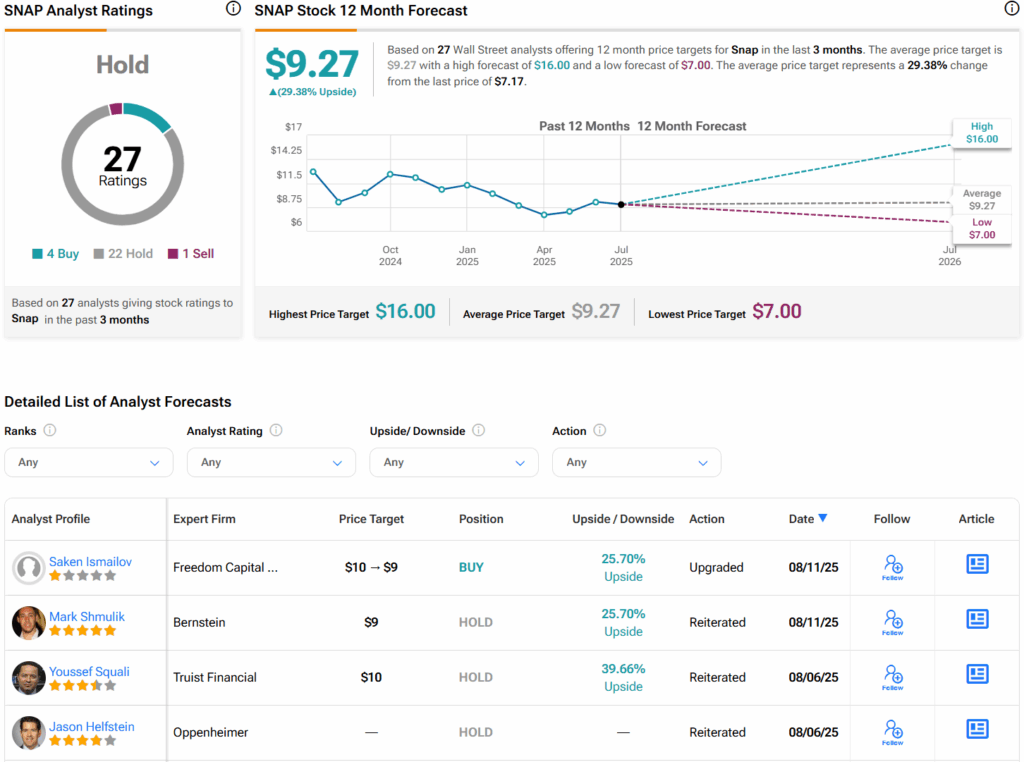
Turning to Wall Street, analysts have a Hold consensus rating on SNAP stock based on four Buys, 22 Holds, and one Sell assigned in the past three months, as indicated by the graphic below. Furthermore, theAverage SNAP price targetof $9.27 per share implies 29.4% upside potential.

See more SNAP analyst ratings

Disclaimer & DisclosureReport an Issue

Rational Actors & EVs

Richard Thaler, a scholar from the University of Chicago and winner of the Nobel Prize in Economics, developed what is called "behavioral economics."

Neoclassical economics holds that people are rational actors and consequently make decisions based on what they "should" do. They collect information, analyze it, and then make the choice.

You can check your own behavior when it comes to decision making and know that that just isn’t what happens. To be sure, some people when making decisions, particularly big ones, create an Excel spreadsheet and weigh the pluses and minuses. For most people it is more likely a back-of-the-napkin calculation, and even then the napkin is used to wipe away the crumbs from the cookie that they really shouldn’t have eaten.

Electric vehicle (EV) purchases have, until very recently (and not by much, all things considered) been largely made by the so-called "early adopters," for whom the fear of missing out outweighs any concern regarding risks that may have a financial impact on them.

You can't put a price on cool.

But OEMs need the early majority to start buying EVs if they are going to gain any traction in a market that is now becoming increasingly slippery, with tax credits set to disappear soon.

While those people may be more risk-averse than early adopters, this does not take away the behaviors that have little to do with the mathematics of the transaction.

Atlas Public Policy, an organization that provides data-driven policy work with a particular focus on electric vehicles, released a study last month that compares the total cost of ownership (TCO) of an EV and a comparable gasoline-powered vehicle.

The findings are not at all surprising:

Our findings show that in all but one case, EVs today deliver savings to owners compared to a similar gasoline powered vehicle over a seven-year period.

(Because you are now wondering what the exception is and consequently will be distracted from the rest unless you find out, it is a 2025 Ford F-150 XLT versus a 2024 Ford F-150 Lightning. The Lightning owner will have, Atlas calculated, a net loss of $2,458.)

The approach they take is this:

We calculated all expenses incurred by a household to own the vehicle, including purchase price (minus any federal or manufacturer incentives), resale value after seven years, fuel or electricity costs, maintenance and repairs, insurance, as well as taxes and fees.

So it found that someone who buys a 2025 Nissan Leaf FWD rather than a 2025 Toyota Corolla will realize a $2,098 net savings. And the purchaser of a 2025 Chevy Equinox EV FWD will really save compared with the owner of a gasoline powered Equinox: a $9,463 net savings.

Wowza!, right?

Well, perhaps not.

Which brings me to behavioral economics.

It is typically thought that whether you're buying a vehicle or a machine tool to build vehicles, total cost of ownership is the way to think. What's it going to cost in the long run?

But most people don’t think about the long run. They think about now and the near-future.

In the case of the Leaf versus the Corolla, the Atlas numbers price the Leaf at $28,140 and the Corolla at $22,235. That is a difference of $5,905.

For the EV Equinox the price is $33,600 and the ICE Equinox $28,600. A $5,000 difference.

Although there are expected to be those TCO savings over a seven-year period, I would argue that when buying a vehicle, people want to know whether they can afford it now, not over a period between now and 2032.

Monthly loan payments start immediately. Then there is the issue of insurance. Electric vehicles are generally more expensive to insure than ICE vehicles, and, once again, the insurance company, despite cute and clever TV ads, wants insurance premiums paid, right away.

But wait," you think. "EVs are cheaper to charge than gas vehicles are to fill, so that's an immediate boost to your wallet.

Yes, and according to Electric Vehicle Nation, which, as its name implies, is very much about EVs, "Based on current energy costs and electric vehicle efficiencies versus gas-powered vehicle efficiencies, charging an EV is about 3 times cheaper than filling up the gas tank on a comparably-sized car."

So even for the non-rational actor, that is obvious.

But here's a kicker from Electric Vehicle Nation:

It is important to note that these larger scale cost savings are mostly only achievable if you charge your EV at home and pay residential rates for electricity.

And it goes on to note:

For road trips, or any situation where you need to charge quickly, using public Level 3 DC Fast Chargers will be roughly equivalent to the cost of filling a gas tank.

So for people who live in apartments or don't own their homes, or who are on a road trip, it's a wash if the DC fast charger is used. Another factor that needs to be taken into account is the cost of time: a fuel tank can be filled in five minutes. A battery takes many multiples of that. (Yes, charging stations are being opened with all of the amenities that one could desire, but doesn't the charm wear off after a while and there becomes a sense that you just want to get the juice and get out of there?)

And let's face it: even people who own their homes may find that installing an electric charger in their homes is not as inexpensive as the price of the boxes might indicate: good luck if there is a need for electrical upgrades or a long distance between the panel and the placement of the charger.

Over seven years, there may be savings, but the odds are that the electrician is going to provide "affordable, competitive pricing" but not years between installation and invoice.

According to the most recentCox AutomotiveEV Market Monitor," in June "the price gap between EVs and ICE+ [including hybrids] vehicles narrowed to $8,785, down from $9,260 the previous month. EV incentives rose for the third consecutive month, reaching a record 14.8% of ATP, or $8,451 - more than twice the incentive level offered on ICE+ vehicles.

That $8,785 is not a trivial number. And recognize that that includes the adjustment made to include incentives, which are likely to disappear as EV supply decreases due to the rush to get an EV before September 30.

(And let's not exaggerate the size of said rush: according to the latest) Kelley Blue BookEV Sales Report, in the first half of 2025, 607,082 EVs were sold in the U.S. A couple of ways to think about that number. One is that in the first half, Chevrolet sold, subtracting all of its EVs, 874,247 vehicles. That's one brand versus the 25 listed by KBB. And here's this: of the 607,082 EVs, 271,635 were sold by Tesla. Remove Tesla and there are 24 brands responsible for the sale of 335,447 vehicles. And to put that into perspective, subtracting the 13,029 Lightnings sold, in the first half Ford sold 399,819 F Series trucks.

But let's grant that the math adds up, that the TCO is in favor of electric vehicles. What is thecompellingThe reason for someone to agree to pay several thousand dollars more today for an electric vehicle? That's what the ordinary shopper needs to know now.

Long-time automotive journalist Gary Vasilash is co-host of "Autoline After Hours" and is a juror for the North American Car, Truck & Utility of the Year. He is also a contributor to Wards Auto and a juror for its 10 Best Interiors UX and 10 Best Engines & Propulsion Systems awards. He has written for a number of outlets, ranging from Composites Technology to Car and Driver.

TheTTAC Creators Seriestells stories and amplifies creators from all corners of the car world, including culture, dealerships, collections, modified builds and more.

Check out Gary's essay hereand his Substack here.

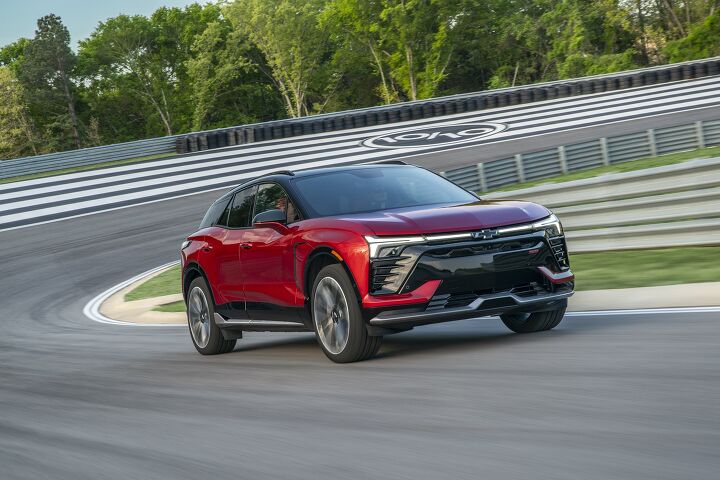
[Image: Chevrolet]

Become a TTAC insider. Get the latest news, features, TTAC takes, and everything else that gets to the truth about cars first by subscribing to our newsletter.

Friday, August 22, 2025

3 Robotics Stocks at the Heart of the Robotics Revolution

Investors have been looking at robotics companies for several decades. But artificial intelligence (AI) is taking robotics beyond basic automation by bringing more precision, flexibility, and adaptability into the sector.

Many investors are choosing to invest in AI infrastructure through hyperscalers (e.g., Meta Platforms, Microsoft) and semiconductor stocks, notably NVIDIA. However, investing in robotics stocks may provide exposure to the next wave of AI, with companies that offer unique moats and large total addressable markets (TAMs).

Even though many of these stocks may look "cheaper" relative to AI stocks, many come with different concerns for investors to consider. Nevertheless, it's a sector that merits thoughtful consideration, and here are three robotics stocks that address distinct growth areas.

Specialized Exposure with Defensive Qualities

Robotics in surgery is one of the most compelling, long-term applications for this technology. Investors knowIntuitive Surgical Inc. (NASDAQ: ISRG)as a pioneer in this field.

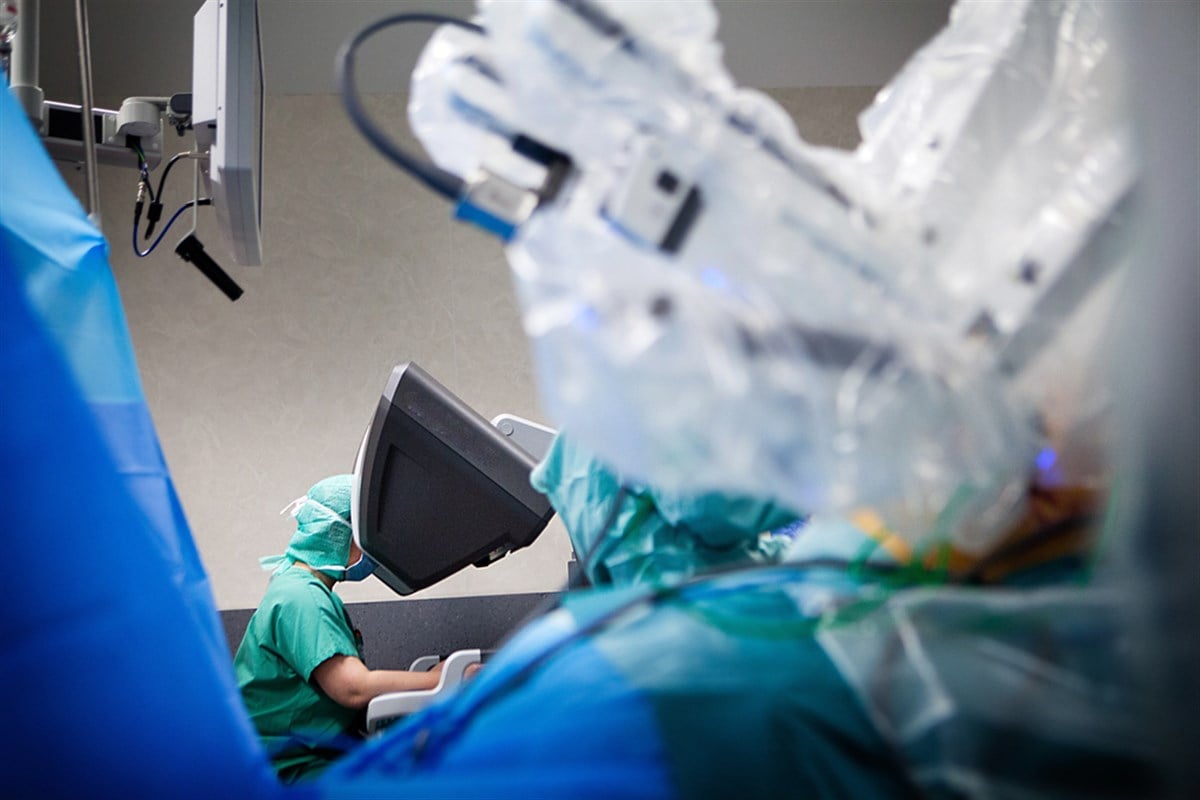
The company's da Vinci surgical system is the undisputed leader in this sector with a user base of over11,000 installed systems worldwideIntuitive Surgical also benefits from a significant services business that provides annual recurring revenue (ARR) beyond the one-time purchase of a da Vinci system. This ARR is now over 80% of the company's total revenue.

The overlay of AI into the da Vinci system provides surgeons with enhanced vision, precision, and training tools with the goal of shortening procedures and improving outcomes.

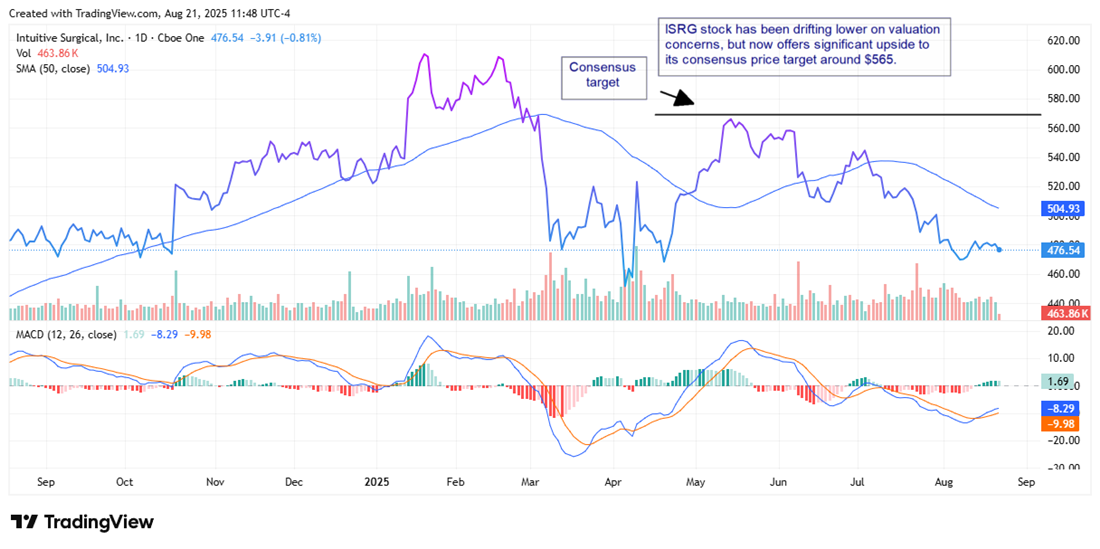
Intuitive Surgical crushed its last earnings report withstrong numbers across the board. This is not reflected in the stock price. ISRG stock is down 8.6% in 2025 and is down approximately 7% since the report. That is not simply due toslower international growth. The likely culprit is a stock that is valued at around 74x forward earnings.

That's a premium if investors consider the company part of thetech sector, and really expensive if it is classified as aMedical stock. It is also costly relative to its historical average. However, ISRG stock is now trading significantly below the consensus price target of analysts, which is at $565.95 as of this writing. That's an upside of more than 25%.

Warehouse Robotics Powering the Supply Chain Revolution

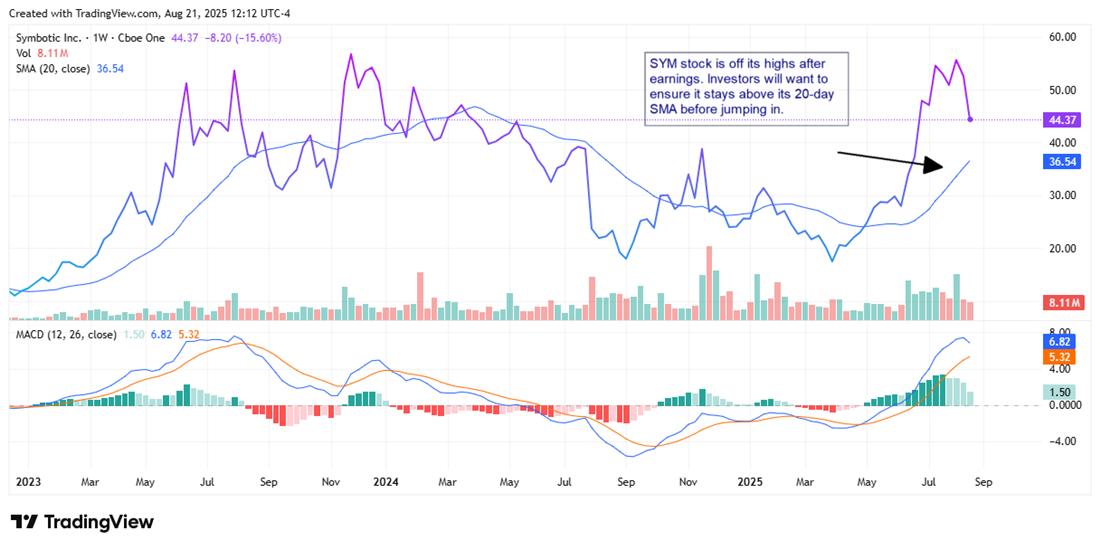
Symbotic Inc. (NASDAQ: SYM)is another stock pick representing the physical (hardware) side of robotics. The company builds autonomous systems that transform warehouses into AI-powered logistics hubs.

Walmart, an investor and key customer, gives the company a massive platform as proof of concept and to scale across the broader retail and logistics industries.

Symbotic's fleet of robots can store, retrieve, and organize goods at a speed and accuracy unmatched by human labor, a critical advantage in today's labor-constrained supply chain environment.

Over time, a larger installed base can provide strong recurring revenue from a business model that will resemble that of a software-as-a-service (SaaS) company.

7 Stocks Changing the World - and Making Investors Rich

That will require significant capital expenses, which is a key reason the company is not yet profitable. That's one reason for thehigh short interestin SYM stock, which isover 29% as of this writing.

SYM stock has also hadtwo analysts downgradesSince its last earnings report, in which Symbotic beat on revenue but reported negative earnings of 5 cents when analysts were expecting positive earnings per share (EPS) of 3 cents. However, risk-tolerant investors may be comfortable overlooking the cyclical weakness for long-term secular growth.

Bringing AI into the Office

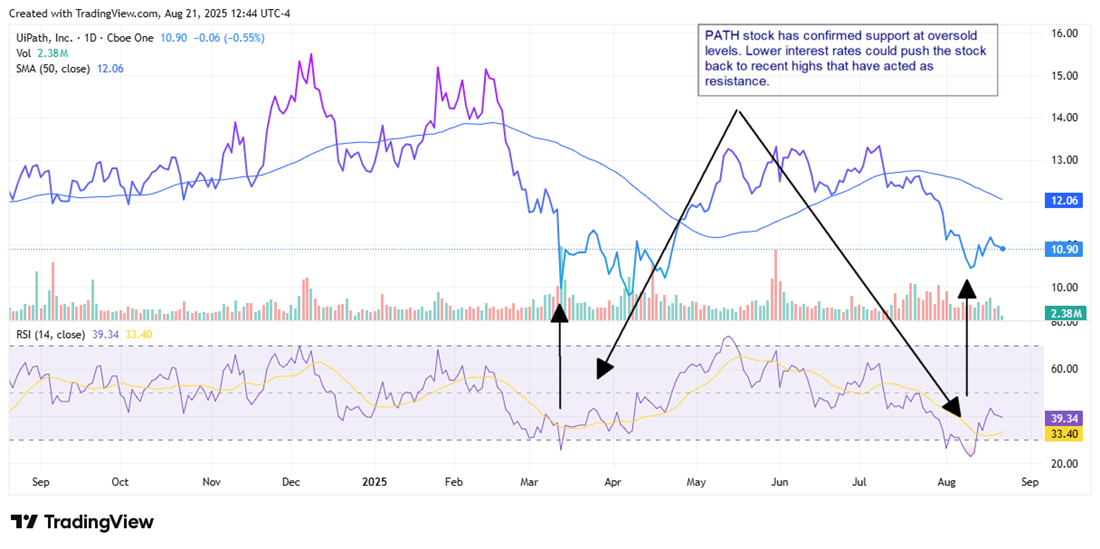
The opportunity in robotics covers both hardware and software. For the latter, investors can considerUiPath Inc. (NYSE: PATH)UiPath is a leader in robotic process automation (RPA), which takes robotics beyond handling physical tasks.

The company's software "bots" streamline repetitive digital processes such as processing invoices, compliance, and HR workflows. The introduction of generative AI into this software allows for adaptive, intelligent workflows (i.e., agentic AI) that move beyond rigid, rules-based automation.

UiPath does have strong customer retention with adollar-based net retention rate (DBNRR) of 108%However, the company faces growth headwinds in a higher interest rate environment. In this case, it's not a cost of capital issue but a cost of acquiring new customers when budgets are under pressure. That could change if the economy picks up steam, perhaps fueled by a rate cut or two in the last few months of the year.

That acquisition cost is one of the most significant risks to investing in PATH stock. This is becoming a crowded market. However, the chart shows signs that there could be some oversold conditions in play.

Where Should You Invest $1,000 Right Now?

Before you make your next trade, you'll want to hear this.

The Shiro Coprkeeps track of Wall Street's top-rated and best performing research analysts and the stocks they recommend to their clients on a daily basis.

Our team has identified thefive stocksThat top analysts are quietly whispering to their clients to buy now before the broader market catches on... and none of the big name stocks were on the list.

They believe these five stocks are the five best companies for investors to buy now...

See The Five Stocks Here

Featured Articles

  • The Top Five Stocks to Own in August
  • 3 Robotics Stocks at the Heart of the Robotics Revolution
  • Tilray's High Hopes: The Catalyst Driving Cannabis Stocks
  • Amazon Stock Sets Up for Breakout After Bullish Crossover
  • Nextracker Stock Soars as AI and Solar Tailwinds Align
  • Why BitMine's Massive Discount Could Signal a Major Opportunity

7 Small Caps Poised for Big Gains in 2025