
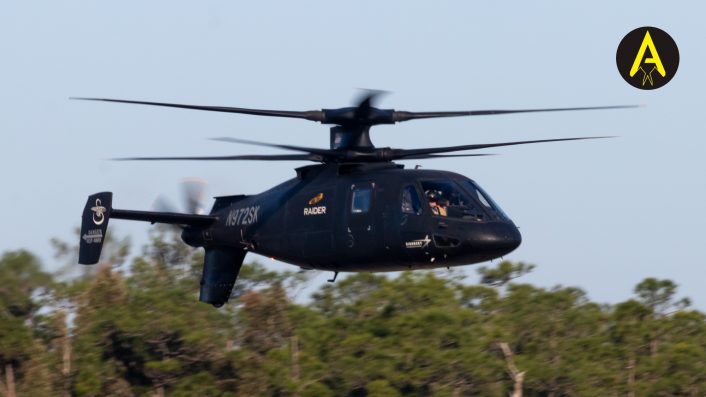
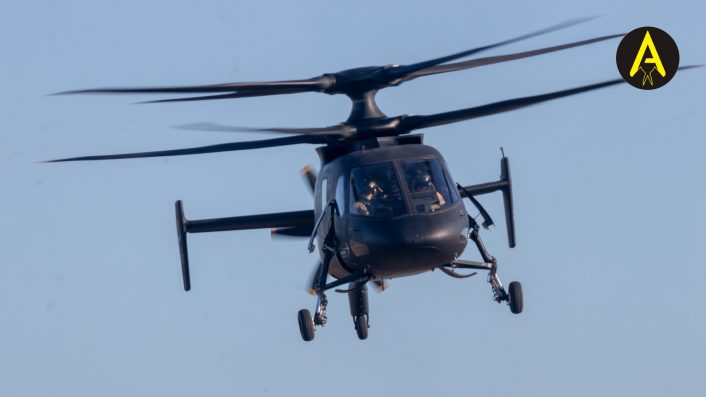
The images, reportedly captured in April, show a compound helicopter with coaxial main rotors and pusher propeller, which bears similarity to Sikorsky's X2 Technology.
Few days after photos emerged ofChina's first crewed tiltrotor aircraft, the first images of a Chinese compound helicopter were published online. Although these first emerged on X on August 21, 2025, it appears they were initially published on the Chinese social media Weibo on April 23.
Chinese compound helicopter
Compared to a standard helicopter, this compound helicopter features two coaxial counter-rotating main rotors and a prop rotor in the tail. The architecture of the aircraft and its overall shape immediately catch the eye for their resemblance to theSikorsky S-97 Raider demonstrator, based on the company's X2 technology.
Chinese military aviation researchers Andreas Rupprecht and Rick Joe both agree that this compound helicopter may be demonstrators. Specifically, Joe correlated this new aircraft to the previously unveiled tiltrotor, mentioning that they could be small-to-medium size technology demonstrators for next generation configurations, somewhat similar to theU.S. Future Vertical Lift (FVL) program.
Joe further mentions that the compound helicopter might be built by Chengdu Aircraft Industry Group (CAIG), a subsidiary of the Aviation Industry Corporation of China (AVIC). On the other hand, the tiltrotor is reported to be built by Hafei Aviation Industry, a subsidiary of Harbin Aircraft Industry Group (HAIG).
The helicopter has a slender shape optimized for higher speed, with two four-bladed counter-rotating coaxial main rotors and the proprotor at the rear. The proprotor is installed behind large tail planes and a lower tail fin which also serves as a mounting point for the tail wheel, while the main landing gear appears to retract with a swiveling mechanism behind the cockpit.
The helicopter appears to have a protrusion on the right side, starting in coincidence with the main rotors' mast and ending where the engine outlet is located. It is unclear if there is also a cabin in the area behind the main landing gear and below the main rotors, although the quality of the image does not allow to discern many details.
The S-97 Raider
Earlier this year,The Aviationistwas among the outlets who were invited to the Sikorsky Development Flight Center to attend a demonstration of theX2 technologyand get an up-close look at the S-97 Raider. Similarly to the Chinese helicopter, this compound helicopter has two coaxial counter-rotating main rotors and a prop rotor in the tail.
This aircraft is the result of 20 years of development, started in 2005 with the X2 demonstrator, and exploited the Advancing Blade Concept that Sikorsky developed in the 1970s. However, at the time there were still some technical challenges to solve, and that took decades.
Sikorsky created the Advancing Blade Concept with the goal of significantly increasing helicopter flight speed. The concept is based on the rotor's ability to develop lift on the blade that advances in the direction of flight, relieving of this duty the retreating blade that goes in the opposite direction.
Using counter-rotating, rigid rotors with limited bending in the vertical direction, this design delayed the drag increase caused by the blades' tip Mach number effects, thus enabling higher speeds. Technology evolved through the years and, decades later, advancements such as composites rotor blades and fly by wire control system, together with a pusher propeller added for efficiency, solved some of the technical challenges.
This paved the way for theX2 technologydemonstrator which proved the efficiency and viability of this technology. Sikorsky viewed this as the perfect choice for the U.S. Army's armed aerial scout which was supposed to replace the OH-58 Kiowa Warrior, theFuture Attack Reconnaissance Aircraft(FARA) program, which resulted in the S-97 Raider.
You can read our in-depth report about the S-97here.
Chinese FVL?
The U.S. Army's Future Vertical Lift (FVL) program saw a tiltrotor and a compound helicopter competing for theFuture Long-Range Strike Aircraft(FLRAA), which would replace some of theUH-60 Black Hawkhelicopters currently in service. The tiltrotor was the winning proposal with the Bell V-280 Valor, on which the future MV-75 will be based.
We don't know the current PLA plans about next generation helicopters, however the appearance of demonstrators for a tiltrotor and a compound helicopter, just few months away from each other, could hint to an evaluation of the state of helicopter technologies for a future application.
Looking at the main advantages, a tiltrotor and a compound helicopter would extend the range and speed of China's helicopter fleet. In a military application, it would mean being able to move troops or materials farther and faster, among other things.
Currently, China doesn't seem to find a pressing need for a fast-moving and far-reaching helicopter to move troops and material to its islands. However, the PLA Navy seems to be interested in expanding its blue water operations, the evaluation of these new technologies could be a sign that things might change in the near future.
If you enjoyed this article and would like to stay updated withThe Aviationist,please click theFollowbutton at the top of this page.
0 comments:
Ikutan Komentar