The Role of Towed Array Patrol Ships in UK Maritime Security
The Towed Array Patrol Ship (TAPS) plays a crucial role in the Royal Navy's (RN) anti-submarine warfare (ASW) operations, specifically tasked with detecting and neutralizing submarine threats around UK waters. This mission is carried out by one of the RN’s ASW frigates, typically for periods lasting up to two months. The primary goal is to identify adversary submarines and "sanitise" the waters surrounding the UK, ensuring the safe movement of deterrent-carrying ballistic missile submarines (SSBNs). Beyond this, it also helps counter Russian submarine activity in more distant waters.
Operating primarily from Devonport Naval Base, the six remaining Type 23 frigates—HMS Somerset, Richmond, Portland, St Albans, Sutherland, and Kent—are equipped with the Type 2087 Towed Array Sonar. These vessels rotate in and out of TAPS duty, maintaining a constant vigil against submarine threats. Until recently, the TAPS tasking was not publicly acknowledged, making it less visible than other missions such as the Fleet Ready Escort (FRE), which monitors Russian surface ships near the UK.
A Challenging but Critical Mission
ASW, often referred to as "Awfully Slow Warfare," requires persistent concentration and can be a mundane task, with occasional excitement. Crews spend long periods operating independently in the North Atlantic, GIUK Gap, North Sea, and Norwegian Sea, often in poor weather conditions. As a result, this duty is not particularly popular among sailors, and opportunities for shore leave are limited. However, TAPS offers professional rewards, being foundational to national security and providing a direct contribution to the defense of the UK.
TAPS is coordinated from Northwood and works closely with the US and other NATO partners who manage water space for allied submarines and surface units. The TAPS is positioned based on information from the Integrated Undersea Surveillance System (IUSS), which detects submarines using underwater arrays. This collaboration highlights the deep integration of US forces within sensitive aspects of UK defense.
An Ecosystem of Defense Assets
TAPS is part of a broader ecosystem that includes various platforms and personnel. NATO submarines, Merlin helicopters, maritime patrol aircraft, and other assets form a layered defense system. This collaborative approach enhances TAPS capabilities by integrating real-time intelligence and multi-domain awareness to counter increasingly quiet and sophisticated adversary submarines.
The Type 23 Frigate: A Cold War Legacy
Conceived in the late 1970s during the Cold War, the Type 23 frigate was designed to counter Soviet nuclear submarines in the North Atlantic. Despite their age, these vessels remain highly effective submarine hunters, having undergone significant upgrades over time.
The unique propulsion system of the Type 23, known as Combined Diesel-Electric and Gas (CODLAG), is optimized for stealth. It uses electric motors for low-speed, silent running, minimizing acoustic signatures during submarine hunting. Two diesel generators are located on the upper deck, further reducing noise radiated into the sea. For sprint speeds, two Rolls Royce Spey gas turbines can be used. This adaptability ensures the Type 23 can operate stealthily, a critical advantage when deploying its towed array sonar.
Advanced Sonar Capabilities
The Type 2087 Towed Array Sonar, developed by Thales, is the primary ASW sensor on the Type 23. Unlike traditional hull-mounted sonars, the towed array is streamed from a winch system, trailing up to one and a half kilometers behind the ship. This reduces interference from the vessel’s self-generated noise and allows variable depth deployment to exploit oceanographic conditions like thermoclines. The active component emits low-frequency pulses, capable of detecting submarines at significant distances, while the passive array listens for faint acoustic signatures.
The detection capabilities of the S2087 are highly classified but regarded as among the best sensors of its type globally. In the hands of experienced operators, it can detect submarines at great distances and has been proven on many occasions. The frigates also have a bow-mounted active/passive Type 2150 sonar, recently upgraded from the S2050, useful for closer range detection and warning of torpedoes and mines.
Supporting Assets and Future Developments
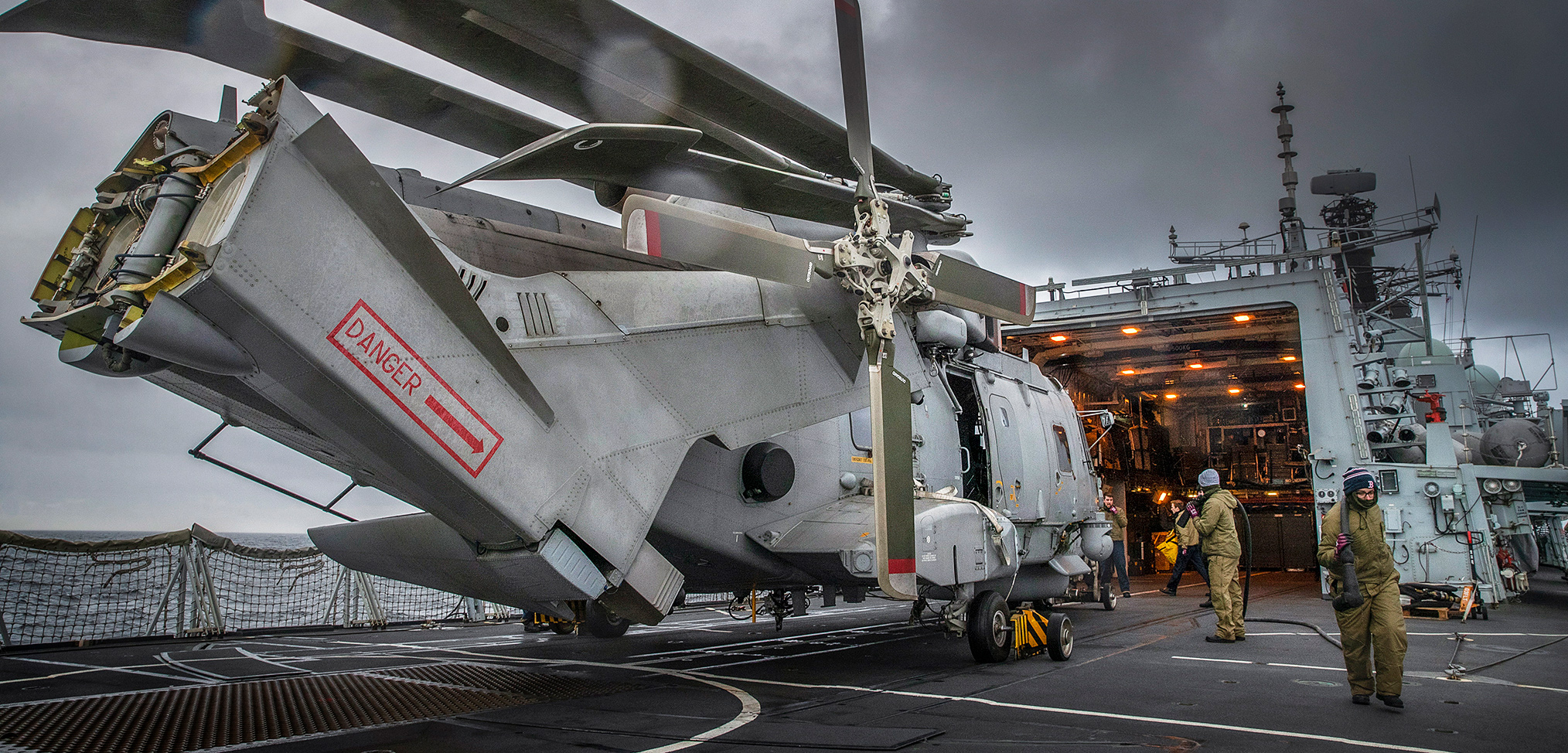
Complementing the Sonar 2087 is the Merlin HM2 helicopter, an integral part of the Type 23’s ASW arsenal. Equipped with Thales FLASH dipping sonar, sonobuoys, and Sting Ray torpedoes, the Merlin extends the frigate’s sensor and strike range. Its ability to hover and deploy dipping sonar into specific water layers enhances detection in complex underwater environments, while its onboard processing allows rapid target classification.
In the future, the Type 26 may complement the Merlin’s capabilities with uncrewed RWUAS (such as PROTEUS) that can add endurance and another means to prosecute the submarine threat. Detection ranges could potentially be extended by deploying UUVs or XLUAVs. The RN is also exploring the purchase of an ASROC-type weapon to provide a 24/7 capability to deliver torpedoes onto fleeting targets at medium-range.
Challenges and the Need for More Resources
The 2021 Defence White Paper expected the RN to maintain a force of at least 17 escorts, yet delays to the Type 26 programme have reduced this margin. Frigate numbers are bottoming out, with the premature retirements of two S2087-equipped frigates, HMS Westminster and Northumberland, compounding the pressure on ASW resources. Maintenance cycles, crew shortages, and concurrent commitments limit the availability of the aging Type 23s.
The surface fleet is tasked with multiple operational demands while the RN must also prepare for the transition to the Type 26 and Type 31s. The impending CSG25 deployment will further tax the fleet, requiring at least one, ideally two, Type 23s acting as the primary ASW pickets for the carrier strike group. This demand risks operational overstretch, potentially compromising the TAPS mission at a time when Russian submarine activity in the North Atlantic is resurgent.
Preserving ASW Expertise
The RN was primarily an ASW navy for much of the Cold War period, and this specialist skill set must be preserved. It encompasses not just technology but operational expertise in underwater acoustics, tactics, and inter-platform coordination. This institutional knowledge cannot be reconstituted quickly if lost, making the smooth introduction of the Type 26s a key priority.
Conclusion
Arguably, the Russian submarine threat and the vast geographical area suggest the RN needs significantly more than six towed array-equipped ships. This number should rise to eight when the final Type 26, HMS London, commissions around 2035. The frigates assigned to the unsung TAPS role quietly help ensure CASD’s viability and, by extension, the UK’s nuclear credibility. Any further weakening of the protective ring around the SSBNs would undermine deterrence, embolden adversaries, and weaken NATO’s collective defense.
Effective ASW is the first line of maritime defense for the UK, a lesson learned from the submarine threat twice in the 20th Century. There is no question that the RN needs more frigates, and the delivery of the Type 26 frigates cannot come fast enough. Even if there was more funding and construction could be accelerated slightly, other means must be found to add ASW mass as soon as possible.

0 comments:
Ikutan Komentar